EasyManua.ls Logo

Delfi P.T.S. - User Manual

Default Icon
26 pages
Print Icon
To Next Page IconTo Next Page
Loading...
OPERATOR and MAINTENANCE MANUAL
DELFI P.T.S. PORTABLE TOURNIQUET SYSTEM
PORTABLE TOURNIQUET
SYSTEM
PRESSURE
DEFLATE
INFLATE
TIME
P.T.S.
REF 9-2100-001
U.S. PATENTS 6,213,939; 5,931,853; 5,649,954; 4,469,099; PAT. PEND. and FOREIGN PATENTS
Delfi
medical
innovations inc.
Delfi Medical Innovations Inc.
Vancouver BC, Canada
800-933-3022 (US & Canada)
+ 604-742-0600 (Global)
Fax. + 604-742-3800
www.delfimedical.com
Question and Answer IconNeed help?

Do you have a question about the Delfi P.T.S. and is the answer not in the manual?

Summary

DELFI PORTABLE TOURNIQUET SYSTEM (P.T.S.) GENERAL INFORMATION

Intended Use

Describes the intended medical use for blood flow occlusion during surgery.

Contraindications

Lists medical conditions or situations where tourniquet use is not recommended.

Precautions in Use

Outlines essential safety measures and best practices for applying and using the system.

Adverse Effects

Details potential negative outcomes or side effects from using the tourniquet system.

P.T.S. INSTALLATION AND OPERATING INSTRUCTIONS

Specifications

Technical parameters including power, performance, size, and environmental operating conditions.

Initial Inspection

Procedures for inspecting the unit for damage upon receipt before initial use.

Controls, Indicators, Displays, and Connectors

Identifies and explains the function of all buttons, lights, displays, and connection ports.

Initial Setup

Steps for preparing the unit for its first use, including battery charging.

Functional and Calibration Checks

Guides on performing checks to ensure proper operation and accuracy before clinical use.

Pressure and Time Defaults

Instructions on how to change the default pressure and time settings for the system.

Operation

Step-by-step instructions for the normal use and procedures of the tourniquet system.

Alarm Conditions

Details various alarm states, their causes, and recommended corrective actions.

P.T.S. MAINTENANCE INSTRUCTIONS

General Maintenance Information

Provides an overview of recommended maintenance to ensure safe and effective operation.

Periodic Maintenance

Outlines routine tasks like cleaning and inspection to maintain the unit.

Calibration

Procedures for ensuring the accuracy of pressure readings through calibration.

Leak Testing

Steps to identify and correct leaks in the system to ensure proper function.

Battery Testing and Replacement

Guidance on checking battery health and replacing the battery pack.

Troubleshooting Guide

A guide to identify and resolve common malfunctions and issues with the unit.

Internal Hardware Servicing

Information regarding internal servicing and when to contact the manufacturer for repairs.

Warnings, Cautions, Labels, and Symbol Definitions

Explains all safety warnings, cautions, and symbols used in the manual and on the equipment.

Overview

The Delfi P.T.S. Portable Tourniquet System is a medical device designed for qualified medical professionals to temporarily occlude blood flow in a patient's extremity during surgical procedures. It is typically used for operations lasting less than 90 minutes and is useful in producing a bloodless operative field for various extremity procedures, including fracture reduction, tumor and cyst excisions, arthroscopy, bone grafts, Kirschner wire removal, knee joint replacements, finger joint replacements, amputations, nerve injuries, and total wrist joint replacements.

Important Warnings and Precautions:

  • Do not use tourniquet cuffs to control the distal flow of CO2 or other gases used as a distention media, as this has not been evaluated for safety and effectiveness and may lead to serious subcutaneous emphysema.
  • Refer to medical literature for contraindications; the final decision to use a tourniquet rests with the attending physician.
  • The system must be well calibrated and in operable condition, with accessories checked regularly for leaks and defects.
  • Never puncture the tourniquet cuff.
  • Cuffs with inner rubber bladders must be completely enclosed by the outer envelope to prevent ballooning and rupture. Follow manufacturer's cleaning and assembly instructions.
  • Avoid using elastic bandages for exsanguination if it could spread bacteria, exotoxins, malignant cells, or dislodge thromboemboli.
  • Apply the tourniquet cuff in the proper location on the limb, minimizing pressure and inflation time. Avoid applying over superficial nerves, major nerves compressed against bone (e.g., peroneal nerve near the fibula head), or over joints.
  • Do not readjust an already inflated cuff by rotating it, as this can cause shearing forces and tissue damage.
  • Prolonged ischemia can lead to temporary or permanent damage to tissues, blood vessels, and nerves.
  • Prolonged tourniquet time can affect blood coagulability; always minimize tourniquet time.
  • Excessive pressure can cause tourniquet paralysis, while insufficient pressure can lead to passive congestion and irreversible functional loss. Use the minimum effective pressure.
  • Inflation should be rapid to occlude arteries and veins simultaneously.
  • Complete exsanguination can prolong pain-free tourniquet time and improve IVRA quality. If infection, painful fractures, or malignant tumors are present, exsanguination without an elastic bandage can be done by elevating the limb for 3-5 minutes.
  • In case of failure, fully deflate the cuff and re-exsanguinate the limb before reinflation to prevent intravascular thrombosis.
  • Users must be familiar with inflation-deflation sequences, especially when using two cuffs and two P.T.S. units for IVRA, to avoid accidental release of the wrong tourniquet.
  • Test hemoglobin type and level before using on sickle-cell anemia patients; if used, carefully exsanguinate the limb and closely monitor PO2 and pH.
  • Select the proper cuff size to allow for manufacturer-recommended overlap, preventing cuff rolling, telescoping, unexpected release, inability to maintain a bloodless field, or undesired pressure distribution.
  • Protect skin under the cuff from mechanical injury with smooth, wrinkle-free application. Avoid applying over materials that shed fibers (e.g., Webril) as fibers can embed in contact closures. Use a limb protection sleeve.
  • If skin preparations are used preoperatively, prevent them from flowing or collecting under the cuff to avoid chemical burns.
  • Upon cuff pressure release, protect the wound from blood surging by applying pressure dressings and, if necessary, elevating the limb. Elevating the limb can lessen transient pain. If full color doesn't return within 3-4 minutes, place the limb slightly below body level.
  • Completely remove the deflated cuff and any underlying limb protection material immediately after pressure release.
  • For IVRA, it is recommended that the tourniquet remain inflated for at least 20 minutes from the time of injection.
  • Use only the Delfi REF 4-2100-013 AC power supply and cord assembly. Improper power supplies can cause irregular operation, patient/user hazard, and permanent damage to the unit.
  • Avoid exposing the AC power supply to liquids; do not immerse. Clean with a damp cloth (alcohol or mild detergent). It is resistant to occasional splashing but not fluid-tight. Immersion or excessive liquid exposure can cause failure and electrical shock.
  • Use only Delfi-supplied battery packs (REF 4-2100-017). Improper battery packs can cause irregular operation, patient/user hazard, and permanent damage to the unit.
  • If a connected cuff is pressurized to 50 mmHg or more during power-up, the P.T.S. will assume a surgical procedure is in progress, adopt the sensed pressure as the new set point, and regulate the cuff at this pressure. An alarm will sound, the red alarm indicator light will illuminate, the pressure display will flash, and "PRESSURE" will show. Immediately check and readjust the pressure set point.

Adverse Effects:

  • Dull aching pain (tourniquet pain) may develop.
  • Stiffness, weakness, reactive hyperemia, and skin discoloration may occur.
  • Pathophysiologic changes due to pressure, hypoxia, hypercarbia, and acidosis become significant after about 1.5 hours.
  • Symptoms of tourniquet paralysis include motor paralysis and loss of touch, pressure, and proprioceptive responses.
  • Intraoperative bleeding may be caused by:
    • Impeding effect of an unpressurized cuff (and limb protection material) preventing venous return.
    • Insufficient exsanguination.
    • Inadequate tourniquet pressure or slow inflation/deflation, allowing arterial blood entry while preventing venous return.
    • Blood entering through nutrient vessels of long bones (e.g., femur, humerus).

Technical Specifications:

  • Power Requirements (AC Powered Mode):
    • Mains Line Voltage: 90-264 VAC, 47/63 Hz.
    • Line current: < 0.5 A RMS at 90 VAC input.
    • Input Power: 20 watts maximum.
    • AC Power Adaptor: Supplied Delfi REF 4-2100-013.
    • AC Power plug: Hospital grade, 3 prong straight blade, 15 amp (North America).
  • Battery Type: Sealed 4.8V nickel-metal-hydride (NiMh) pack, 1800 milliamp hours. Use only Delfi REF 4-2100-017 battery pack.
  • Battery Recharge Time: 8.0 hours (typical).
  • Performance:
    • Cuff Pressure Range: 50-475 mmHg, 5 mmHg increments.
    • Pressure Accuracy: +/- 5 mmHg.
    • Pressure Regulation: +/- 10 mmHg of set point (10 second average under non-transient conditions).
    • Time Alarm Set Point Range: 0-240 minutes.
    • Timer Accuracy: 0.1% of elapsed time.
    • Inflation Rate: 34 inch cylindrical cuff on a 30 inch thigh inflates to 350 mmHg in < 20 seconds.
    • Deflation Rate: 34 inch cuff on a 30 inch thigh deflates to < 10 mmHg in < 25 seconds.
  • Size:
    • Height: 240 mm (9.45 inches)
    • Width: 116 mm (4.57 inches)
    • Depth: 50 mm (1.97 inches)
    • Weight: 500 g (17.5 oz)
  • Environmental:
    • Operating temperature: 10 to 40 °C (15 to 105 °F)
    • Storage temperature: -20 to 40 °C (-4 to 105 °F)
    • Humidity: Max 80% non-condensing

Usage Features:

  • Controls:
    • 'ON/STANDBY' Button: Turns the unit on or sets it to standby. Cannot set to standby if pressure is in the cuff.
    • 'PRESSURE + ' / 'PRESSURE - ' Buttons: Display and adjust the pressure set point in mmHg. Momentary press displays set point with an asterisk for 2 seconds. Holding increases/decreases in 5 mmHg then 10 mmHg increments.
    • 'TIME + ' / 'TIME - ' Buttons: Display and adjust the time limit set point in minutes. Momentary press displays set point with an asterisk for 2 seconds. Holding increases/decreases in 5 minute then 10 minute increments.
    • 'INFLATE' Button: Inflates the cuff to the pressure set point and starts the elapsed time monitor.
    • 'DEFLATE' Button: Deflates the cuff and stops the elapsed time monitor. Requires pressing and holding for approximately 2 seconds to prevent accidental deflation.
  • Displays:
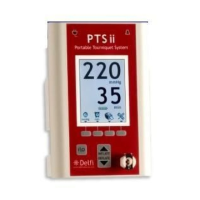
    • Pressure and Time Display: Top line shows current sensed cuff pressure (mmHg), lower line shows elapsed tourniquet time (minutes). A trailing asterisk indicates a set point. Can show error codes or alarm messages. Tourniquet time can be reset to zero by simultaneously pressing 'TIME+ ' and 'TIME- ' when the cuff is deflated.
    • Message Display: Shows corresponding words when alarm conditions are present. Also shows battery indicator symbol when operating on battery power.
  • Indicators:
    • AC Power Indicator Light (Green): Illuminated when AC power is plugged in.
    • Alarm Indicator Light (Red): Illuminated when any alarm condition exists.
    • Battery Indicator Symbol: Visible on message display when operating on battery power. Six darkened segments indicate full charge; decreasing segments indicate decreasing capacity.
  • Connectors:
    • Hose Connector: Positive locking type for connecting the hose assembly to the P.T.S. unit.
    • Hose Assembly: Supplied with the unit, connects to the P.T.S. unit and the tourniquet cuff. Designed for use with Delfi and other single-port cuffs with Positive Locking Connectors. An adapter is provided for calibration equipment.
    • AC Power Receptacle: Located beside the hose connector, for connecting the supplied AC power supply.
    • AC Power Supply: Adapter supplied with every unit. Plug the locking connector into the AC power receptacle and the AC power cord into an outlet.
    • AC Power Cord: Hospital grade plug, connects AC power supply to an AC power outlet.
  • Initial Setup:
    • Upon receipt, inspect for damage. Perform functional and calibration check after an 8-hour battery charge.
    • The unit must be plugged into AC power for 8 hours to fully charge the battery before initial use.
    • The P.T.S. performs a power-up sequence and self-tests, illuminating all display segments and symbols, red alarm light, and sounding an alarm tone for 2 seconds, then repeating. "CAL" is displayed for 2 seconds during pressure sensing calibration. "0" is displayed for pressure and time after startup.
    • Default pressure set point is 250 mmHg, and default time limit set point is 60 minutes. These can be adjusted and stored as new defaults.
  • Operation:
    • Power up the unit daily to ensure self-test routine is performed. Keep plugged into AC power when not in use.
    • Connect hose assembly and cuff.
    • Select appropriate tourniquet pressure and time limit.
    • Prepare patient according to established procedures and cuff manufacturer instructions.
    • Press 'INFLATE' to pressurize the cuff and start the tourniquet time clock. A leak alarm will sound if the cuff cannot pressurize to within 15 mmHg of the set point in less than 45 seconds.
    • Press and hold 'DEFLATE' to deflate the cuff and stop the time clock. Remove cuff and limb protection material immediately after deflation.
    • Disconnect cuff from P.T.S. after removal.
  • Alarm Conditions:
    • High Pressure above set point: Cuff pressure +15 mmHg above set point for >1 second. Message: "PRESSURE HIGH" (steady), Alarm tone: Constant, Pressure display: Flashing. Action: Adjust set pressure or deflate cuff.
    • Low Pressure below set point: Cuff pressure -15 mmHg below set point for >1 second. Message: "PRESSURE LOW" (steady), Alarm tone: Constant, Pressure display: Flashing. Action: Adjust set pressure or deflate cuff.
    • Tourniquet time exceeded: Elapsed time reaches time limit set point. Message: "TIME LIMIT" (steady), Alarm tone: Constant, Time display: Flashing. Action: Increase time limit or deflate cuff.
    • Battery Low (stage 1): Battery voltage drops, indicating need for AC power. Message: "BATT LOW" (2 segments darkened), Alarm tone: Cycle 1s on / 10s off. Action: Plug in AC power or shut unit down.
    • Battery Low (stage 2): Battery voltage drops further, nearing "BATT ERROR". Message: "BATT LOW" (1 segment darkened), Alarm tone: Constant. Action: Plug in AC power immediately or shut unit down.
    • Battery Failure: Battery voltage below safe operation threshold or battery removed/disconnected. Message: "BATT ERROR" (symbol empty), Alarm tone: Constant, Pressure/Time display: "Err"/Blank. Action: Shut unit down, disconnect hose, ensure battery connected, recharge, or replace battery pack.
    • Attempt to power off unit with cuff pressurized: Operator attempts standby with pressure in cuff. Message: "CUFF NOT DEFLATED" (steady), Alarm tone: Constant while button held, and for 2 seconds after release. Action: Deflate cuff, then shut unit down.
    • Cuff pressurized during power up: Cuff pressure >= 50 mmHg detected at power up. Message: "PRESSURE" (steady), Alarm tone: Constant, Pressure display: Flashing. Action: Display pressure set point or adjust pressure set point.
    • Cuff not fully deflated: Pressure >15 mmHg in cuff 60 seconds after deflation. Message: "CUFF NOT DEFLATED" (steady), Alarm tone: Constant, Pressure display: Flashing. Action: Disconnect hose to exhaust pressure.
    • Leak in cuff or hose: Large leak, cuff fails to reach set point in reasonable time, or pump runs excessively. Message: "CUFF LEAK" (may also display "PRESSURE LOW"), Alarm tone: Constant, Pressure display: Flashing. Action: Fix leak, reduce set point, or deflate cuff.
    • Calibration failure: Invalid calibration in pressure transducer. Unit shuts down in safe state. Message: "ERROR" (steady), Alarm tone: Constant, Pressure/Time display: "CAL"/"Err". Action: Disconnect hose, shut down and restart, or calibrate unit.
    • Internal electronic failure: Internal error, unit shuts down in safe state. Message: "ERROR" (steady), Alarm tone: Constant, Pressure/Time display: "Err"/Error code. Action: Shut down and restart, or disconnect hose if deflation required.
  • Alarm Silence Functions: Most audible alarms can be silenced for 30 seconds by momentarily pressing any 'PRESSURE' or 'TIME' button. The alarm will restart if the condition is not corrected.
  • Internal Hardware Failures: If "Err" and a numeric error code or "CAL" and "Err" appear, an internal hardware failure has likely occurred. The unit enters 'safe state' mode, disabling pneumatic valve and pump, holding current cuff pressure (if no leaks). A tone may sound. If erratic operation or unintelligible displays occur, set to standby, restart. If needed, clamp hose with hemostat, disconnect faulty unit, and connect replacement. If deflation is required, disconnect cuff from P.T.S. unit.

Maintenance Features:

  • General Maintenance: Periodic inspection, testing, and calibration are recommended. Do not attempt to disassemble or open the unit; servicing must be done by Delfi staff to avoid electric shock, damage, injury, and voiding warranties.
  • Cleaning:
    • Exterior of the unit: Clean with a damp cloth (not dripping) with mild detergent.
    • Cuff hose exterior: Clean with mild detergent solution or alcohol.
    • Tourniquet cuffs: Clean per manufacturer's instructions.
    • Do not clean or flush interior of hose assembly.
    • Do not allow fluids or debris into hose connectors.
    • AC power supply: Avoid exposing to liquids; do not immerse. Clean with damp cloth (alcohol or mild detergent).
  • Inspection: Externally inspect every three months for:
    • Obvious external damage.
    • Missing or illegible labels/warnings.
    • Kinks or damage in the power cord.
    • Secure connection and locking of power cord plug to receptacle.
    • Secure connection and locking of hose connectors.
    • Kinks or damage in the hose assembly.
  • Functional and Calibration Checks: Perform checks described in Section 2.5 at least once every three months.
  • Calibration: Perform every six months or after unscheduled maintenance.
    • Requires a calibrated 0-500 mmHg pressure gauge, adjustable 0-500 mmHg pressure source, and suitable pneumatic hoses/connectors.
    • Steps: Enter calibration mode by pressing 'INFLATE' and 'DEFLATE' simultaneously, then 'ON/STANDBY'. Unit displays "0" in pressure and "CAL" and "0" alternating in time.
    • Calibrate zero pressure: With hose connector open to atmosphere, press 'PRESSURE + '. Unit adjusts transducer output and sounds a tone.
    • Calibrate 50 mmHg point: Press 'TIME+ '. Time display alternates "CAL" and "50". Connect to reference pressure source and gauge. Apply 50 +/- 1 mmHg, press 'PRESSURE + '. Unit calibrates and sounds a tone. If pressure difference >15 mmHg, "CAL" and "Err" messages appear, and calibration halts.
    • Repeat for 250 +/- 1 mmHg and 475 +/- 1 mmHg.
    • Exit calibration: Remove reference pressure source, press 'TIME- ' three times to cycle to zero, then press 'INFLATE' and 'DEFLATE' simultaneously. Unit saves new calibration values and displays "CAL". Power off.
  • Leak Testing: Perform at least once every six months, or if leak alarms occur without obvious cuff/hose leak.
    • Connect a leak-free Delfi Contour Lower Leg cuff, Contour Arm cuff, or similar cuff.
    • Adjust pressure set point to 475 mmHg.
    • Inflate cuff and allow pressure to stabilize.
    • Set unit to standby: Press 'ON/STANDBY' until "CUFF NOT DEFLATED" appears. Release, then press and hold 'ON/STANDBY' for 10 seconds.
    • Wait 10 +/- 1 minutes, then turn unit back on. A "PRESSURE" alarm will occur. Momentarily press 'PRESSURE+ ' to cancel the alarm. The set point should be at least 400 mmHg.
    • If the new set point is <400 mmHg, there is a significant leak. Repeat with different cuffs/hose assemblies. If failure persists, the leak is internal, and the unit must be serviced by Delfi.
  • Battery Testing and Replacement:
    • Caution: Risk of electric shock. Set to standby and disconnect AC power before opening battery compartment.
    • Recommended to test every 3 months and replace annually.
    • A new battery pack provides ~10 hours of typical use. Life varies with use, storage, and discharge cycles.
    • To test: Charge for 8 hours. Remove AC power, power up. Battery indicator symbol should be visible with all 6 segments darkened. Connect to cuff, inflate to 350 mmHg. If <5 segments darkened after 1 hour, replace.
    • Replace if "BATT ERROR" alarm occurs and cannot be corrected by AC power or secure connection, or if "BATT LOW" alarms occur soon after full charge.
    • Replacement: Remove single battery cover screw and cover. Unplug old battery pack, dispose per local regulations. Install new Delfi REF 4-2100-017 NiMh battery pack, pushing connector until flush. New battery pack must be charged for 8 hours before use.
  • Troubleshooting Guide: Provides a table of malfunctions, possible causes, and corrective actions for common problems.
  • Internal Hardware Servicing: If maintenance, calibration, and troubleshooting do not restore normal operation, contact Delfi for service advice. Do not attempt to disassemble or open the unit.

Delfi P.T.S. Specifications

General IconGeneral
BrandDelfi
ModelP.T.S.
CategoryMedical Equipment
LanguageEnglish

Related product manuals