
 Need help?
Do you have a question about the Delta Elektronika ES300 Series and is the answer not in the manual?
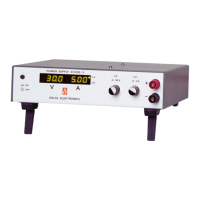
The Delta Elektronika ES300-series, specifically the ES 030-10 model, is a versatile DC power supply designed for various applications, offering both constant voltage and constant current operation. It is equipped with advanced features for precise control, monitoring, and protection, making it suitable for a wide range of industrial and laboratory environments.
The ES 030-10 can operate as either a constant voltage (CV) source with current limiting or a constant current (CC) source with voltage limiting. The transition between these modes occurs sharply at the intersection of the voltage and current settings, allowing for flexible output control. The unit incorporates active power factor correction (PFC), ensuring a near-sine wave input current with low RMS value and harmonic distortion, which contributes to high efficiency across a wide output current range. This high efficiency minimizes power loss and heat generation.
For precise control, the output voltage and current can be programmed using an external analog voltage, offering accuracy and linearity. The programming inputs are standardized at 5V and include protection circuits with a series resistor and parallel zener diode to limit speed to a safe value. The analog inputs and outputs are not floating; their common is connected to the negative output terminal. For isolated programming, the ISO AMP MODULE is recommended to prevent earth loops. The programming mode (program or manual) can be selected via a rear panel switch.
The unit also supports Ethernet, IEEE488, and RS232 programming through internal controllers (PSC-ETH, PSC-232) or an external PSC-488 module. These interfaces allow for easy programming and read-back of voltage, current, and status outputs via a computer.
Monitoring outputs provide a 0-5V voltage proportional to the output current or voltage, enabling external measurement without a shunt. These outputs are buffered by op-amps and protected by zeners, ensuring stability for capacitive loads. A CC status output, with an open output voltage of 5V and a short-circuit current of 10mA, allows direct driving of opto-couplers, TTL, or CMOS gates. A remote shutdown feature, activated by a +5V signal or a relay contact, switches off the power circuit, reducing power consumption to standby levels.
The ES300-series is designed for robust operation with comprehensive overload protection, including short-circuit protection. It features RFI filters on both input and output, resulting in very low conducted and radiated RFI, and a clean output voltage with minimal spikes. Thermal protection is integrated, shutting down the output in case of insufficient cooling, with automatic restart upon cooling.
The ES 030-10 is designed for ease of use and flexibility in various setups. For initial operation, users should ensure no condensation is present, set program switches to MANUAL (factory default), switch on the unit, and turn CV and CC potentiometers clockwise to establish an output voltage.
Analog programming is initiated by setting the appropriate switches to PROGRAM and connecting 0-5V programming voltage sources to the ANALOG PROG. CONNECTOR using shielded cables. If only voltage is programmed, maximum current can still be set with the CC potentiometer, and vice versa. For fixed settings, external potentiometers can be used. The analog inputs are internally connected to the negative output, and a 650mA self-resetting fuse protects the internal wiring.
For remote sensing, links on the rear panel terminal block must be removed, and sense leads connected to S+ and S-. This compensates for voltage drops across load leads, maintaining constant voltage at the load, especially useful when variations of a few millivolts are critical. However, it is not recommended for normal use due to potential issues. For pulsating loads with remote sensing, a capacitor between S+ and + and between S- and - with a series resistor in the sense leads can filter AC components caused by voltage drops.
The unit supports series and parallel operation. For series operation, up to 600V total voltage is allowed without special precautions. For parallel operation, units can be connected without limitations. Master/Slave (M/S) operation is recommended for easier control, where the master unit controls slaves. M/S series operation requires a MASTER/SLAVE SERIES ADAPTER and allows up to 600V total voltage, ensuring true voltage sharing. M/S parallel operation allows easy connections on the analog programming connector, with the master controlling all slaves for true current sharing. Mixed M/S parallel-series operation is also possible. For computer-controlled M/S parallel combinations, the interfaces PSC-ETH, PSC-488, or PSC-232 can be used.
Environmental conditions for safe operation include indoor use, ambient temperatures from -20 to 50°C (with derating above 50°C), maximum relative humidity of 95% (non-condensing up to 40°C) and 75% (non-condensing up to 50°C), and altitudes up to 2000m. The unit has a pollution degree of 2.
The ES300-series power supplies generally require minimal maintenance or calibration. Regular care primarily involves ensuring that the cooling of the unit is not obstructed. If calibration is needed, the V-meter can be adjusted with trimpotmeter R480, and the I-meter with R490.
Troubleshooting for "NO OUTPUT" in normal operation involves removing the load, checking program switch positions (should be MANUAL), switching on the unit, and turning CV and CC potentiometers clockwise to verify voltage presence.
If programming is not working correctly, users should check the program switch positions. If the unit works in manual control but shows a large error in programming mode, the 650mA self-resetting fuse in series with the programming connector's Ø (pin 1) may have tripped. This can be checked by measuring the voltage between Ø and the minus output during the fault condition; a high voltage indicates unwanted current flow. Earth loops can cause unwanted programming offsets, especially if the load and programming source are connected to earth. Using a floating programming source with an ISO AMP MODULE or a floating load is recommended to prevent these issues.
For "STATUS OUTPUT FAILS," the 650mA self-resetting fuse in series with Ø (pin 8) of the programming connector should be checked. A high voltage between Ø and the minus DC Power output indicates excessive current flow through the fuse.
In Master/Slave parallel operation, accidental interruption of a minus lead can cause the F400 fuse to blow. This fuse is also a 650mA self-resetting type. Checking the voltage between Ø (pin 1 of prog. conn.) and the minus DC power output can verify this. Additionally, the link between pin 9 and 11 on the programming connector of the slaves should be checked. If "NO LEDs on," overheating could be the cause, and cooling down will reset the thermal protection. Input power and internal fuses should also be checked.
Fuses must only be changed by authorized Delta Elektronika service personnel to maintain fire protection. Operating personnel should not remove unit covers or perform internal adjustments or component replacements. Power must always be disconnected, external voltage sources removed, and circuits discharged before touching components. Parts substitutions and modifications are restricted to authorized service personnel, and units requiring such work should be returned to a Delta Elektronika service facility. Safety covers should always be replaced before reconnecting to mains supply.
 General
| Brand | Delta Elektronika |
|---|---|
| Model | ES300 Series |
| Category | Power Supply |
| Language | English |






 To Next Page