Need help?
Do you have a question about the Delta 50-820 and is the answer not in the manual?
Attaching the intake flange to the dust collector body using screws and the flange adapter.
Connecting the angled and upper support tubes to the dust collector body via clamps.
Details on using appropriate electrical circuits, fuses, and checking motor specifications.
Essential steps for grounding the tool to protect against electric shock, including adapter use.
Guidelines for using safety gates in open (use) and closed (storage) positions for protection.
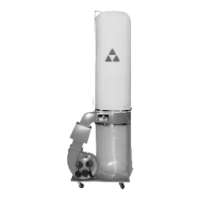
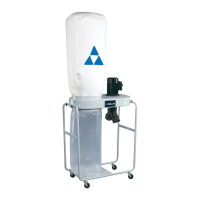
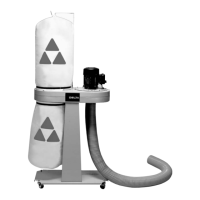
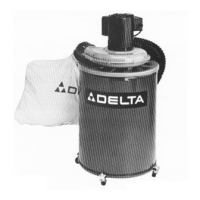
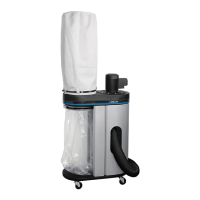
The Delta Portable Single-Stage Dust Collector (Model 50-820) is a versatile and compact machine designed for effective dust and wood chip collection in both home workshops and light commercial settings. Its primary function is to maintain a clean and safe work environment by efficiently removing airborne particulate matter generated during woodworking operations.
The dust collector operates by drawing in dust and wood chips through a vacuum hose and collecting them in a dust bag. The core of its operation involves a powerful motor and an impeller that create a strong vacuum, pulling debris from the work area. The single-stage design means that the air and debris are drawn directly into the impeller, which then forces the heavier particles into the collection bag while filtering the air before it is exhausted. This process helps to reduce the amount of airborne dust, which can be injurious to health and can also interfere with the quality of woodworking finishes. The device is specifically engineered to handle wood materials, making it ideal for use with various woodworking machines such as routers, planers, and table saws. It is crucial to note that the dust collector should only be used for wood materials and not for flammable or combustible liquids, metal shavings, metal dust, or hot ashes, as this could pose significant safety risks, including fire or explosion.
The Delta 50-820 is designed with user convenience and safety in mind. Its portability is a key feature, allowing it to be easily transported to different locations within or outside the workshop. The sturdy tubular frame, equipped with four rubber feet, ensures stability during operation, preventing the unit from "creeping" or "walking" across the supporting surface.
Connecting the device to a power source requires attention to specific electrical guidelines. It is wired for 120 volts and should be connected to a properly grounded outlet. A dedicated electrical circuit, not less than #12 AWG and protected with a 20 amp, time-lag fuse, is recommended to ensure optimal performance and prevent damage to the motor. The instruction manual provides clear grounding instructions, including the use of a 3-prong grounding type plug and, if necessary, a temporary adapter for 2-prong receptacles, emphasizing the importance of proper grounding to prevent electric shock.
The assembly process is straightforward, beginning with attaching the intake flange to the dust collector body, ensuring the warning label on the flange adapter faces upward. Next, the support tube and connector are assembled, followed by the vacuum hose. The vacuum hose, typically 10 feet long and 4 inches in diameter, can be attached to various woodworking machines using appropriate connectors and hose clamps. The dust collector hood can be positioned and clamped to a workbench or directly attached to the dust chute of a machine, depending on the application. Finally, the dust collection bag is securely fastened to the outlet flange using a strap and clamp.
Operating the dust collector is simple. The ON/OFF power switch is located on the side of the motor. Moving the switch toggle upward turns the machine ON, and downward turns it OFF. For enhanced safety, the switch can be locked in the OFF position by pulling out the switch toggle, preventing unintentional starts.
Safety gates are an important feature of the dust collector. When the machine is in use, these gates must be in the open position to allow for the free flow of dust and wood chips through the vacuum hose and into the collection bag. Conversely, when the dust collector is not in use, the safety gates should be pushed inward into the closed position over the inlet and outlet housings. This prevents accidental contact with the fan blade or sharp edges and promotes overall operator safety.
The versatility of the Delta 50-820 is demonstrated through various application examples. It can be positioned on the floor behind a wood lathe to clear chips, placed on a lower shelf for router applications, or connected to a table saw's dust chute via a specially designed connector hood. Its ability to be fitted with different connectors allows it to accommodate a wide range of woodworking machinery. The manual also illustrates its use for cleaning out truck beds, though it explicitly warns against picking up metallic objects.
Regular maintenance is crucial for ensuring the longevity and safe operation of the Delta Portable Single-Stage Dust Collector. Before performing any maintenance or service, it is paramount to disconnect the dust collector from the power source to prevent accidental starting and to ensure the safety gates are closed. All maintenance procedures, other than those explicitly recommended in the manual, should be performed by an authorized Delta Service Center.
One of the primary maintenance tasks involves the dust collection bag. The condition of the dust bag should be checked periodically for any cuts, rips, or tears. Operating the dust collector with a damaged bag or vacuum hose is strictly prohibited and can compromise its efficiency and safety. The dust bag should also be emptied on a regular basis to prevent overfilling, which can reduce suction power and potentially strain the motor. It is also advised not to transport the machine with a full dust bag.
Another important maintenance step is the cleaning of the impeller. Monthly, the impeller should be cleaned, and a dry silicone lubricant applied to remove any dirt, pitch, gum, or wood shavings that may have accumulated. This helps to maintain the impeller's balance and efficiency, ensuring consistent performance.
The vacuum hose should also be inspected periodically for any damage or blockages. A clear hose ensures optimal airflow and prevents the motor from overheating due to restricted suction.
By adhering to these usage and maintenance guidelines, users can ensure the safe, efficient, and long-lasting performance of their Delta Portable Single-Stage Dust Collector.
 General
| Category | Dust Collector |
|---|---|
| Motor Power | 1.5 HP |
| Airflow | 1, 200 CFM |
| Collection Bag Capacity | 5.6 Cubic Feet |
| Weight | 150 lbs |
| Impeller Diameter | 12 Inches |
| Model | 50-820 |
| Motor | 1.5 HP induction motor |


 To Next Page