The Dennerle CarboPOWER E400 + Special Edition / CarboPOWER M400 + Special Edition / CarboPOWER Flex400 + Special Edition / Pressure reducer CarboPOWER is a CO2 plant fertilization system designed for aquariums. This system provides a convenient, reliable, and precise way to supply CO2 to aquarium plants, promoting lush growth.
Function Description:
The CO2 plant fertilization system is used to supply aquariums with CO2 to enhance plant growth. The system includes a CO2 bottle (either disposable or reusable), a pressure reducer, a CO2 magnet valve (for Special Edition models), a check valve, and a CO2 diffuser (Flipper). The CO2 is released from the bottle, regulated by the pressure reducer, and then diffused into the aquarium water through the Flipper. For Special Edition models, a magnet valve allows for automatic night cut-off, saving CO2 as plants do not consume it during darkness. A pH controller (Evolution DeLuxe, available separately) can further automate and precisely regulate CO2 addition based on the aquarium's pH value.
Important Technical Specifications:
Pressure Reducer CarboPOWER:
- Manometers: Includes operating pressure and bottle pressure manometers for precise monitoring.
- Needle Valve: Precision needle valve with a stainless steel needle and fine thread for accurate CO2 flow adjustment.
- Maximum Permissible Bottle Pressure (Operating Pressure): 160 bar.
- Hose Connection: Designed for 4/6 mm hose.
- Regulation System: Precise regulation through Dynamic Valve Control (DVC).
- Safety Feature: Self-closing pressure relief valve.
Magnet Valve (Special Edition):
- Voltage: 230 V~, 50/60 Hz.
- Power Consumption: 1.6 W.
- Maximum Allowable Pressure: 5 bar.
- Mains Cable Length: 1.80 m.
- Protection Class: IPX 4 (splash-proof).
CO2 Flipper:
The Flipper is a modern, highly effective CO2 diffuser. It ensures optimal utilization of CO2 fertilizer. As CO2 bubbles slowly rise within the Flipper, CO2 dissolves into the aquarium water. Simultaneously, other gases naturally dissolved in the aquarium water penetrate the CO2 bubbles. These "waste gases" are lighter than CO2 and collect in the CO2 collection tank at the top, from where they are regularly removed by a special waste gas vent. The running-in period for the Flipper is approximately 2 days, during which individual CO2 bubbles combine to form larger bubbles until a biological surface of microorganisms forms, allowing bubbles to flow through to the collection tank.
CO2 Long-Term Test Maxi Crystal:
- Components: Test container with suction holder, 2 ampoules of CO2 special indicator, pipette, and colour comparison scale.
- Indicator Reaction: The CO2 special indicator changes colour based on CO2 content: Blue for too little CO2, Green for optimal CO2 (approx. 20 mg/l), and Yellow for too much CO2. The CO2 content in mg/l can be read directly from the colour comparison scale.
- pH Monitoring: Can also be used as a pH long-term test if no other pH-influencing substances are present in the water, by measuring carbonate hardness (KH) and comparing with a pH colour comparison scale.
Usage Features:
Assembly and Connection:
- Pressure Reducer to CO2 Bottle: Ensure the pressure reducer's control knob is turned to "–" (CO2 supply closed). Check for clean seals. Screw the pressure reducer onto the CO2 bottle (disposable or reusable) firmly by hand or with a spanner (27 mm for reusable bottles). A slight hiss may occur during connection.
- Magnet Valve (Special Edition): Cut a 50 cm piece of CO2 hose. Connect the pressure reducer and magnet valve, ensuring the arrow on the magnet valve points in the direction of CO2 flow. Secure hose ends with union nuts. The magnet valve can be fixed in the stand cabinet and connected to a time switch to stop CO2 supply at night.
- Check Valve: Install the check valve as close to the aquarium as possible, cutting the hose straight and ensuring the arrow points from the CO2 source to the diffuser. Secure hose ends with union nuts.
- CO2 Flipper: Rinse the Flipper with warm tap water. Moisten the hose connection and attach the CO2 supply hose. Fix the Flipper vertically in a dark area of the aquarium with good water flow, at least 5 cm below the water level.
Setting CO2 Quantity (Bubble Count):
- Recommended CO2 Content: 20 to 25 mg/l for lush plant growth. Avoid levels above 30 mg/l.
- Basic Setup Rule: Start with approximately 10 bubbles per minute per 100 L of aquarium water.
- Adjustment: Close the needle valve, then slowly open the bottle valve (for reusable bottles). Turn the pressure reducer's control knob to "+" until the operating pressure gauge shows approx. 1.5 bar. Open the needle valve until bubbles appear in the Flipper. Adjust the desired bubble count by turning the needle valve. Fine adjustments can be made by slightly increasing or reducing the operating pressure (1-2 bar).
- Time Delay: Bubble count reacts with a time delay; adjust in small steps and wait a few minutes for stabilization.
CO2 Long-Term Test Usage:
- Preparation: Shake the indicator ampoule, twist off the seal, and pour the contents into the test container.
- Placement: Carefully turn the test container over and fix it vertically in a visible spot in the aquarium with slight water flow.
- Monitoring: Stick the "CO2" colour comparison scale on the outside of the aquarium window. The colour display reacts with a 1-2 hour delay.
- pH Monitoring: Measure carbonate hardness (KH) and stick the "pH" colour comparison scale on the aquarium window.
Maintenance Features:
Replacing CO2 Bottles:
- Disposable Bottles: The pressure reducer can be unscrewed at any time (bottle valve closes automatically). Screw onto a new bottle. The bubble count setting is retained.
- Reusable Bottles (Empty): Close bottle valve, unscrew union nut with 27 mm spanner, and screw pressure reducer onto a newly filled bottle. Open bottle valve. The bubble count setting is retained.
- Reusable Bottles (Not Empty): Close bottle valve. Open the needle valve on the pressure reducer to release residual pressure. Unscrew union nut, screw pressure reducer onto a newly filled bottle, and open bottle valve. Re-adjust the bubble count.
- Long-Term Storage: Close the bottle valve and unscrew the pressure reducer.
Checking the CO2 Check Valve:
- Frequency: Check at least once a year, replace every 2-3 years.
- Test: Temporarily install a transparent test hose between the check valve and pressure reducer/magnet valve. Turn off CO2 supply for 24 hours. If water is in the test hose after this time, the check valve is leaking.
- Important: Use only Dennerle CO2 special check valves, as normal air check valves can become brittle and leak with CO2.
Replacing Seals:
- Pressure Reducer Seal: A long-life seal is in the connection piece. Replacement is generally not required during the pressure reducer's lifespan. Can only be replaced with special tools (send to Dennerle After-Sales Service).
- Adapter Seal: Replace the seal (Art.-Nr. 3056) in the adapter for reusable bottles regularly to ensure a tight bottle connection.
Removing CO2 Hose:
- After long use, the CO2 hose can be very tight. Use a small screwdriver to pry it off. Do not pull with force or cut with a knife to avoid damaging connections.
Cleaning the CO2 Flipper:
- Disassembly: Pull the CO2 collection tank straight up. Lay the Flipper in hand with suction cups to the right. Slide the front side wall up approx. 2 cm, fold out the side wall, and remove the CO2 tube (do not pull).
- Cleaning: Clean all parts with warm water and a soft sponge. Do not use cleaning agents.
- Reassembly: Reassemble the Flipper in reverse order. Ensure the CO2 tube is placed in the side wall so that its end is at the bottom stop.
Replacing CO2 Special Indicator:
- Frequency: Replace every 4-6 weeks with fresh indicator fluid for fastest and most accurate colour reaction. Used fluid can be poured down the drain.
Cleaning the CO2 Long-Term Test:
- Use warm water and a soft sponge. Do not use cleaning agents.

 Need help?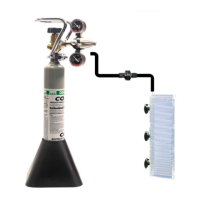

 To Next Page
 General