Need help?
Do you have a question about the Denver SEL-80125F and is the answer not in the manual?
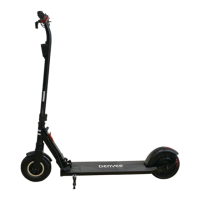
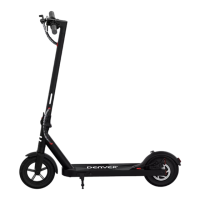
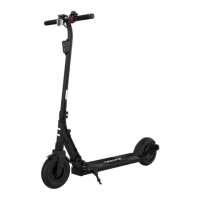
The Denver SEL-80125F is an electric scooter designed for personal entertainment and domestic use, suitable for individuals aged 14 and above with a maximum weight of 100 kg. It is not intended as a means of transport or sports equipment. The scooter features a robust design with an 8.0" wheel, front shock absorption, and both electric and mechanical brakes for reliable stopping power. For visibility and safety, it is equipped with a front LED light and a rear LED lamp, along with white reflector stickers.
The electric scooter is powered by a Li-ion battery and controlled via a handlebar-mounted display screen. The display provides essential information such as battery level, current gear, speed, single mileage, and total mileage. The scooter offers three speed gears, allowing the user to select between slow, medium, and fast speeds. Acceleration is controlled by gently pressing the accelerator button, with the depth of the press influencing the acceleration relative to the selected gear. Deceleration is achieved by gently pressing the deceleration dial, which also provides greater deceleration with a deeper press. For braking, the scooter utilizes both an electric brake and a mechanical rear brake. The rear wheel brake system is particularly recommended for use at high speeds to ensure safety.
The scooter features an intuitive power management system. To turn it on, simply long-press the power button until the display illuminates. A long-press again will turn it off. The scooter also has an automatic power-off function, activating after 5 minutes of inactivity to conserve battery. The display allows users to cycle through different data views (TIME, ODO, DIS) by short-pressing the power button. The "TIME" display shows the running time since power-on, which resets upon power-off. "DIS" shows the driving distance since power-on, also resetting after power-off. "ODO" displays the total mileage, which is retained unless manually cleared.
The scooter supports two start modes: "Zero start" and "Non-zero start." In "Zero start" mode, the scooter can be driven from a stationary position by pressing the accelerator. In "Non-zero start" mode (factory default), the user must manually push the scooter with their foot to gain some initial speed before the accelerator button becomes active.
For nighttime riding, the scooter includes a front LED light that can be turned on or off by pressing and holding the speed-up button for 3 seconds. The rear LED lamp, powered by two AA batteries, provides additional visibility. It can be turned on/off or set to flash by pressing its "PUSH" button multiple times.
Before riding, it is crucial to ensure the steering system is correctly adjusted, and all connection components are firmly secured. The handlebar assembly involves attaching the two handlebars and adjusting the display angle by loosening a screw, rotating the axle and display screen inwards to a horizontal level, and then re-tightening the screws.
The scooter is designed for single-person use, and the operator must wear personal protective equipment, including a helmet and protective gear for elbows, knees, and wrists. Loose clothing or open laces should be avoided to prevent entanglement with the wheels.
The scooter should only be operated in good visibility conditions and on dry, level surfaces. Riding on public roads, in traffic, or in wet conditions (rain, snow, ice) is not recommended. Users should avoid riding over obstacles, steep slopes, textiles, small branches, and stones. Abrupt starts or stops should also be avoided.
When riding, feet must always remain on the footboard. Users should maintain a safe speed that allows for braking at any time and keep a sufficient distance from other people to prevent collisions. Steering is primarily achieved through balance shifting. Fast movements or "trick riding" can lead to falls and injuries, which are not covered by the warranty.
Charging the scooter requires using the supplied XHK-800B-4220 power adapter. The charging port is located on the scooter. The adapter's indicator light will turn red during charging and green when fully charged. It is important to charge the scooter in an open, dry area, away from combustible materials, and not in direct sunlight or near open flames. The charging process typically takes up to 3 hours, and overcharging should be avoided to prolong battery life. The scooter should not be used during the charging cycle.
Regular maintenance is essential to ensure optimal performance and longevity of the electric scooter. This includes battery maintenance, checking bearings, screws, brakes, and wheels, as well as proper storage and cleaning.
The battery has a finite life cycle, and its performance will degrade over time. To maximize battery life, it should be charged at regular intervals, even during periods of non-use, to prevent damage from low voltage. It is best to charge the battery before it is completely drained. Charging should occur within a temperature range of 5°C to 45°C. Extreme temperatures (below -10°C or above 50°C) can damage battery cells and reduce performance. The battery package should not be disassembled; this task must be handled by official service repair centers.
The scooter's sealed and dustproof bearings do not require lubrication but should be checked regularly for wear to ensure safe riding. All screws must be properly tightened, and loose screws should be re-tightened promptly. The brake system, including the rear tire, rear brake, and brake pad, should be inspected regularly for wear. Excessive force on the brake should be avoided. Constant braking can lead to tire wear, overheating, and reduced grip. If unusual noises or vibrations are detected, especially from the handlebar, it may indicate damaged bearings, requiring professional inspection and replacement. Wheels should also be checked for wear. For inflatable tires, maintaining the correct pressure is important for durability.
When the scooter gets dirty, it should be cleaned with a damp cloth. Pressurized water or running water should not be used, as this can damage vital parts. A small amount of toothpaste can be used for stubborn dirt, followed by cleaning with a damp cloth. The scooter must be turned off during cleaning, and the charging input should be covered to protect the electronics. After cleaning, the scooter should be dried with a towel if it becomes wet. Harsh chemicals like alcohol, gas, kerosene, or other corrosive solvents should not be used, as they can damage the scooter's appearance and internal structure. The scooter should be stored in a dry and cool environment, away from direct sunlight and high temperatures, as it is not designed for outdoor storage in wet areas.
 General
| Type | Electric Scooter |
|---|---|
| Maximum speed | 20 km/h |
| Maximum load weight | 120 kg |
| Motor power | 350 W |
| Maximum range per charge | 25 km |
| Charging time | 4-5 hours |
| Battery voltage | 36 V |
| Battery capacity | 7.5 Ah |
| Foldable | Yes |

 To Next Page