
 Need help?
Do you have a question about the Denver SEL-90100F and is the answer not in the manual?
Step-by-step guide to unfold the electric scooter for use.
Step-by-step guide to fold the electric scooter for storage or transport.
Advice to maximize the life span of the battery and proper charging practices.
Inspection and maintenance of key mechanical components for safe operation.
Guidelines for cleaning, drying, and storing the electric scooter.
Explanation of the scooter's display symbols and gear modes (ECO, D, S).
Instructions for powering the scooter on/off and changing speed gears.
Details on the two types of brakes and recommended braking techniques.
Pre-transport checks including battery charging and wearing protective gear.
Information on the maximum vehicle payload and reasons for the restriction.
Factors affecting the scooter's range and how to maintain it.
Essential safety guidelines, rider restrictions, and riding practices.
Detailed instructions and cautions for charging the electric scooter.
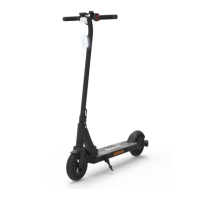
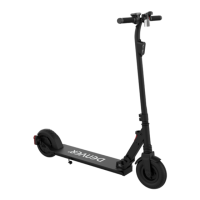
This document describes the Denver SEL-90100F Electric Scooter, providing essential information for its safe assembly, operation, and maintenance.
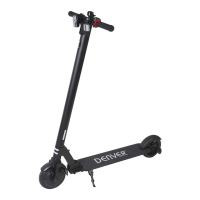
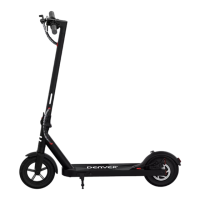
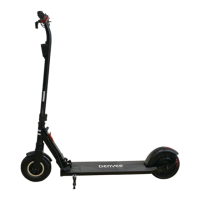
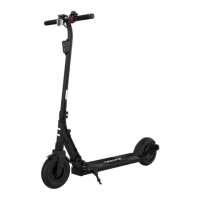
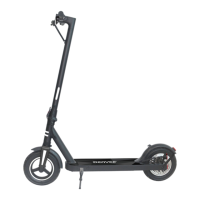
The Denver SEL-90100F is an electric scooter designed for personal transportation. It features a foldable design for portability and storage, a front light, rear light, and a display that shows battery level, speed, and gear modes. The scooter is equipped with two separate braking systems: an electronic brake and a disc brake, ensuring reliable stopping power. It offers three distinct gear modes: ECO (pedestrian mode at 6 km/h with flashing lights as per EU regulation), D (15 km/h), and S (25 km/h), allowing users to adjust speed according to their needs and local regulations. The motor provides propulsion, and the scooter requires a manual push-off with a foot to activate the accelerator.
Before use, the handlebar must be assembled by inserting it into the vehicle frame and securing it with four screws. To unfold the scooter, it is placed on its wheels, the hook on the handlebar is unlocked, and the handle is pulled up until the rod clicks into place. Folding involves releasing the lever on the handlebar support tube, fully opening it, accompanying the handlebar tube downwards, and hooking the folded tube onto its support.
The scooter is intended for individuals aged 14 and above, with a maximum weight of 120 kg. It should only be operated in good visibility conditions and when the rider's physical conditions for stability are met. Riders are strongly advised to wear personal protective equipment, including a helmet, elbow pads, knee pads, and wrist protectors. Loose clothing or open laces that could get caught in the wheels should be avoided.
The operational control is managed via a power button. Pressing and holding the power button for a few seconds turns the scooter on or off. A single press of the power button when the display is on toggles the lights. Quick-pressing the power button twice changes the scooter's gear mode, which is indicated on the display.
For braking, it is recommended to first release the throttle and then press the electronic brake. If harder braking is required, the disc brake should be used. Users should be aware that braking distances will be extended in wet weather. The scooter is splash-proof but not waterproof, and should only be ridden on dry surfaces. Riding up or down long and steep slopes should be avoided. When the "Low Battery Warning" is received, the scooter will move slowly, and the electric brake will not work, requiring the use of the disc brake to stop. The electric brake and throttle should not be used simultaneously.
Riders should always be aware of their surroundings, ride at a safe speed, and maintain a sufficient distance from other people to avoid collisions. Steering is achieved through balance shifting. Obstacles like curbs or steps should be avoided, and it is recommended to dismount the vehicle if these obstacles become dangerous. The scooter is not intended for acrobatic use.
Regular maintenance is crucial for optimal performance and longevity of the electric scooter. This includes battery maintenance, checking bearings, screws, brakes, and wheels, as well as proper storage and cleaning.
Battery Maintenance: The battery should be charged at regular intervals, even during periods of non-use, to prevent damage from low voltage. It is best to charge the battery before it is completely drained to extend its life. Constantly depleting the battery can damage it and is not covered under warranty. Charging should occur within temperatures of 5°C to 45°C. Charging at lower or higher temperatures can reduce battery performance and potentially damage the product. The battery should not be charged for more than 7 hours, as overcharging shortens its life. The product should not be charged over extended periods and should always be supervised during charging. The scooter should be allowed to cool down for an hour after use before charging. Only the original supplied power adapter should be used for charging. The battery package should not be disassembled; this should only be handled by official service repair centers.
If the scooter does not turn on or charge (charger lights up green instantly), it is recommended to leave the charger connected for 7-8 hours. If this does not resolve the issue, manually move the scooter with your foot for about 100 meters without turning it on, then connect the charger. This can help activate the charging function.
Bearings, Screws, Brakes, and Wheels: The electric scooter has sealed and dustproof bearings that do not require lubrication. Bearings should be checked for wear at regular intervals to ensure safe riding. Excessive force or jumping on and off the scooter should be avoided to prevent damage to the bearings. All screws should be properly tightened, with a recommended average value of 20 N/m, and checked regularly for looseness.
The brakes should be checked for wear at regular intervals. The disc brake will require adjustment and eventual replacement as it wears down. The scooter should not be used if the brakes are worn, as this is unsafe and can damage the braking system. Wheels should also be checked for wear regularly. If a wheel appears wobbly even after tightening screws, the bearings may need replacement.
Storage and Cleaning: For cleaning, use only a damp cloth. Pressurized water guns or running water should not be used, as this can damage vital parts. Stubborn dirt can be removed with a little toothpaste, followed by cleaning with a damp cloth. The electric scooter must be turned off during cleaning, and the charging input should be covered to protect electronics. After cleaning, the scooter should be dried with a towel. Alcohol, gas, kerosene, or other corrosive and volatile chemical solvents should not be used, as they can damage the scooter's appearance and internal structure.
When not in use, the electric scooter should be stored in a dry and cool environment. It should not be left outdoors or exposed to high temperatures from direct sunlight for extended periods. If the product is left with other persons, it should be partially charged (20-50%), not fully charged.
General Safety and Warnings: Users must ensure the steering system is correctly adjusted and all connection components are firmly secured before riding. Any loose parts, abnormal noise, or reduced battery life should prompt contact with the retailer for service. Self-locking nuts and other fixings may lose effectiveness over time and should be checked regularly. All parts and materials of the electric scooter are not to be changed; modifications are not allowed and will void the warranty. Neither water nor other liquids should penetrate the inner components, as this can permanently damage electronics/batteries and pose a risk of injury. The electric scooter casing should not be opened, as this voids the warranty. Plastic covering should be kept away from children to avoid suffocation. The vehicle should not be used if it switches off automatically; it can be restarted by pressing On/Off.
 General
| Type | Electric Scooter |
|---|---|
| Maximum speed | 20 km/h |
| Maximum load weight | 120 kg |
| Motor power | 250 W |
| Wheel size | 8.5 inches |
| Battery voltage | 36 V |
| Charging time | 4-5 hours |
| Maximum range | 25 km |
| Weight | 12 kg |
| Foldable | Yes |


 To Next Page