6
08090418 - 01 VIFSU154 09/2010
General installation instructions
1. Devi self-limiting heating cables are only
for safe (non hazardous) areas.
2. Measure the insulating resistance of the
heating cable immediately before the
installation is begun.
3. Make sure that the necessary materials
are present at the building site.
4. Remove any sharp objects and irregulari-
ties on the pipe system, so the heating
cable are not damaged.
5. Finished or painted pipes or containers
must be completely dry when installing.
The heating cable must only be used in
the manners recommended by DEVI and
should be properly connected to the
main electrical source.
6. Connection of the heating cable must be
done by an authorised electrician accord-
ing to local legislation.
7. The maximum effect for the different
installations and operating effects must
be observed.
8. The heating cable must be protected
against excess strain and tension.
9. The surface onto which the heating cable is
to be installed must be non-combustable,
clean and free from sharp objects.
10. The heating cables bending diameter
must not be less than 50 mm. The cable
must only be bend on the flat side.
11. The heating cables screen must be
earthed in accordance with local electric-
ity legislation.
12. The power circuit must be equipped with
an isolation switch or a similar overload
protection device.
13. Residual current device (RCD) protection
is required.
14. To reduce energy consumption we
strongly recommend to switch off the
heating cable, if this is longer than 3 m,
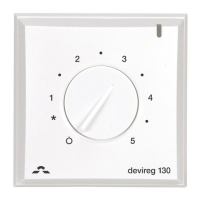
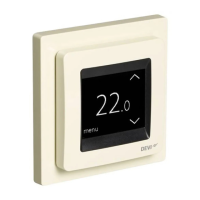
i.e. by using a Devireg™ thermostat (see
„Regulation“).
15. At low temperatures the heating cable
can become stiff and difficult to work
with. This problem can be solved by con-
necting the cable shortly to the mains
16. The cable insulation resistance must be
measured before and after installation.
17. The presence of a heating cable must be
made evident by caution signs or mark-
ings at the power connection fittings
and/or frequently along the circuit line,
as well as being stated in any electrical
documentation following the installation.
• Heating cables and connecting leads must
be kept in a clean and dry place.
• Avoid contact with chemicals and petro-
chemical products during storage of the
cables.
• Do not expose the heating cables to me-
chanical strain.
• The storage temperature may not drop
below -40°C and may not exceed +60°C.
• Are the heating cables and connecting
leads kept in moist rooms or at building
sites, they must be protected against
moisture - also during storage for a short
period (e.g. when installing the cable
terminal).
Storage of self-limiting cables


 To Next Page