This document is an operation manual for the EXCELL VR2400 Pressure Washer, manufactured by DeVilbiss Air Power Company. It provides comprehensive information regarding the device's function, technical specifications, usage, and maintenance.
Function Description:
The EXCELL VR2400 is a gasoline-powered pressure washer designed for various cleaning tasks. Its primary function is to increase the pressure of a water supply to create a high-velocity spray, which is effective for cleaning surfaces. The unit is equipped with a high-pressure pump driven by an engine, a high-pressure hose, a spray gun, and a multi-adjustable spray wand. It also features a chemical injection system, allowing for the application of cleaning agents with the pressurized water to enhance cleaning effectiveness. The pressure washer is intended for consumer use (personal, residential, household) and commercial applications.
Important Technical Specifications:
- Model: VR2400
- Pressure: 2400 PSI (Pounds per Square Inch) - This is the unit of measure for water pressure.
- Water Flow Rate: Minimum requirements for water supply are 20 PSI and 5 GPM (Gallons Per Minute). The unit itself operates at a flow rate measured in GPM, which, when multiplied by PSI, gives Cleaning Units (CU).
- Engine: The pressure washer is powered by a gasoline engine. Specific engine details (e.g., horsepower, displacement) are not provided in this manual but are referenced as being in a separate "Engine Owners Manual."
- Fuel: Requires fresh, high-quality unleaded gasoline with a pump octane rating of 86 or higher.
- Engine Oil: Requires engine oil, with specific type and quantity to be referenced in the Engine Owners Manual.
- Hose Length: The manual recommends using a high-pressure hose under 100 feet for optimal performance. A 36-inch length of garden hose with a male connector is mentioned for winterizing.
- Chemical/Water Ratio: The chemical injection system operates at a 7:1 chemical/water ratio (1 gallon of chemical/cleaning solution for every 7 gallons of water pumped).
- Warranty: One-year warranty for consumer use, 90-day warranty for commercial use.
Usage Features:
- Multi-Adjustable Spray Wand: This is a key feature, offering versatility in spray patterns and pressure settings.
- High Pressure Setting: Achieved by pulling back the nozzle of the wand. Used for cleaning and rinsing. The spray pattern can be adjusted from a narrow jet (0°) to a wide-angle fan spray (40°) by twisting the nozzle clockwise or counterclockwise.
- Low Pressure Setting: Achieved by extending the nozzle of the wand. Used for applying chemicals or cleaning solutions.
- Pressure Adjustment: The pressure setting is factory preset for optimum cleaning. To lower pressure, users can increase the distance from the surface or widen the fan spray. The manual explicitly states DO NOT attempt to increase pump pressure beyond factory settings.
- Chemical Injection System: Allows for the application of cleaning agents. Users must use soaps and chemicals specifically designed for pressure washers and not bleach. Chemicals are siphoned into the pump when the wand is in the low-pressure setting. After use, the system must be rinsed with clean water.
- Starting Procedure: Requires adding fresh unleaded gasoline, checking engine oil, verifying the water inlet filter, connecting the water source (minimum 20 PSI, 5 GPM), connecting the high-pressure hose, turning on the water source, and then starting the engine (referencing the Engine Owners Manual for specific engine starting procedures). The trigger must be depressed to start water flow and released to stop it.
- Shutting Down Procedure: After use, especially with chemicals, the chemical hose should be placed in clean water to rinse the system. The engine must be turned off (never turn off water with the engine running), the water source turned off, and the spray gun trigger pulled to relieve pressure.
- Safety Features: The manual emphasizes numerous safety warnings, including risks of explosion/fire (due to gasoline), breathing hazards (engine exhaust), injury/property damage during transport/storage (fuel/oil leaks), fluid injection hazards (high-pressure spray), chemical burn risks, unsafe operation (kickback, unattended wand), electrical shock (spraying electrical outlets), and hot surfaces (engine exhaust). It highlights the importance of wearing safety glasses and protective clothing.
Maintenance Features:
- Routine Maintenance Schedule: Recommended for efficient operation and longer life, with more frequent checks for unusual conditions (high temperatures, dusty environments).
- Engine Maintenance: Users are directed to consult the separate Engine Owners Manual for all engine-related maintenance.
- Nozzle Cleaning: If the nozzle becomes clogged or restricted, causing pulsating pump pressure or excessive pressure, it needs to be cleaned. The process involves shutting off the pressure washer and water supply, disconnecting the spark plug wire, relieving water pressure by pulling the trigger, disconnecting the wand from the gun, removing the nozzle with the provided 2mm allen wrench, cleaning the nozzle with the provided cleaner or a straightened paper clip, and backflushing with water. After cleaning, the nozzle and wand are reassembled, and the unit is tested.
- Water Inlet Filter Cleaning: The screen filter in the water inlet should be checked periodically and cleaned by removing it, flushing it with water on both sides, and re-inserting it. The manual warns against operating the pressure washer without the filter properly installed.
- Pump Storage/Winterizing: For storage longer than 30 days or when freezing temperatures are expected, the manufacturer recommends using EXA80 Pump Saver/Winterizer. If unavailable, RV antifreeze can be used. The procedure involves obtaining a funnel and a 36-inch garden hose, disconnecting the spark plug wire and high-pressure hose, connecting the short hose to the water inlet, adding RV antifreeze, slowly pulling the engine starter rope until antifreeze comes out of the high-pressure hose connection, removing the short hose, reconnecting the spark plug wire, draining and coiling the high-pressure hose, and draining the spray gun and wand. The chemical hose, high-pressure hose, spray gun, and wand should be stored protected from damage.
- Troubleshooting Guide: Provides common problems, their causes, and corrections, covering issues like the engine not starting, no or low pressure, chemicals not drawing, water leaking, and pump pulsates.

 Need help?
 General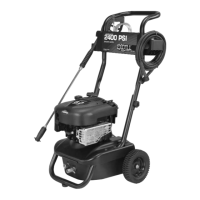

 To Next Page