20 GB
Information about noise development
The noise levels of this machine during operation are
as follows:
L
pA
: 99.6dB(A) K=3dB(A)
L
wA
: 112.6dB(A) K=3dB(A)
Vibration: 4.51m/s
2
K=1.5m/s
2
Warning: Noise can have serious effects on your
health. If the machine noise exceeds 85 dB (A), please
wear suitable hearing protection. If the electrical con-
nection is defective, the power can fail when starting
the machine. This could inuence other machines (e.g.
blinking lamps). If the electrical power corresponds to
Zmax < 0.27, such disruptions should not occur. (How-
ever, if they do, inform your specialist dealer).
• The specied vibration emission value has been
measured according to a standardised testing pro-
cedure and can be used for comparison of one elec-
tric tool with another;
• The specied vibration emission value can also be
used for an initial assessment of the load.
Warning:
• The vibration emission value can vary from the speci-
ed value during the actual use of the electric tool,
depending on the type and the manner in which the
electric tool is used;
• Try to minimise stress from vibrations as low as pos-
sible. Some examples of means for reducing the vi-
bration stress are wearing gloves while using the tool
and limiting work time. In the process all parts of the
operating cycle must be taken into account (such as
times in which the electric tool is switched off or time
in which it is switched on, but is not running under
a load).
Proper use
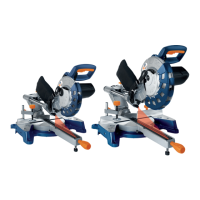
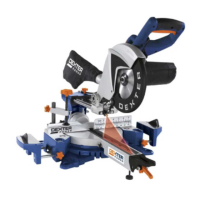
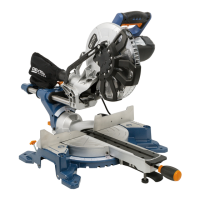
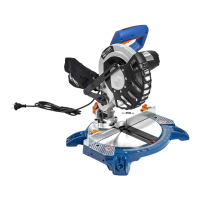
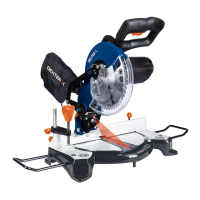
The mitre saw is used for the cutting of wood and plas-
tic, according to the machine size.
Warning! The supplied saw blade is only intended for
the sawing of wood! Do not use this blade for the saw-
ing of plastic!
The saw is not suitable for the cutting of rewood.
The machine may only be used in the intended manner.
Only suitable saw blades may be used for the machine.
The use of any type of cutting wheels is prohibited.
An element of the intended use is also the observance
of the safety instructions, as well as the assembly in-
structions and operating information in the operating
manual.
Persons who operate and maintain the machine must
be familiar with the manual and must be informed about
potential dangers.
Any use beyond this is improper. The user/operator, not
the manufacturer, is responsible for damages or injuries
of any type resulting from this.
In addition, the applicable accident prevention regula-
tions must be strictly observed.
Other general occupational health and safety-related
rules and regulations must be observed.
The liability of the manufacturer and resulting damages
are excluded in the event of modications of the ma-
chine.
Despite use as intended, specic risk factors cannot be
entirely eliminated. Due to the design and layout of the
machine, the following risks remain:
• Contact with the saw blade in the non-covered saw
area.
• Reaching into the running saw blade (cutting injury).
• Kick-back of workpieces and workpiece parts.
• Saw blade breakage.
• Ejection of faulty carbide parts of the saw blade.
• Hearing damage when the necessary hearing protec-
tion is not used.
• Harmful emissions of wood dusts during use in en-
closed areas.
Please observe that our equipment was not designed
with the intention of use for commercial or industrial
purposes. We assume no guarantee if the equipment
is used in commercial or industrial applications, or for
equivalent work.
Important information
Attention! The following basic safety measures must
be observed when using electric tools for protection
against electric shock, and the risk of injury and re.
Read all these notices before using the electric tool and
keep the safety instructions for later reference.
Safe work
1 Keep the work area orderly
– Disorder in the work area can lead to accidents.
2 Take environmental inuences into account
– Do not expose electric tools to rain.
– Do not use electric tools in a damp or wet envi-
ronment.
– Make sure that the work area is well-illuminated.
– Do not use electric tools where there is a risk of
re or explosion.
3 Protect yourself from electric shock
– Avoid physical contact with earthed parts (e.g.
pipes, radiators, electric ranges, cooling units).
4 Keep other persons away
– Do not allow other persons, especially children,
to touch the electric tool or the cable. Keep them
away from your work area.
– The operating person must be at least 18 years of
age; trainees must be at least 16 years, however
only under supervision.
5 Securely store unused electric tools
– Unused electric tools should be stored in a dry,
elevated or closed location out of the reach of
children.
6 Do not overload your electric tool
– They work better and more safely in the specied
output range.
7 Use the correct electric tool
– Do not use low-output electric tools for heavy work.


 To Next Page
 Loading...