5
Overview
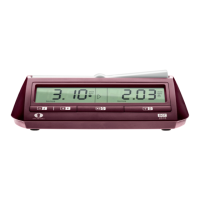
This DGT2010 Game Timer has been designed to be used as game clock for
various two-person board games, especially Chess, Go and Draughts.
The main features are:
• 13 dierent algorithms covering all popular timing standards
• Manual programming of all these methods
• 21 preprogrammed options for quick and ease of use
• Move counter for all options
• Time and move counter correction option during a game
• Optional sound alert to warn for running out of time
• LCD contrast correction feature
• Low battery indication
Registration methods
Introduction
Time forms a part of every sport, especially sports such as chess, go,
draughts, shogi and scrabble®. The dierence between the players is deter-
mined not only by the potential performance level of the individual player
but also by the time the player needs in order to reach this level. The more
a sport is seen as a measure of performance the more important it is to limit
the time a player needs to make a move. This must be done in a way which is
most appropriate for the game and the sport concerned. The DGT 2010 of-
fers 13 dierent methods for registering the timing of a game between two
players. Whilst several methods are well known, others may be less familiar.
Several of these methods have been in use for a long time; others are the
result of the possibilities oered by modern electronics. Every method has
its own charm and has an inuence on the manner in which a sport is expe-
rienced. The traditional “quickie” of 5 minutes per person is dierent from
3 minutes using “Delay” or “Bonus” in which every move attracts an extra
3 seconds of thinking time, although the total thinking time for a game is
hardly any dierent. We recommend players to experiment with the vari-
ous methods which the DGT 2010 oers. It can add an extra dimension to
a favorite sport.
1. Time Rapid and Blitz (Options 1, 2 and 3)
This is the simplest way to indicate time. Both players are allocated one
period in which they must make all moves.
2. Time + Guillotine (Options 4 and 5)
The rst period is used to play a predetermined number of moves. The se-
cond period, the Guillotine, is used to complete the game. 1 Period + Guil-
lotine is similar to “Rapid and Blitz” but with a slower start. Notice that the
guillotine time is added when one player used all rst period time (not after
the completion of e.g. 40 moves).
3. 2 x Time + Guillotine (Options 6 and 7)
For an even quieter start it is possible to play a game with two periods be-
fore the Guillotine. Notice that the second and guillotine time are added
when one player passes zero time.
4. Time + Repeating Time (Options 8 and 9)
A quiet end to a game also has its advantages. The simple traditional clock
gives the players repeated one-hour periods in which to complete a subse-
quent number of moves.


 To Next Page