16
15. LIMBING AND PRUNING
WARNING! Be alert for and guard
against kickback. Do not allow the moving
chain to contact any other branches or objects at
the nose of the guide bar when limbing or pruning.
Allowing such contact can result in serious injury.
WARNING! Never climb into a tree to
limb or prune. Do not stand on ladders,
platforms, a log, or in any position which can
cause you to lose your balance or control of the
saw.
IMPORTANT POINTS
• Work slowly, keeping both hands rmly gripped
on the saw. Maintain secure footing and balance.
• Watch out for spring poles. Spring poles are
small size limbs which can catch the saw chain
and whip toward you or pull you off balance. Use
extreme caution when cutting small size limbs or
slender material.
• Be alert for spring back. Watch out for branches
that are bent or under pressure. Avoid being
struck by the branch or the saw when the tension
in the wood bers is released.
• Keep a clear work area. Frequently clear
branches out of the way to avoid tripping over
them.
16. LIMBING
• Always limb a tree after it is cut down. Only then
can limbing be done safely and properly.
• Leave the larger limbs underneath the felled tree
to support the tree as you work.
• Start at the base of the felled tree and work
toward the top, cutting branches and limbs.
Remove small limbs with one cut.
• Keep the tree between you and the chain. Cut
from the side of the tree opposite the branch you
are cutting.
• Remove larger, supporting branches with
the cutting techniques described in BUCKING
WITHOUT A SUPPORT.
• Always use an overcut to cut small and freely
hanging limbs. Undercutting could cause limbs to
fall and pinch the saw.
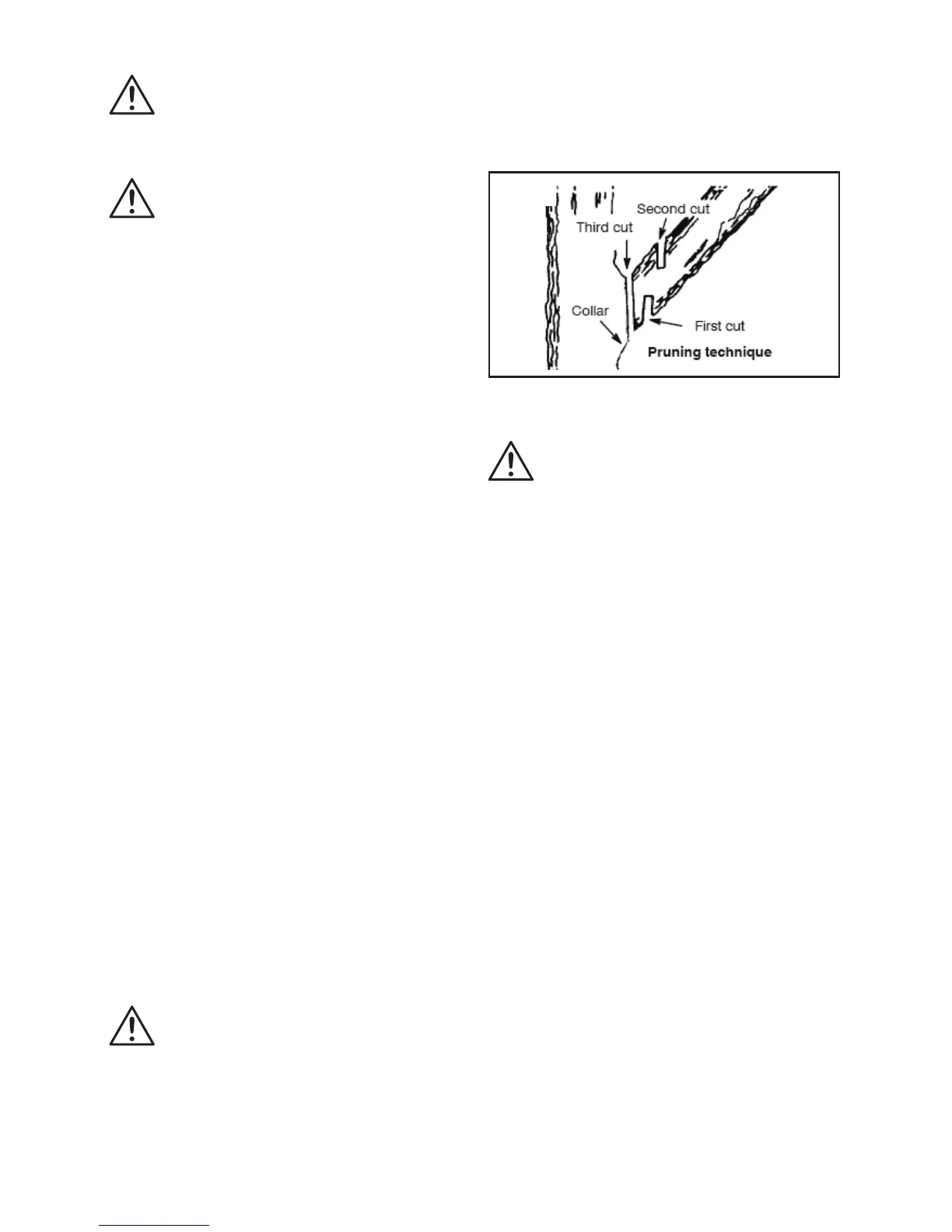
17. PRUNING (Fig. X)
WARNING! Limit pruning to limbs
shoulder height or below. Do not cut if
branches are higher than your shoulder. Get a
professional to do the job.
Make your rst cut 1/3 of the way through the bottom
of the limb.
Next, start cutting from the upper side of the limb
about one inch further out from the trunk. Keep
cutting until you start hearing wood crack. Stand
back and watch the limb snap off the tree under it
own weight.
Then cut a third overcut leaving a 1 to 2 inch (2.5 to
5cm) collar from the truck of the tree.
Fig.X
MAINTENANCE
WARNING! Disconnect the
spark plug before performing
maintenance except for carburetor
adjustments.
We recommend all service and
adjustments not listed in this manual
be performed by an authorized or
Master Service Dealer.
1. CHECK FOR DAMAGED OR WORN
PARTS
Contact an authorized service dealer for
replacement of damaged or worn parts.
NOTE: It is normal for a small amount of oil to
appear under the saw after engine stops. Do not
confuse this with a leaking oil tank.
• “I”/”O” switch -- Ensure “I”/”O” switch functions
properly by moving the switch to the”O” switch
position. Make sure engine stops; then restart
engine and continue.
• Fuel Tank -- Do not use saw if fuel tank shows
signs of damage or leaks.
• Oil Tank -- Do not use saw if oil tank shows signs
of damage or leaks.
2. CHECK FOR LOOSE FASTENERS AND
PARTS
• Bar Nuts
• Chain
• Mufer
• Cylinder Shield
• Air Filter
• Handle Screws
• Vibration Mounts
• Starter Housing


 To Next Page