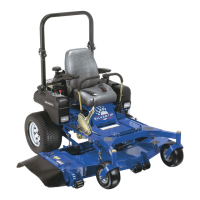
The Dixon ZTR DX260D / 966651601 is a ride-on zero-turn mower designed for efficient mowing of large areas. It features a Kubota engine and a hydrostatic transmission, providing variable speed and direction control through steering levers.
Function Description
The primary function of this machine is to mow grass on lawns and even ground free of obstacles. It can also be used for other tasks when equipped with manufacturer-provided accessories. The machine's zero-turn capability allows for high maneuverability.
Controls:
- Motion Control Levers: These two levers control the machine's speed and direction. Moving both forward or backward equally results in straight movement. Moving one lever more than the other allows for turns. Zero-turn is achieved by moving one lever backward and the other forward. The levers have a neutral position, which can be locked.
- Parking Brake: Located on the left side, it is activated by pulling the lever backward and released by pushing it forward. The machine must be stationary when applying the parking brake.
- Blade Switch: A knob that, when pulled out, engages the mower deck, and when pressed down fully, disengages the blades.
- Hour Meter: Displays total operating time and flashes "CHG OIL" at 50-hour intervals to indicate an oil change is due.
- Tracking Adjustment: Bolts are used to adjust the motion control levers to ensure the mower tracks straight, especially if rear tire air pressure is uneven.
- Ignition Switch: Located on the control panel, it starts and stops the engine. It has RUN and START positions, and an accessory position.
- Control Module: Monitors functions like battery voltage, oil pressure, coolant temperature, and glow plugs, with warning lights and an audible buzzer for unsafe conditions.
- Cutting Height Pedals: Release the deck lift to set the desired cutting height. Pushing the lift pedal fully forward latches the deck in the highest (transport) position.
- Seat Adjustments: A lever on the right side of the seat allows for lengthways adjustment.
- Fuses: Main harness fuses are under the seat (10 amp for accessories, 20 amp for ignition/safety interlock). Engine harness fuses are near the starter (30 amp for fan reversing module/cooling fan, 50 amp for glow plugs).
- Fuel Shut Off Valve: Located on the right front side of the engine, it is off when the handle tab is perpendicular to the fuel line.
- Pump Release Valves: Located on the right side of each pump, these valves release the hydrostatic system, allowing the machine to be moved by hand when not running.
Operation:
- Starting: Requires the blade switch to be depressed, parking brake on, and steering controls in the locked (outer) neutral position. The fuel tank valve must be open. The engine speed should be set to mid-throttle for 3-5 minutes before heavy loading, and full throttle for mowing.
- Operating on Hills: Mow up and down slopes (maximum 10 degrees), not across. Avoid stopping or changing speed on hills. Use the slowest possible speed.
- Stopping: Move throttle to minimum, steering controls to neutral, disengage the mower deck, raise the deck to transport position, activate the parking brake, turn the ignition key to STOP, and remove the key.
Important Technical Specifications
- Model: DX260D / 966651601
- Engine: Kubota D1305-E3B, 29 HP @ 3200 rpm (average net power output)
- Fuel: No. 2-D diesel fuel
- Fuel Tanks Capacity: 11 gallons / 41.6 liters (two tanks)
- Cooling: Radiator
- Air Filter: Heavy duty canister
- Alternator: 12v 60 amp @ 3600 rpm
- Starter: Electric
- Transmission: Dual pump and wheel motor, internal hydraulic
- Speed (Forward): 0-14 mph (0-22.5 Km/h)
- Speed (Reverse): 0-7 mph (0-11.3 Km/h)
- Front Caster Tires: 13 x 6.5 Flat Free, smooth tread
- Rear Tires: 26 x 12-12 4 ply, turf pneumatic
- Tire Pressures: 15 PSI / 103 kPa / 1 bar
- Cutting Width: 60" (152.4 cm)
- Cutting Height: 1"-5" (2.5-12.7 cm)
- Uncut Circle: 0
- Number of Blades: 3
- Blade Length: 21" / 53.3 cm
- Anti-scalp Rollers: 5 adjustable
- Seat: Sprung seat with hinged armrests
- Blade Engagement: Ogura
- Deck Construction: 7 gauge
- Productivity: 7 acres/h / 28,320 m²/h
- Weight: 1680 lbs / 762 kg
- Base Machine Length: 86½" / 220 cm
- Base Machine Height: 50" / 127 cm
- Base Machine Width: 58" / 147 cm
- Overall Width (Chute Up): 61½" / 156 cm
- Overall Width (Chute Down): 73" / 185 cm
- Overall Height (ROPS Up): 73" / 185 cm
- Rollover Protection System (ROPS): Increases basic weight by 73 lbs/33 kg. Max GVW: 2822 lbs/1283 kg.
Usage Features
- Zero-Turn Maneuverability: Allows for precise turns and efficient mowing of complex areas.
- Operator Presence System: Shuts off the engine if the operator leaves the seat without setting the parking brake.
- Personal Protective Equipment (PPE): Requires sturdy footwear, eye protection, and hearing protection during operation. Gloves are recommended when handling blades.
- Slope Operation: Designed for slopes no greater than 10 degrees, to be mowed up and down, not across.
- Fuel Handling Safety: Emphasizes extreme caution due to flammability; refueling outdoors, avoiding open flames, and proper storage are critical.
- Children Safety: Strict warnings against carrying passengers and keeping children away from the mowing area.
- Spark Arrestor: Standard equipment on the muffler, requiring regular cleaning to prevent fire hazards.
- Transport: Requires approved fastening equipment and slow speeds when loading/unloading on ramps. Not to be operated on public roadways.
- Towing: Use extreme caution, avoid children on towed equipment, make wide turns, and travel slowly. Do not tow on sloped ground.
Maintenance Features
General Maintenance:
- Keep all nuts and bolts tight.
- Regularly check and clean safety devices, grass catcher components, and discharge guard.
- Keep the machine free of grass, leaves, and debris buildup.
- Inspect for damage after striking foreign objects.
- Mower blades are sharp and require caution (gloves) during servicing.
- Check brake operation frequently.
- Maintain safety and instruction labels.
- Do not modify safety equipment or change governor settings.
- Handle battery acid with care; wear protective goggles.
- Regularly clean the deck and underside, avoiding spraying water on engine and electrical components.
Scheduled Maintenance (Daily, 50h, 100h, 250h, 500h, Annual):
- Daily/Before Use: Check parking brake, engine oil level, safety system, fuel/oil leakages, mower deck, loose hardware, tire pressures. Clean under the mower deck.
- After 10 Hours (Initial): Change engine oil and filter, check hydraulic oil level, hoses, belt, filter, neutral position, safety system, seat belt, ROPS, fuel system for leaks, safety guards/shields, and brake adjustment.
- 50 Hours: Clean debris from mower, check engine oil level, tire pressures, underside of deck, deck pulleys, radiator fins/debris screen, safety system, seat belt, ROPS, fuel system for leaks, safety guards/shields, brake adjustment, and clean around gear box.
- 250 Hours: Grease fittings (caster pivots, wheels), inspect dampers, frame, throttle cable, hardware. Check tire pressures. Change engine oil/filter, air filter, fuel filter. Check engine RPM, blade pitch. Grease blade spindles, inspect spindle bearings, deck belt/blades, idler arm bearings/pulleys. Check hydraulic oil level/filter, hydraulic drive belt/hoses, neutral position, battery connections, safety system, seat belt, ROPS, fuel system for leaks, safety guards/shields, brake adjustment, clutch belt. Change gear box oil (every 100 hours). Check radiator hoses/clamps, air intake hose/clamps (every 100 hours).
- 500 Hours: Includes all 250-hour checks plus change hydraulic oil/filter, anti-freeze, replace hydraulic drive belt, load test battery, clean electrical connections, inspect clutch, and change alternator belt.
- At Least Once Each Year: Clean radiator fins, replace air cleaner's filter, change engine oil, replace engine oil filter, check/adjust cutting height, check/adjust parking brake, and check engine valve clearance (every 800 hours).
Specific Maintenance Procedures:
- Battery: Maintenance-free, but periodic charging extends life. Keep clean, tighten bolts. Removal/installation instructions provided, emphasizing safety with terminals.
- Parking Brake Adjustment: Involves raising the rear of the mower, removing tires, loosening nuts on the brake bracket and linkage, engaging the brake, pulling linkage, tightening nuts, and testing.
- Drive Lever Adjustment: Allows adjustment of height and alignment of drive levers to suit the operator.
- Deck Belt Removal/Installation: Involves removing foot plate/shields, relieving tension with a breaker bar, and routing the belt according to the decal.
- Pump Belt Replacement: Requires removing skid plate and left drive tire, relieving tension, and routing the belt.
- Clutch Belt Removal/Reinstallation: Involves disconnecting battery, removing guards, loosening tensioner bolt, relieving tension on detent pin, and reassembling.
- Cutting Blades: Sharpening and balancing should be done by an authorized service workshop. Replacement requires specific Dixon bolts and proper torque.
- Adjusting Mower Deck (Leveling): Involves checking tire pressure, wearing gloves, aligning blade tips, and adjusting bolts to ensure the deck is slightly higher in the rear.
- Anti-scalp Rollers: Adjustable to three positions (1-2½", 2½-4", 4-5" grass) to prevent scalping, but not to support the deck.
- Deck Lift Spring: Tension can be adjusted by loosening a nut after tilting the seat forward.
- Caster Wheels: Check every 200 hours for free rotation. Removal/installation instructions provided.
- Cleaning: Regular cleaning, especially under the deck, is recommended. Avoid high-pressure washing on engine/electrical components.
- Lubrication: Follow engine manufacturer's instructions. Use good quality bearing grease for zerks. Wipe away excess grease. Avoid lubricant on belts.
- Hydraulic Drive Fluid and Filter Change: Recommended every 500 hours. Involves draining oil, replacing the filter, refilling with synthetic 15W 50 oil, and purging the system of air.
- Transmission Purging Procedures: Critical for efficiency after opening the hydrostatic system or adding oil. Involves moving directional controls with bypass valve open and closed to remove air.
Winter Storage:
- Thoroughly clean the machine, especially the mower deck.
- Inspect for worn/damaged parts and tighten loose fasteners.
- Change engine oil.
- Empty fuel tanks or add fuel stabilizer and run the engine.
- Lubricate all grease zerks, joints, and axles.
- Remove, clean, charge, and store the battery in a cool place.
- Store the machine in a clean, dry place.

 Need help?
 General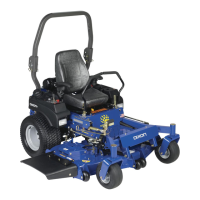

 To Next Page