9
STORAGE COMPARTMENTS
FIRE OR EXPLOSION HAZARD. Do not store
or use gasoline, oil or gasoline soaked rags,
or other ammable vapors and liquids in the
service area behind the refrigerator or in the
vicinity of this or any other gas appliance.
Failure to obey this warning could cause a
re or an explosion resulting in death or seri-
ous injury.
REFRIGERATOR VOLUME
MODEL TOTAL REFRIGERATED
VOLUME (CU. FT.)
RM2351& RM2354 3
RM2451& RM2454 4
RM2551 & RM2554 5
DM2652, DM2662 & DM2663 6
DM2852 & DM2862 8
NDM1062 9.2
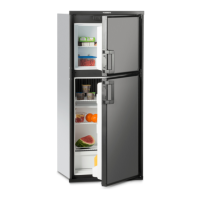
FOOD STORAGE COMPARTMENT
• Cool the refrigerator before placing any food inside.
Never put hot food or drinks into the refrigerator - cool
them rst.
• The food storage compartment is completely closed and
unventilated, which is necessary to maintain the required
low temperature for food storage. Consequently, foods
having a strong odor or those that absorb odors easily
should be covered.
• Vegetables, salads, etc. should be covered to retain
their crispness.
• The coldest positions in the refrigerator are under the
cooling ns and at the bottom of the refrigerator. The
warmer areas are on the upper door shelves. This
should be considered when placing different types of
food in the refrigerator.
• Arrange all food in the unit to allow for free air circu-
lation. Do not overpack because a stuffed refrigerator
must work harder and will have higher cabinet tempera-
tures.
• Do not leave the unit’s door open any longer than nec-
essary. This will reduce frost formation and increase the
efciency of the refrigerator.
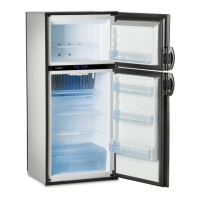
FROZEN FOOD STORAGE
COMPARTMENT
This compartment is not designed for deep or quick freez-
ing of food.
• To prevent food from drying out, keep it in covered
dishes, containers, plastic bags or wrapped in alumi-
num foil.
• Meat or sh, whether raw or prepared, can be stored in
the frozen food storage compartment provided they are
precooled rst in the refrigerator. They can be stored
about three times longer in the frozen food compart-
ment as compared to the fresh food compartment.
• Quick frozen soft fruits and ice cream should be placed
in the coldest part of the compartment, which is at the
bottom of the aluminum liner.
• Frozen vegetables, may be stored in any part of the
compartment.
• To prevent frost buildup, which can reduce the efcien-
cy, wipe excess moisture off items being placed in the
compartment.
REMOVING AND REPLACING THE
SHELVES
1. Remove the shelf locks by inserting the tip of a
at bladed screwdriver into the slot of the locks.
Turn the screwdriver counterclockwise and then
remove the shelf locks from the wire shelf.
2. Slide the shelf to the left until bushings disen-
gage, then tilt the shelf to one side at an angle
while pulling forward.
3. Reposition the shelf in the desired location. In-
sert the ends of the wire shelf on the left-hand
side and slide the shelf into the holes on the
right-hand side.
4. Slide the plastic plugs into the holes of the wall.
5. Snap the shelf locks back onto the wire shelf.



 To Next Page
 Loading...