15
Indirect Flash Photography
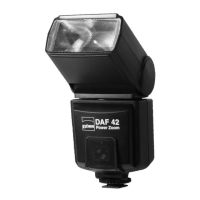
The DAF-42 equipped with a bounce and swivel head which allows you to change the
direction of the ash up to 270° horizontally and up to 90° vertically. You can avoid
direct ashing onto objects by positioning the ash towards a reection surface.
This surface should be neutrally white (e. g. white ceiling, white wall) as the light will
be reected in the color of the surface ashed on. This leads to color distortions
when using colored reecting surfaces. Indirect ash photography oers you the
following advantages:
• avoiding harsh shadows
• avoiding red eyes
• soft outlines and even illumination (particularly suitable for portraits)
• avoiding disturbing light reections o non-metallic surfaces such as windows, glasses, or water.
On the backside of the ash you can read o the position of the bounce angle. When tilting the ash head,
no ash range is indicated on the LC display as the light path length does not comply with the distance to the
object but with the distance: ash- reecting surface- object. Please consider that indirect ash photography
reduces the ash range. In TTL mode the ash and the camera automatically ensure proper dosage of the
ash´s power output. With indirect ash photography the power-zoom function is inactive. Please select the
focal length manually. Further the ash range, lm speed and aperture are not indicated on the LC display.
Still, TTL ash control is active.
Indirect Flash Photography with Reecting Plate
If you want to ash indirectly but no adequate reection surface (white ceiling/white wall) is available, you
can use the built-in reecting plate. One advantage to “regular” indirect ashing: The distance ash --->
reecting surface ---> object is shorter. The reecting plate is integrated in the ash head above the diuser
plate. To use, slide it out until the stopper is reached.
Diuser Plate
Especially with portraits a softer illumination is advantegous. Alternatively to indirect ashing this can also
be achieved by using a diuser plate. The diuser plate is integrated in the ash head beneath the reecting
plate. To use, slide it out until the stopper is reached and the diuser plate aps over the reector. Please
consider that the ash range reduces when using the diuser plate. In TTL mode the ash and the camera
automatically ensure proper dosage of the ash´s power output. The reecting plate is integrated in the ash
head above the diuser plate. To use, slide it out until the stopper is reached.
Red-Eye Eect
With ash photography, the subject´s eyes may appear red in a picture. This is caused by ashlight reecting
o the blood circulated retina. This phenomenon especially appears when the ash is located close to the
lens axis. Weak ambient light even supports the red-eye eect as the pupils will widen. A secure method to
avoid the red-eye eect is to use indirect ash photography. But even with direct ashing, the design of the
DAF-42 reduces the red-eye eect as the ash head is located as far as possible from the optical axis. The
larger the ash angle of incidence the lesser the red-eye eect.
Flash Synchronization
Digital Cameras: All shutter speeds can be used for ash photography. There are no restrictions.
Analog Cameras: Synchronization time refers to the shutter speeds which will allow ash photography.
Special attention must be paid in the case of short shutter speeds. Each camera model features a “shortest”
synchronization - the so-called x-synchronization. Please review the instruction manual of your camera.


 To Next Page
 Loading...