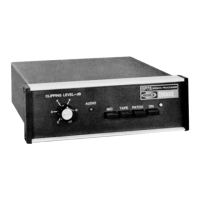
transmitter operation
With the TR7 this means advancing the SP75 output
level until the green TR7 ALC indicator just lights to full brilliance. Do not
advance output level beyond this point. NOTE:
Transmitter
microphone
gain should not be changed from the setting determined in step 1.
5) To use the processor with a tape or phone patch input, depress the appro-
priate pushbutton. Do not change the processor output level or transmitter
microphone gain control
from
the
settings
determined above. Adjust the
output level
on
the patch
or
tape
player
for proper audio level using the same
general procedure as step 3 above. The SP75 microphone gain control is not
operative in the TAPE or PATCH mode and the level
must be set by the
control on the tape player or patch.
Once the SP75 has been adjusted as per the above procedures it is ready for
operation. One of the three possible inputs can be selected by depressing the
appropriate interlocking pushbutton. Any input can be fed directly to the
transmitter, bypassing the processor, by leaving the ON pushbutton in the out
position. When the ON pushbutton is
depressed,
the processor is switched in.
The clipping control can be advanced to obtain the desired amount of clipping.
The best setting will depend on band conditions and the individual operator,
however 9 to 12
dB
is usually a good setting.
V. THEORY OF OPERATI’ON
Refer to the schematic diagram. The audio input is amplified by the micro-
phone preamp when the microphone input is selected. Gain control
R5
allows
the gain to be set properly for the particular microphone being used. The output
from the microphone preamp is then routed to the audio compressor stage.
When selected, tape or phone patch inputs are routed directly to the compres-
sor. The audio compressor compresses the dynamic range thus providing
a
more constant level to the RF clipper. This compression also allows more RF
clipping of the softer speech‘passages.
The audio compressor output is fed through the clipping level potentiometer
and muting circuitry to the input of a MC1496 balanced modulator integrated
circuit. A double sideband output signal is generated by the balanced modula-
tor at an intermediate carrier frequency of 459
kHz.
This signal then passes
through two cascaded ceramic filters, leaving only a single sideband signal at


 To Next Page
 Loading...