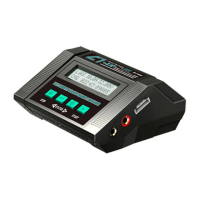
CHARGER INSTRUCTION MANUALC1 - XR AC/DC SMART BALANCE CHARGER
98
Warning and Safety Notes Warning and Safety Notes
These warnings and safety notes are particularly
important. Please follow the instructions for maximum
safety; otherwise the charger and the battery can be
damage or at worst it can cause a re.
Neverattempttochargeordischargethefollowingtypesof
batteries.
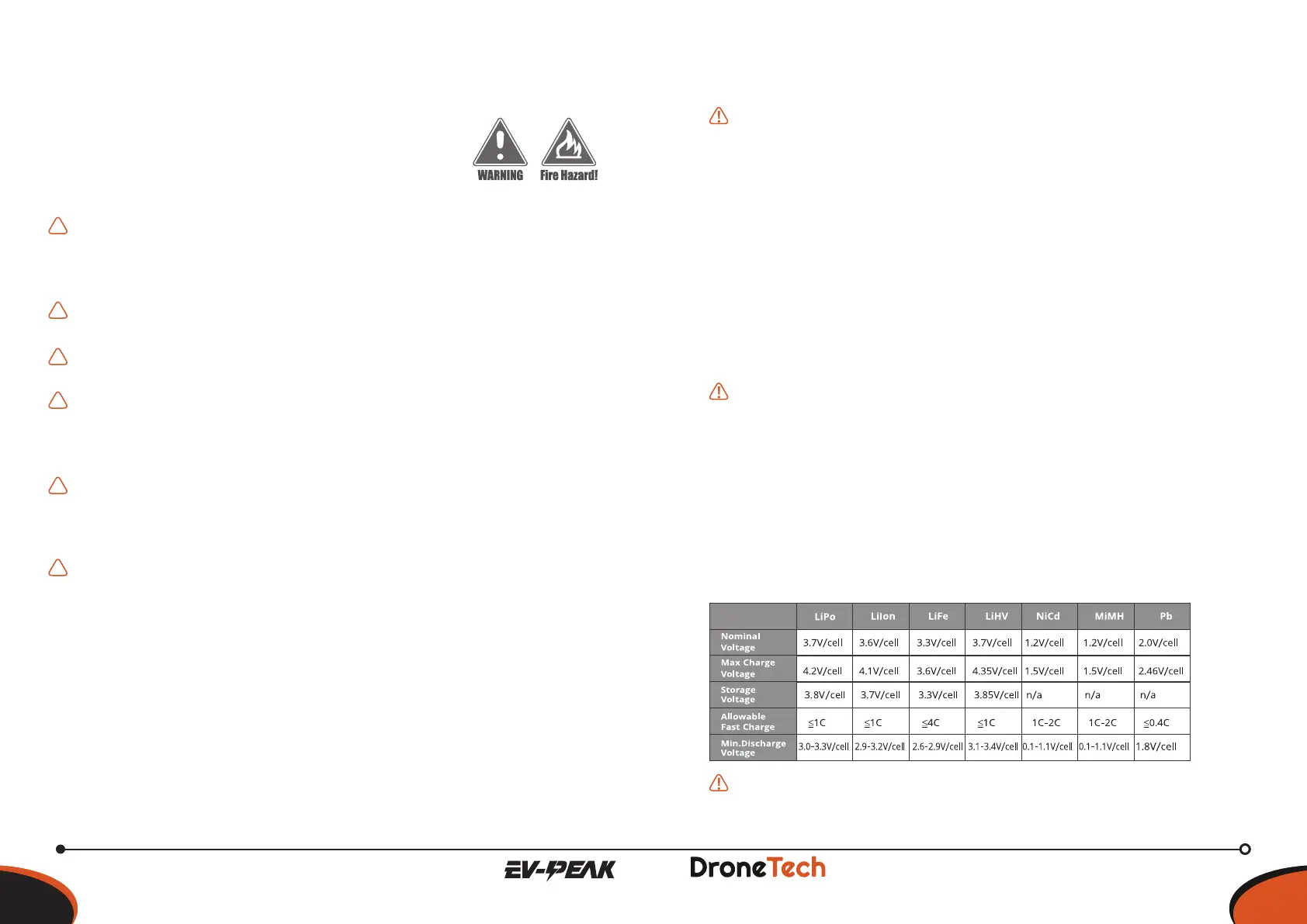
Beverycarefultochoosethecorrectvoltagefordierenttypes
ofbatteryotherwiseyoucancausedamagetothebatteries.
Incorrectsettingscouldcausethecellstoreorexplode.
! Never leave the charger unattended when it is connected to its power
supply. If any malfunction is found, TERMINATE THE PROCESS AT ONCE
and refer to the operation manual. If any malfunction is found, TERMINATE
THE PROCESS AT ONCE and refer to the operation manual.
! Keep the charger well away from dust, damp, rain, heat, direct sunshine
and vibration. Never drop it.
! The allowable DC input voltage is 11-18V DC. The allowable AC input
voltage is 100-240V AC.
! This charger and the battery should be put on a heat-resistant,
noninammable and nonconductive surface. Never place them on a car
seat, carpet or similar. Keep all the inammable volatile materials away
from operating area.
! Make sure you know the specications of the battery to be charged or
discharged to ensure it meets the requirements of this charger. If the
program is set up incorrectly, the battery and charger may be damaged. It
can cause re or explosion due to overcharging.
! To avoid short-circuiting between the charge lead, always connect the
charge cable to the charger rst, then connect the battery. Reverse the
sequence when disconnecting.
• A battery pack, which consists of dierent types of cells (including dierent
manufacturers)
• A battery that is already fully charged or just slightly discharged.
• Non-rechargeable batteries (Explosion hazard).
• A faulty or damaged battery.
• A battery tted with an internal charge circuit or a protection circuit.
• Batteries installed in a device or which are electronically linked to other
components.
• Batteries that are not expressly stated by the manufacturer to be suitable
for the currents the charger delivers the charge process.
Pleasebearinmindthefollowingpointsbeforecommencing
charging:
•
Did you select the appropriate program suitable for the type of battery you
are charging?
• Did you set up adequate current for charging or discharging?
• Have you checked the battery voltage? Lithium battery packs can be wired
in parallel and in series ie. a 2 cell pack can be 3.7V (in parallel) or 7.4V (in
series).
• Have you checked that all connections are rm and secure? Make sure
there are no intermittent contacts at any point in the circuit.


 To Next Page
 Loading...