EasyManua.ls Logo

Dual 1249 - Balancing the Tonearm; Tonearm Balancing Procedure; Checking Tonearm Balance

Dual 1249
19 pages
Print Icon
To Next Page IconTo Next Page
To Previous Page IconTo Previous Page
Loading...
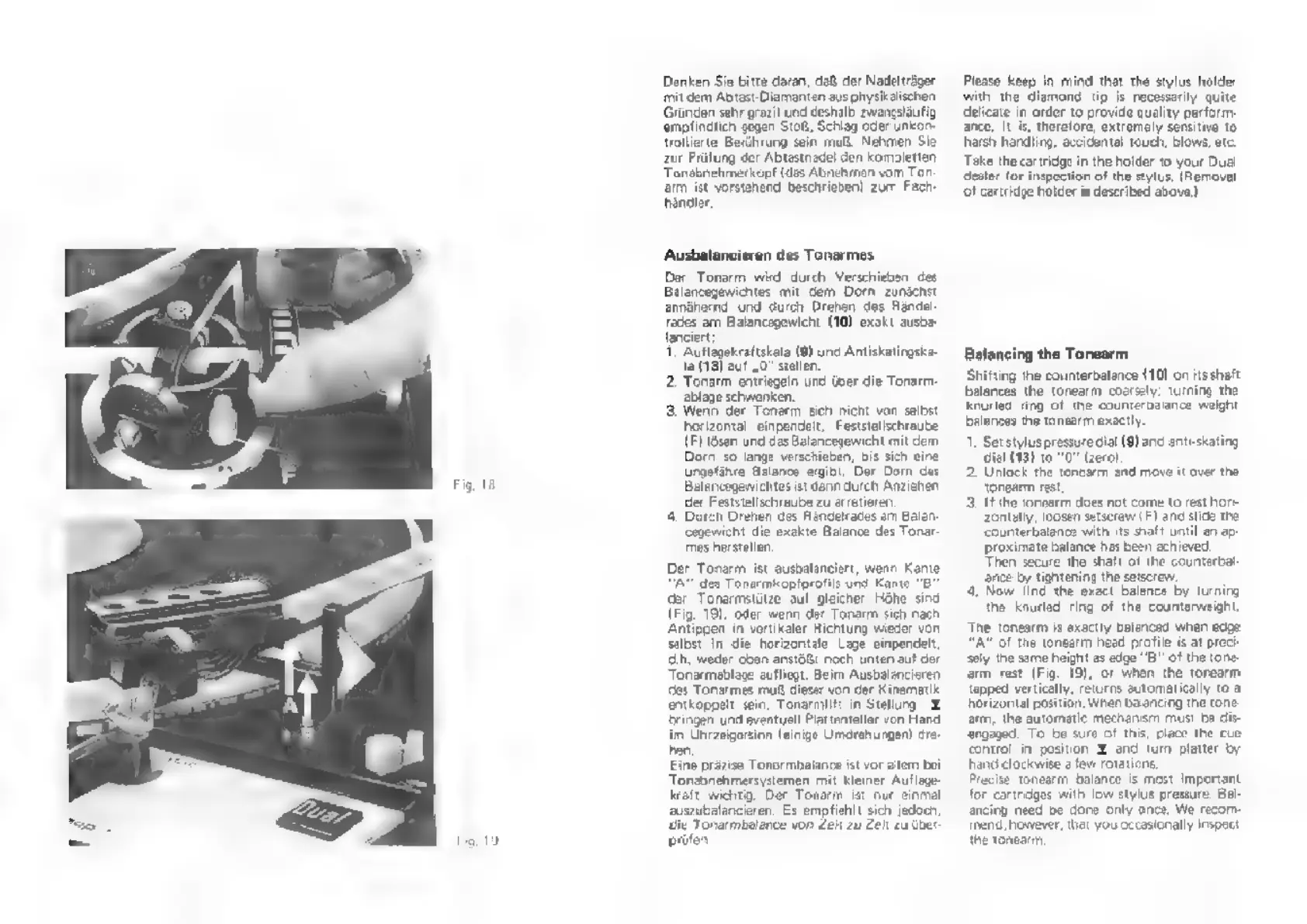
Fig,
18
Denken
Sie
bitte
daran,
da
der
Nadeltrager
mit
dem
Abtast-Diamanten
ous
physikalischen
Griindan
sehr
grazil
und
deshalb
zwaneslaufig
empfindlich
gegen
Sto&,
Schlag
oder
unkon-
trollierte
Berihrung
sein
mu
Nehmen
Siz
zur
Priifung
der
Abtastnadel
den
komaletten
Tonabnehmerkopf
(das
Abnehmen
vam
Ton.
aim
ist
vorstehend
beschrieben)
zum
Fach-
handler,
Ausbalancieren
des
Tonarmes
Dear
Tonarm
wird
durch
Werschiebsn
des
Balancegewichtes
mit
dem
Dorn
zunachst
annahernd
und
durch
Drehan
des
Randel-
rades
am
Balancegewicht
(10)
exakt
ausba-
lanciert:
1.
Auflagekraftskala
(9)
und
Antiskatingska-
ta
(13)
aut
,,0°
stellen.
2.
Tonarm
entriegein
und
Uber
die
Tonarm
ablage
schwenken.
3
Wenn
der
Tonarm
sich
nicht
von
salbst
horizontal
einpendelt,
Feststellschraube
(F)
ldsen
und
das
Balzncegewicht
mit
dem
Dorn.
so
lange
verschieben,
bis
sich
eine
ungefahre
Balance
ergibt,
Der
Dorn
des
Balancegewichtes
ist
dann
durch
Anziehen
der
Feststallschraube
zu
arretieren.
4
Dut
Drehen
des
Randelrades
am
Balan-
cegewicht
die
exakte
Balance
des
Tonar.
mes
herstellen,
Der
Tonarm
ist
ausbalanciert,
wenn
Kante
“A”
des
Tonarmkopfprofils
und
Kante
“B”
dar
Tonarmstiitze
auf
gleicher
Hdhe
sind
(Fig.
19),
oder
wenn
der
Tonarm
sich
nach
Antippen
in
vertikaler
Richtung
wieder
von
selbst
in
die
horizontale
Lage
einpendelt,
dh,
weder
oben
anst6&t
noch
unten
auf
der
Tonarmablage
aufliegt,
Beim
Ausbalancieren
des
Tonarmes
mut,
dieser
von
der
Kinematik
entkoppelt
sein,
Tonarmlift
in
Stellung
Z
bringen
und
eventuell
Plattentelier
von
Hand
im
Uhrzeigarsinn
(einige
Umdrehungen)
dre-
hen.
Eine
prazisa
Tonarmbalance
ist
vor
allem
bei
Tonabnehmersystemen
mit
kleiner
Auflage-
kraft
wichtig,
Der
Tonarm.
ist
nur
einmal
auszubalancieren.
Es
empfiahit
sich
jedoch,
die
Tonarmbalance
vor
Zeit
zu
Zeit
cu
tbe
prifes
Please
keep
in
mind
that
the
stylus
holder
with
the
diamond
tip
is
necessarily
quite
delicate
in
order
to
provide
quality
perform.
ance,
It
is,
therefore,
extremely
sensitive
to
harsh
handling.
accidental
touch, blows,
etc.
Take
the
cartridge
in
the
holder
to
your
Dual
dealer
for
inspection
of
the
stylus,
(Removal
of
cartridge
holder
is
described
above.)
Balancing
the
Tanearm
Shifting
the
counterbalance
(10)
on
its
shaft
balances
the
tonearm
coarsaly;
turning
the
knurled
ring
of
the
counterbalance
weight
balances
the
tonearm
exactly,
1.
Set
stylus
pressuredial
(9)
and
anti-skating
dial
(13)
10
"0"
(zero)
2.
Unlock
the
tonearm
and
move
it
over
the
‘tonearm
rest,
3.
If
the
tonearm
does
not
come
to
rest
hori-
zontally,
loosen
setscrew
(F)
and
stide
the
counterbalance
with
its
shaft
until
an
ap-
proximate
balance
has
been
achieved.
Then
secure
the
shaft af
the
countertal-
ance:
by
tightening
the
setscrew.
Now
find
the
exact
balance
by
turning
the
knurled
ring
of
the
counterweight,
The
tonearm
is
exactly
balanced
when
edge
"A"
of
the
tonearm
head
profile
is
at
preci-
sely
the
same
height
as
edge
"B'
of
the
tone-
arm
rest
(Fig.
19),
or
when
the
tonearm
tapped
vertically,
returns
automatically
to
a
horizontal
position,
When
balancing
the
tone-
arm,
the
automatic
mechanism
must
be
dis-
‘engaged,
To
be
sure
of
this,
place
the
cue
control
in
position
Z
and
turn
platter
by
hand
clockwise
a
few
rotations,
Precise
tonearm
balance
is
most
important
for
cartridges
with
low
stylus
pressure,
Bel-
ancing
need
be
done
only
once,
We
recom
mend,
however,
that
you
occasionally
inspect
the
tonearm.
4,

Related product manuals