EasyManua.ls Logo

Dual 622 - Cue Control and Tonearm Automation; Cue Control Operation; Cue Control Plate Replacement; Automatic Tonearm Movement

Dual 622
14 pages
Print Icon
To Next Page IconTo Next Page
To Previous Page IconTo Previous Page
Loading...
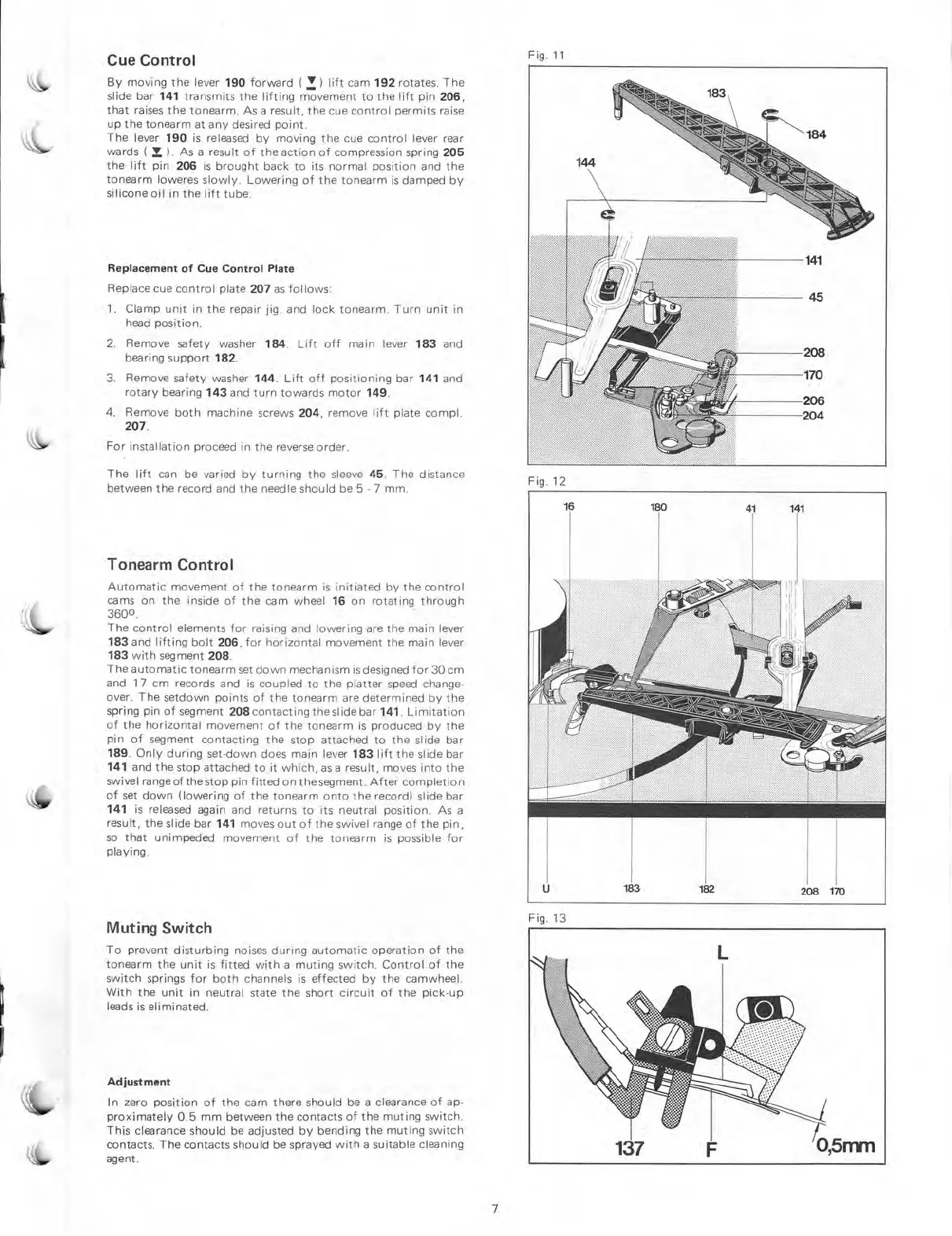
Cue
Control
By
moving
the
lever
190
forward
1V
I
lift
cam
192
rotates.
The
slide
bar
141
transmits
the
lifting
movement
to
the
lift
pin
206,
that
raises
the
tonearm.
As
a
result,
the
cue
control
permits
raise
up
the
tonearm
at
any
desired
point.
The
lever
190
is
released
by
moving
the
cue
control
lever
rear
wards
(
X
I
.
As
a
result
of
the
action
of
compression
spring
205
the
lift
pin
206
is
brought
back
to
its
normal
position
and
the
tonearm
loweres
slowly.
Lowering
of
the
tonearm
is
damped
by
silicone
oil
in
the
lift
tube.
Replacement
of
Cue
Control
Plate
Replace
cue
control
plate
207
as
follows:
1.
Clamp
unit
in
the
repair
jig.
and
lock
tonearm.
Turn
unit
in
head
position.
2.
Remove
safety
washer
184.
Lift
off
main
lever
183
and
bearing
support
182.
3.
Remove
safety
washer
144.
Lift
off
positioning
bar
141
and
rotary
bearing
143
and
turn
towards
motor
149.
4.
Remove
both
machine
screws
204,
remove
lift
plate
compl.
207.
For
installation
proceed
in
the
reverse
order.
The
lift
can
be
varied
by
turning
the
sleeve
45.
The
distance
between
the
record
and
the
needle
should
be
5
-
7
mm.
Tonearm
Control
Automatic
movement
of
the
tonearm
is
initiated
by
the
control
cams
on
the
inside
of
the
cam
wheel
16
on
rotating
through
360
0
.
The
control
elements
for
raising
and
lowering
are
the
main
lever
183
and
lifting
bolt
206,
for
horizontal
movement
the
main
lever
183
with
sag
ment
208.
The
automatic
tonearm
set
down
mechanism
isdesigned
for
30
cm
and
17
cm
records
and
is
coupled
to
the
platter
speed
change-
over.
The
setdown
points
of
the
tonearm
are
determined
by
the
spring
pin
of
segment
208
contacting
the
slide
bar
141.
Limitation
of
the
horizontal
movement
of
the
tonearm
is
produced
by
the
pin
of
segment
contacting
the
stop
attached
to
the
slide
bar
189.
Only
during
set-down
does
main
lever
183
l
ift
the
slide
bar
141
and
the
stop
attached
to
it
which,
es
a
result,
moves
into
the
swivel
range
of
the
stop
pin
fitted
on
the
segment.
After
completion
of
set
down
(lowering
of
the
tonearm
onto
the
record)
slide
bar
141
is
released
again
and
returns
to
its
neutral
position.
As
a
result,
the
slide
bar
141
moves
out
of
the
swivel
range
of
the
pin,
so
that
unimpeded
movement
of
the
tonearm
is
possible
for
playing.
Muting
Switch
To
prevent
disturbing
noises
during
automatic
operation
of
the
tonearm
the
unit
is
fitted
with
a
muting
switch.
Control
of
the
switch
springs
for
both
channels
is
effected
by
the
camwheel.
With
the
unit
in
neutral
state
the
short
circuit
of
the
pick
-up
leads
is
eliminated.
Adjustment
In
zero
position
of
the
cam
there
should
be
a
clearance
of
ap-
proximately
0.5
mm
between
the
contacts
of
the
muting
switch.
This
clearance
should
be
adjusted
by
bending
the
muting
switch
contacts.
The
contacts
should
be
sprayed
with
a
suitable
cleaning
agent.
Fig.
11
Fig.
12
Fig.
13
7

Related product manuals