Home Owner's Information — Air Conditioners and Heat Pumps
Room Thermostat
The wall-mounted thermostat controls your air
conditioner. The thermostat is available in various
configurations from different manufacturers. The
information below is typical for most thermostats. Ask your
dealer for specific information regarding the model of
thermostat installed.
For Cooling Cycle switch the room thermostat system
lever to "Cool". The thermostat will turn the air conditioner
or heat pump on in the cooling mode until the selected
room temperature is achieved and then shut off
automatically.
For Heating Cycle switch the room thermostat system
lever to "Heat". The thermostat will turn the heat pump (or
furnace) on in the heating mode until the selected room
temperature is achieved and then shut off automatically.
On heat pumps systems only, sometimes an emergency
heat setting "EM HT" is available on the thermostat, which
will automatically cycle supplemental electric heat only to
heat your home.
Some room thermostats have a setting on the system
lever marked "AUTO" which will automatically change
between heating and cooling modes.
NOTE: Some heating and cooling units have a reset
feature which will allow you to reset the unit at the
thermostat after some abnormal condition has caused
safety switches to cut the unit off. If your unit has this
feature, switch the system lever to OFF and back to COOL
or HEAT. If you are in doubt which model you have, please
consult your Dealer.
For Fan Control your thermostat may have a Fan
Selection Switch that allows you to run the fan
continuously or cycle it automatically with the heating or
cooling system. Switch the lever to ON for continuous
operation and to AUTO for automatic cycling.
For maximum comfort satisfaction and continual air
cleaning/filtering, constant fan operation is recommended.
On models without a Fan Selection Switch, the fan will
always cycle with the outdoor unit.
Important System Information
• Your system should never be operated without a clean
air filter properly installed.
• Return air and supply air registers should be free from
restrictions or obstructions to allow full flow of air.
• On heat pump systems, increasing your thermostat
setting by more than 2 degrees may cause
supplemental heaters to turn on, reducing potential
energy savings.
• Air conditioners and heat pumps (in the cooling mode)
remove humidity from your home. Depending on the
amount of moisture in the air inside your home, water
will trickle from the condensate drain of the cooling
coil.
• During the heating cycle of heat pumps, air from the
registers may seem cool as the air being supplied
moves faster and at a more constant flow than a
conventional furnace. Additionally the air from a heat
pump is typically less than 95°F (instead of sudden
bursts of hot air), which may feel cool to your skin
since it is slightly less than your body temperature.
The air is sufficiently warm to maintain the temperature
setting of your thermostat.
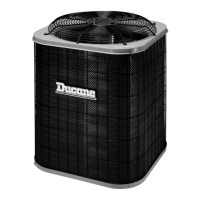
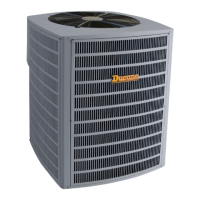
• Outdoor heat pump sections may accumulate frost
during certain operating conditions. It is not abnormal
for the coil to become completely white with frost
before the unit will defrost. Heat pumps are designed
to maintain energy savings by defrosting only at
optimum times when frost accumulation starts to
significantly increase energy consumption.
• Defrost cycles typically occur every 90 minutes of unit
run time, but can be adjusted to 30 or 60 minutes.
Defrost cycles will run until all frost is melted or for up
to 10 minutes before switching back into the heating
cycle automatically. Do not be alarmed if steam or fog
appears to be coming from the outdoor unit during the
defrost cycle. It is simply water vapor condensing into
a mist in the cold outside air.
20407502 ISSUE 0144 Page 7 of 8



 To Next Page