77
EN
Use and maintenance manual
TRANSPORT
Although they occupy useful space,
bicycles in the trunk are more
protected from dirt, shocks and
theft. If you transport your bicycle
on an external bicycle rack, follow
the instructions concerning the
“characteristics of carbon”, which
can be found in the paragraph with
the same name of this manual.
If you need to remove the wheels
of the bicycle to put it in the trunk
of the vehicle, there is some
information below on the correct
procedures to follow to remove
both wheels and the necessary
precautions.
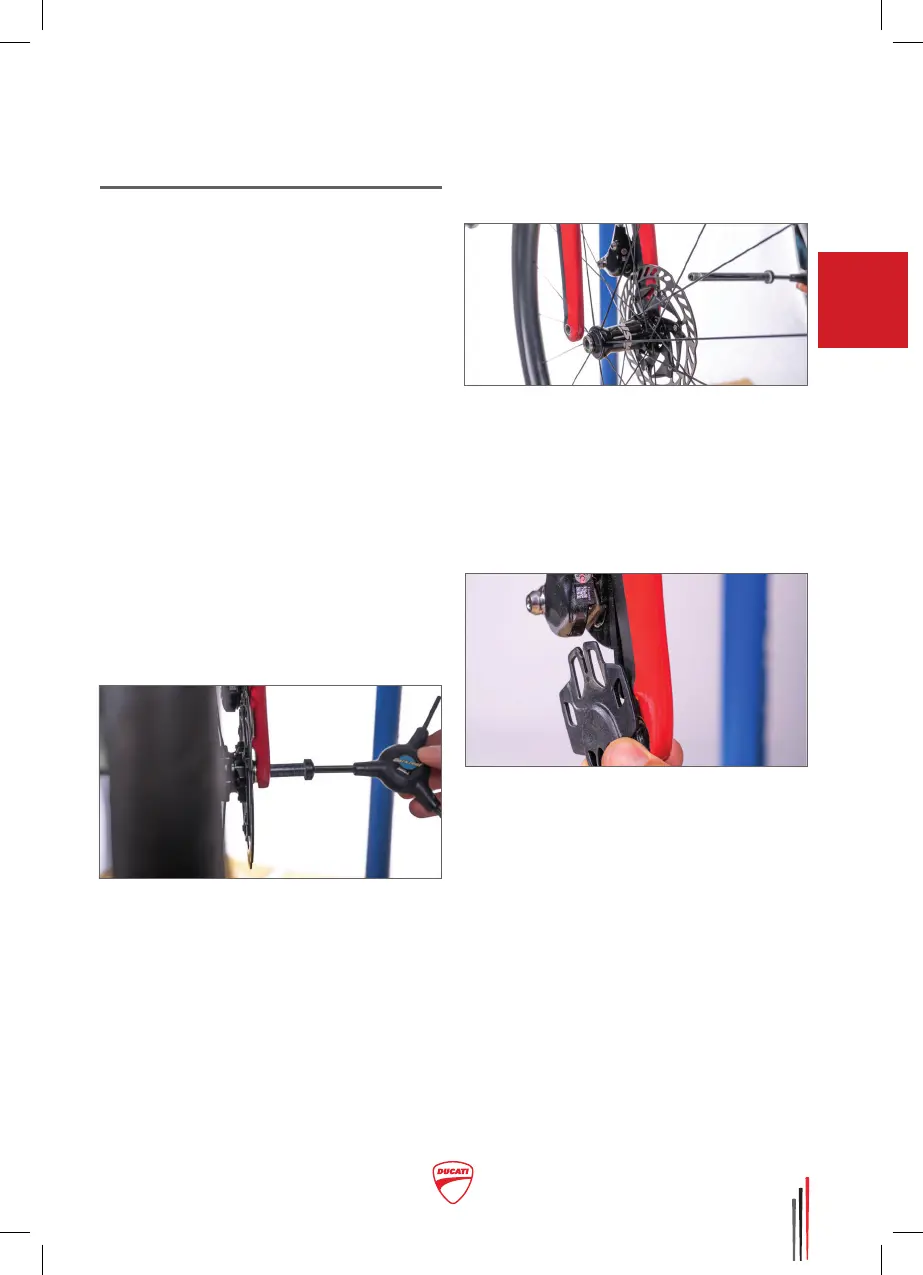
– Removing the front wheel:
To remove the front wheel, the bicycle
needs to be, rst and foremost, in
a steady position, on a work stand
or standing upside down, with the
saddle and the handlebar on the
ground (we recommend laying a rag
on the ground to avoid damaging or
scratching the saddle, commands or
the handlebar). First unscrew the axle
of the wheel counterclockwise using a
suitable Allen wrench.
Continue by removing the axle and
then the wheel, making sure you do
not bend the brake disc. Careful, do
not press the brake lever if the wheel
has been removed.
Once the wheel is removed, position a
spacer between the pads of the brake
calliper, to prevent the pistons from
coming out or getting stuck while
being transported and preventing the
wheel from being inserted again.
To position the bicycle during
transport, remember that you must
never set the wheel on the side of the
disc, to prevent any deformation of the
disc during transport. If possible, put a
protective panel under the fork to
avoid damage while in contact with
the contact surface.



 To Next Page