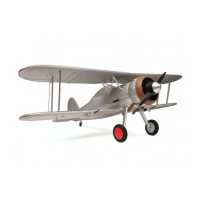
The Durafly Gloster Gladiator Mk1 is a 1100mm Plug and Fly (PNF) radio-controlled biplane fighter model, replicating the iconic British aircraft used by the Royal Air Force and Fleet Air Arm in the late 1930s. It represents the RAF's last biplane fighter and the first to feature an enclosed cockpit. This particular model is a replica of the Shuttleworth Collection's Gloster Gladiator Mk1 "K9785," which is believed to be the only airworthy example flying today, bearing the markings of No. 73 Squadron from its operations at RAF Mildenhall between 1937 and 1938.
Function Description:
The Durafly Gloster Gladiator Mk1 is designed for hobbyists who enjoy assembling and flying scale model aircraft. As a PNF model, it comes with the airframe, motor, ESC, and servos pre-installed, requiring additional components like a receiver, transmitter, and battery to be flight-ready. The model is crafted from strong EPO foam and features a high level of detail, including a blistered cowl, scale exhausts, streamlined landing gear with scale wheels, ribbed wings and tail, and a stringered fuselage to depict a fabric-covered airframe. It also includes blistered machine gun housings, enhancing its scale appearance. The model is capable of performing a full "airshow" routine, including loops, rolls, low banked passes, Split-S's, flick rolls, inverted flight, and knife-edge maneuvers, making it suitable for both scale flying and as a sports flyer.
Important Technical Specifications:
- Wingspan: 1100mm (43.3")
- Length: 938mm (36.9”)
- Flying weight: 1600g (56.4 oz)
- Motor: 3719-770KV brushless outrunner
- ESC: Aerostar 40amp with BEC
- Servos: 4 x 9g digital
- Propeller: 2 blade 11x7
- Recommended Battery (not supplied): 2200mAh 4S 30C or more LiPo
- Channels Required: 4-6 channels
- Center of Gravity (CG): Approximately 88mm from the leading edge of the upper wing.
- Control Throws (from neutral):
- Elevator: Low rates: 5mm, High rates: 8mm (either direction)
- Rudder: Low rates: 7mm, High rates: 12mm (either direction)
- Aileron: Low rates: 8mm, High rates: 15mm (either direction)
Usage Features:
- Assembly: The model features reinforced foam hinges that need to be flexed before assembly to reduce tension. Assembly involves securing the landing gear, dummy exhausts, air-scoop, horizontal stabilizer, elevator, and wings. Control surface linkages are connected to pre-installed servos. The spinner and propeller are the final components to be fitted. Decals are recommended to be applied before full assembly for ease.
- Radio System: Requires a 4-6 channel radio system. Recommended components include the OrangeRx Tx6i 6ch 2.4GHz DSMX Compatible Radio System and the OrangeRx R620X V3 6Ch 2.4GHz DSMX/s.Link Compatible Full Range Receiver.
- Battery: A 2200mAh 4S 30C (or higher) LiPo battery is recommended. Proper battery placement is crucial for achieving the correct CG, which is approximately 88mm from the leading edge of the upper wing. A foam block is supplied to retain the battery securely.
- Flight Performance: The Gloster Gladiator Mk1 is noted for its excellent handling characteristics. For scale flying, about 50% throttle is generally sufficient, but full power allows for impressive vertical maneuvers and advanced aerobatics. The model has a benign stall, making it easy to recover from at height.
- Take-off: Requires holding some right rudder to counteract rotational torque and gentle use of throttle with a little up elevator to keep the tail down. As speed builds, ease off the elevator until the model gently lifts off. High rates on the elevator are recommended for taxiing and landing to prevent nosing over.
- Landing: Designed for "scale" type approaches with a powered descent and a 3-point landing. Maintaining a small amount of power on approach helps overcome drag. Round out and flare just above the ground, then reduce power and flick to high elevator rates as the model slows down to achieve a 3-point landing.
- Rigging and Flying Wires: The model includes rigging and flying wires for enhanced scale realism. These are optional and not essential for flight. If the model needs to be dismantled for transport, it is not recommended to fit them. Instructions for installation are provided, detailing the connection points on the fuselage struts, lower and upper wing fittings, and vertical/horizontal fins. An optional stabilizing tube for the flying wires is mentioned but not supplied.
Maintenance Features:
- Pre-flight Checks: Before each flight, it is essential to perform a range check of the radio system, ensure all screws, bolts, and mounting points are secure, and verify that both the radio and model batteries are fully charged. All control surfaces should move freely and in the correct directions without binding. Inspect the model and propeller for any damage and listen for unusual sounds from the electronics. Confirm propeller rotation is correct.
- Propeller Inspection: The propeller should be inspected frequently, especially after hard landings or impacts. Any damaged propeller must be replaced, and loose fixings tightened.
- Wiring Management: Keep all leads within the fuselage tidy to allow for easier access to internal components, improve battery installation, increase airflow around electronics, and reduce potential electronic signal interference.
- Battery Security: Ensure the flight battery is as far forward as possible and secured with the supplied foam block to maintain the correct CG.
- Decal Application: Decals are vinyl type with a clear adhesive fronting film. Careful application is required, involving studying the scheme, positioning, gently rubbing from the center outwards to avoid wrinkles and air bubbles, and slowly removing the clear protective film sideways. Air bubbles can be pricked with a sharp blade and rubbed out. Finally, sealing the decals to the foam surface with a low-temperature covering iron (covered with a sock) is recommended to prevent lifting.
- Storage: Avoid leaving the model in direct sunlight or a hot car for prolonged periods, as this can adversely affect the foam surface.
- Troubleshooting: A dedicated section provides solutions for common issues such as the motor not turning (battery, transmitter battery, motor connection, damaged motor, receiver not bound, ESC in set-up mode), model moving backwards (propeller installed backwards), control surfaces not moving (servo lead connection, damaged servo), model not flying straight (control surfaces not centered, incorrect CoG), model not climbing well (battery not charged, elevator servo reversed, CoG too far backwards), and limited radio range (transmitter/receiver batteries flat).
The Durafly Gloster Gladiator Mk1 is a sophisticated hobby product and not a toy, requiring caution, common sense, and basic mechanical ability for safe operation. It is recommended for users aged 14 and above, with adult supervision for children. The manufacturer emphasizes that the user is responsible for operating the product safely and accepts no responsibility for damage or injury caused by its use.

 Need help?


 To Next Page
 General