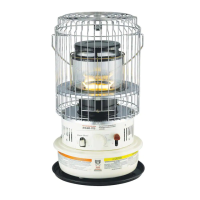
This document serves as the owner's manual for a portable kerosene heater, specifically the DuraHeat DH 1051 model. It provides comprehensive instructions for safe and efficient operation, assembly, and maintenance of the device.
Function Description
The DuraHeat DH 1051 is a portable kerosene heater designed for convection heating. It utilizes 1-K kerosene as its fuel source to produce heat. The heater is equipped with an automatic ignition system, powered by two "C" cell batteries, which lights the wick when raised to its maximum height. In case of ignition system failure or dead batteries, the heater can also be lit manually with a match. A key safety feature is the automatic safety shut-off device, which quickly extinguishes the flame if the heater is jarred or tipped over during operation. This mechanism is crucial for preventing fires and is built into the wick raising and lowering system. The heater also includes a fuel gauge to monitor kerosene levels and a manual shut-off knob for extinguishing the flame.
Usage Features
The manual emphasizes several critical usage features to ensure safety and optimal performance. When fueling the heater, it is imperative to use only water-clear 1-K kerosene and to perform this operation outdoors, away from living spaces and combustible materials. The manual explicitly warns against using gasoline, benzene, paint thinners, or other volatile fuels, as this can lead to flare-ups, explosions, and destructive fires. Kerosene should always be stored in a blue container labeled "KEROSENE," never in a red container associated with gasoline. After fueling, especially when the tank has been completely empty, the wick must be allowed to soak for a minimum of 60 minutes before attempting to light the heater to prevent poor burning and wick damage.
Upon first ignition, a slight odor may be present due to the burning off of manufacturing oils; burning the heater outdoors on a calm day or in a well-ventilated area is recommended to disperse this odor. Once lit, the flame height needs to be adjusted using the wick adjuster knob to a 1/2" flame above the center flame spreader disk for proper combustion. This adjustment is crucial, as operating the heater with a flame that is too high can produce smoke and soot, while a flame that is too low can generate odor and carbon monoxide. The manual stresses that the heater is either on or off, and room temperature cannot be adjusted by lowering the wick, which would lead to improper combustion. Instead, if a room becomes too hot, users should open a door or window or turn off the heater.
The heater should never be operated unattended, especially when leaving the room or going to bed. It is also important to keep children, clothing, furniture, and other combustible objects at least 36 inches away from the top and front of the heater due to high surface temperatures. The heater should not be used in small, unventilated rooms or bathrooms, and adequate fresh air supply is necessary to prevent indoor air pollution and carbon monoxide buildup. Users with respiratory problems are advised to consult a physician before using the heater. After extinguishing the heater, a 10-15 second visual check is recommended to confirm the flame is completely out, and a 10-minute cooling period is necessary before reigniting to avoid strong odors and flare-ups.
Maintenance Features
Regular maintenance is vital for the safe and efficient operation of the DuraHeat DH 1051. Wick maintenance, specifically "dry burning" and carbon removal, is necessary to prevent soot production, low heat output, and performance issues. Carbon and tar accumulate on the wick during regular use, making it hard to light, difficult to adjust, and preventing complete extinguishment. Dry burning should be performed within seven days of first use, after every two tankfuls of fuel, or weekly during the heating season, and anytime the wick feels hard and brittle. This process involves burning the heater dry until the flame extinguishes, then re-lighting and burning out again, followed by brushing off any ash from the wick. If the wick still feels hard, small pliers can be used to break up carbon deposits. Contaminated fuel can also harden the wick, requiring fuel tank cleaning and wick replacement.
The manual also provides instructions for checking and replacing the igniter plug if the automatic ignition system fails. This involves removing batteries, guard brackets, and the burner chamber to access and replace the igniter plug. When replacing the wick, specific steps are outlined, including disassembling parts of the heater, carefully removing the old wick, and installing a new, genuine replacement wick, ensuring it adheres tightly and is properly aligned. After any wick removal or replacement, the automatic safety shut-off device must be tested to ensure it functions correctly. This safety device should also be checked weekly during the heating season by raising the wick and giving the heater a firm shake to confirm the wick drops to its fully lowered position.
For long-term storage, the heater should be prepared by emptying and rinsing the fuel tank with a small amount of kerosene (never water), burning the wick dry, removing batteries, and thoroughly cleaning any carbon, tar, or soot from the wick adjuster, wick guide, and burner. The heater should be stored with the wick in the fully lowered position and the safety shut-off device deactivated, preferably in its original box in a well-ventilated area, along with the owner's manual. These maintenance practices are crucial for extending the heater's lifespan and ensuring safe operation in subsequent seasons.


 To Next Page
 General