2
SPECIAL FEATURES
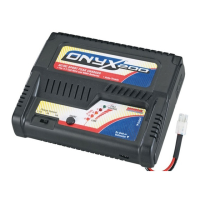
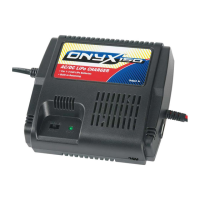
• A tiny built-in switching AC power supply is great for portability and cramped pit areas, yet can still deliver up to 5 amps
charge current!
• Fully adjustable charge currents and NiCd and NiMH fl exibility for a wide range of applications.
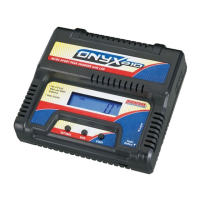
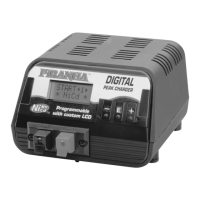
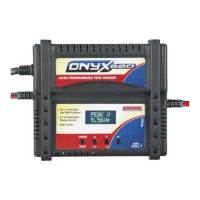
• Includes a custom reversed LCD with backlight – previously only available in expensive racing chargers! Great for
easy viewing in any condition. Shows input and output voltages, peak voltage, charge current, charge capacity and
time, and more!
• A unique jack is built-in for charging 4 or 5 cell NiCd or NiMH receiver batteries for nitro models, and even 8-cell
transmitter batteries.
• Push button controls and audible tones make for easy setup and control.
• A peak detection system with automatic trickle charge fi lls packs completely, for optimum battery voltage and run-
time. 3 to 20mV adjustable peak detection helps to customize charger-to-battery performance.
• A DC power lead with alligator clips easily connects to many 12V DC power sources.
• Solid-state reverse polarity and current overload safety devices ensure trouble-free operation and long duration.
IMPORTANT PRECAUTIONS
Disconnect the battery and remove input power from the charger immediately if the charger becomes hot!!
• Do not attempt to charge incompatible types of rechargeable batteries as permanent damage to the battery and
charger could result.
• Do not use automotive type battery chargers to power the charger.
• Do not allow water, moisture or foreign objects into the charger.
• Do not block the air intake holes, which could cause the charger to overheat.
• Do not attempt to use batteries with more cells or total voltage than listed in the specifi cations.
• Do not overcharge batteries as permanent damage could result. Do not use a charge current that exceeds the safe
level of the battery.
• Do not leave the charger unattended while in use.
• Do not place the charger or battery on fl ammable surfaces or near combustible materials while in use, such as carpets,
a cluttered workbench, paper, plastic, vinyl, leather, and wood, inside an R/C model or full sized automobile!
• Do not connect the charger to AC and DC input power at the same time.
• Allow the charger or battery to cool down before reconnecting.
• Always disconnect from power source when not in use.
GLOSSARY OF TERMS
Amps (A): The unit of measure for charge current.
Milli-amps (mA): A unit of measure for current, being amps (A) multiplied by 1000 and listed as “mA”. So 2.5A is the
same as 2500mA (2.5 x 1000). Or, to convert mA to amps, divide the mA number by 1000. So 25mA is the same as
0.025A (25 divided by 1000).
Capacity and milli-amp hours (mAh): The amount of energy a battery can store is called its capacity, which is defi ned
as how much current a battery can supply constantly over one hour of time. Most hobby batteries are rated for capacity
in “mAh” or milli-amp hours. A 650mAh battery can deliver 650mA of current for one hour (650mA x 1hr = 650mAh).
A 3200mAh battery can deliver 3200mA (3.2A) of current for one hour (3200mA x 1hr = 3200mAh), etc.
“C” rating: Capacity is also referred to as the “C” rating. Some battery suppliers recommend charge currents based on
the battery’s “C” rating. A battery’s “1C” current is the same number as the battery’s rated capacity number, but noted
in mA or amps. A 600mAh battery has a 1C current value of 600mA, and a 3C current value of (3 x 600mA) 1800mA or
1.8A. The 1C current value for a 3200mAh battery would be 3200mA (3.2A), etc.


 To Next Page