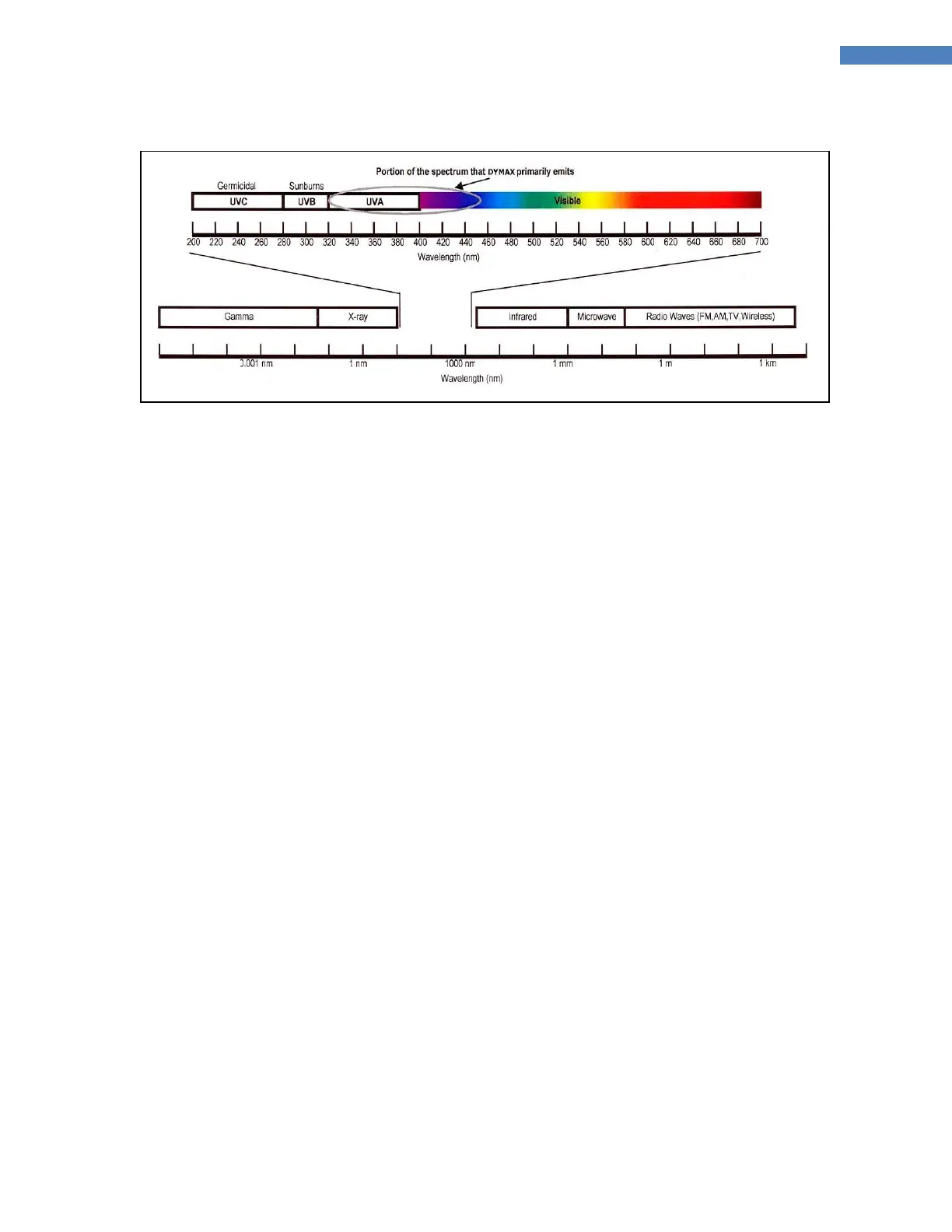
Figure 1. Spectrum of Light
Shield the Operator
UV-Blocking Eye Protection – UV-blocking eye protection is recommended when operating UV-curing
systems. Both clear and tinted UV-blocking eye protection is available from Dymax.
UV-Blocking Skin Protection – Where the potential exists for UV exposure upon skin, opaque, UV-blocking
clothing, gloves, and full-face shields are recommended.
Shield the Source of UV Light
Any substrate that blocks UV light can be used as a shield to protect workers from stray UV light. The
following materials can be used to create simple shielding structures:
Sheet Metal – Aluminum, steel, stainless steel, etc. Sheet metal should be coated black or black anodized to
minimize reflection of UV and visible light toward operators.
Rigid Plastic Film – Transparent or translucent, UV-blocking plastics (typically polycarbonate or acrylic) are
commonly used to create shielding where some level of transparency is also desired.
Flexible Film – Translucent UV-blocking, flexible urethane films can be used to quickly create workstation
shielding. This UV-blocking, flexible urethane film is available from Dymax.
High-Temperature Surfaces
Surfaces exposed to high-intensity curing lights will rise in temperature. The intensity, distance, exposure
time, cooling fans, and the type/color of the surface can all affect the actual rise in surface temperature. In
some cases, exposed surfaces can reach temperatures capable of producing a burn or causing damage to a
substrate. In these cases, care must be taken to ensure either a more moderate surface temperature or
appropriate protection/training for operators.
Ozone
Standard Dymax bulbs (UVA type) generate an insignificant amount of UVC and therefore essentially no
ozone. Some UV light-curing systems, like those used to cure UV inks, emit primarily “shortwave” (UVB and
UVC) energy. Upon exposure to UVC energy (specifically <240 nm), oxygen molecules (O
2
) split into oxygen



 To Next Page