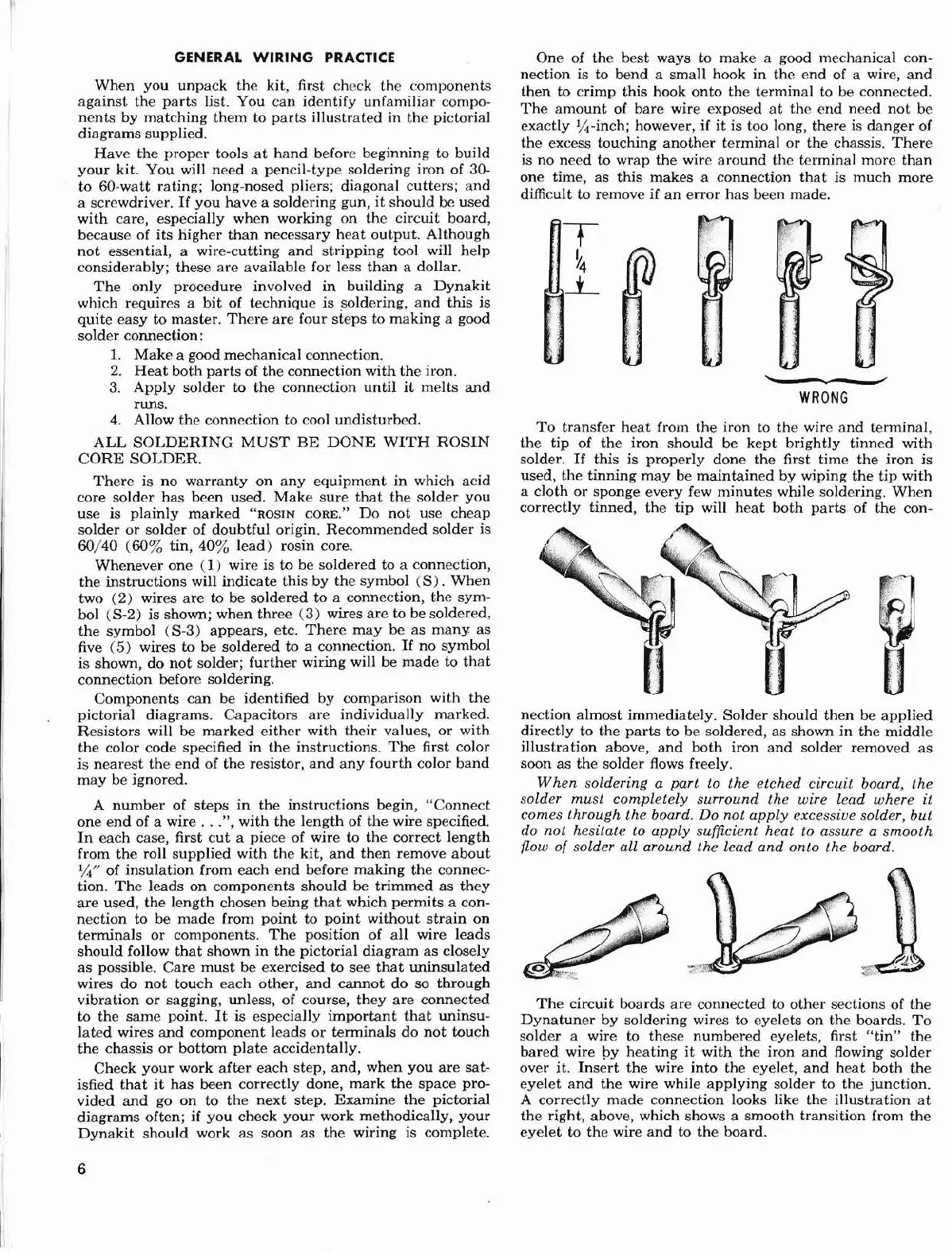
nection
almost
immediately.
Solder
should
then
be
applied
directly
to
the
parts
to
be soldered,
as
shown
in
the
middle
illustration
above,
and
both
iron
and
solder
removed
as
soon
as
the
solder flows freely.
When
soldering a part to the
etched
circuit board, the
solder
must
completely
surround the wire lead where it
comes through the board. Do not
apply
excessive solder, but
do not hesitate to
apply
sufficient heat to assure a
smooth
(low of solder all around the lead
and
onto the board.
, i
WRONG
One of
the
best
ways
to
make
a good mechanical con-
nection
is to
bend
a small
hook
in
the
end
of a wire,
and
then
to
crimp
this
hook
onto
the
terminal
to be connected.
The
amount
of
bare
wire exposed
at
the
end
need
not
be
exactly
11i-inch; however, if
it
is too long,
there
is
danger
of
the
excess touching
another
terminal
or
the
chassis.
There
is no
need
to
wrap
the
wire
around
the
terminal
more
than
one time,
as
this
makes
a
connection
that
is
much
more
difficult to remove
if
an
error
has
been made.
To
transfer
heat
from
the
iron to
the
wire
and
terminal,
the
tip of
the
iron
should
be
kept
brightly
tinned
with
solder.
If
this is
properly
done
the
first
time
the
iron
is
used, the
tinning
may
be
maintained
by
wiping
the
tip
with
a cloth
or
sponge
every
few
minutes
while soldering.
When
correctly
tinned,
the
tip
will
heat
both
parts
of
the
con-
The
circuit
boards
are
connected to
other
sections of
the
Dynatuner
by
soldering wires
to
eyelets
on
the
boards.
To
solder
a wire to
these
numbered
eyelets, first
"tin"
the
bared
wire
py
heating
it
with
the iron
and
flowing solder
over it.
Insert
the
wire into the eyelet,
and
heat
both
the
eyelet
and
the
wire while
applying
solder to
the
junction.
A
correctly
made
connection looks like
the
illustration
at
the
right, above, which shows a
smooth
transition
from
the
eyelet
to
the
wire
and
to
the
board.
GENERAL
WIRING
PRACTICE
When
you
unpack
the
kit, first check
the
components
against
the
parts
list. You
can
identify
unfamiliar
compo-
nents
by
matching
them
to
parts
illustrated
in the pictorial
diagrams
supplied.
Have
the
proper
tools
at
hand
before beginning
to
build
your
kit.
You
will
need
a
pencil-type
soldering iron of 30-
to
60-watt rating; long-nosed pliers; diagonal
cutters;
and
a screwdriver.
If
you
have
a soldering gun,
it
should
be
used
with
care, especially when working
on
the
circuit
board,
because of its
higher
than
necessary
heat
output.
Although
not
essential, a wire-cutting
and
stripping
tool will
help
considerably;
these
are
available
for less
than
a dollar.
The
only
procedure
involved
in
building a
Dynakit
which
requires
a
bit
of technique
is
soldering,
and
this
is
quite
easy
to
master.
There
are
four
steps
to
making
a good
solder
cOTU1ection:
1.
Make
a good
mechanical
connection.
2.
Heat
both
parts
of
the
connection
with
the
iron.
3.
Apply
solder
to
the
connection
until
it
melts
and
runs.
4. Allow
the
connection
to coo)
undisturbed.
ALL
SOLDERING
MUST
BE
DONE
WITH
ROSIN
CORE
SOLDER.
There
is
no
warranty
on
any
equipment
in
which acid
core solder
has
been
used.
Make
Sure
that
the
solder
you
use is
plainly
marked
"ROSIN
CORE."
Do
not
use
cheap
solder
or
solder
of
doubtful
origin.
Recommended
solder
is
60/40
(60%
tin,
40%
lead)
rosin core.
Whenever
one
(1)
wire
is
to
be
soldered
to a connection,
the
instructions
will
indicate
this
by
the
symbol
(S).
When
two
(2)
wires
are
to
be
soldered
to
a connection,
the
sym-
bol (S-2) is shown;
when
three
(3)
wires
are
to be soldered,
the
symbol
(S-3)
appears,
etc.
There
may
be
as
many
as
five
(5)
wires
to
be
soldered
to a connection.
If
no
symbol
is shown,
do
not
solder;
further
wiring will be
made
to
that
cOTU1ection
before soldering.
Components
can
be identified by comparison
with
the
pictorial diagrams.
Capacitors
are
individually
marked.
Resistors
will be
marked
either
with
their
values,
or
with
the color code specified
in
the
instructions.
The
first color
is
nearest
the
end
of
the
resistor,
and
any
fourth color
band
may
be ignored.
A
number
of
steps
in
the
instructions
begin,
"Connect
one
end
of a wire
...
",
with
the
length
of
the
wire specified.
In
each
case, first
cut
a piece of wire to
the
correct
length
from
the
roll
supplied
with
the
kit,
and
then
remove
about
114/1
of
insulation
from
each
end
before
making
the
connec-
tion.
The
leads
on
components
should
be
trimmed
as
they
are
used,
the
length
chosen being
that
which
permits
a con-
nection to be
made
from
point
to
point
without
strain
on
terminals
or
components.
The
position of
all
wire
leads
should
follow
that
shown
in
the
pictorial
diagram
as
closely
as
possible.
Care
must
be exercised to see
that
uninsulated
wires
do
not
touch
each
other,
and
cannot
do
so
through
vibration
or
sagging, unless, of course,
they
are
cOTU1ected
to
the
same
point.
It
is especially
important
that
uninsu-
lated
wires
and
component
leads
or
terminals
do
not
touch
the
chassis
or
bottom
plate
accidentally.
Check
your
work
after
each
step,
and,
when
you
are
sat-
isfied
that
it
has
been correctly done,
mark
the
space
pro-
vided
and
go
on
to
the
next
step.
Examine
the
pictorial
diagrams
often; if
you
check
your
work methodically,
your
Dynakit
should
work
as
soon
as
the
wiring is complete.
6


 To Next Page
 Loading...