EasyManua.ls Logo

Dyna FM-3 - Page 8

Dyna FM-3
32 pages
Print Icon
To Next Page IconTo Next Page
To Previous Page IconTo Previous Page
Loading...
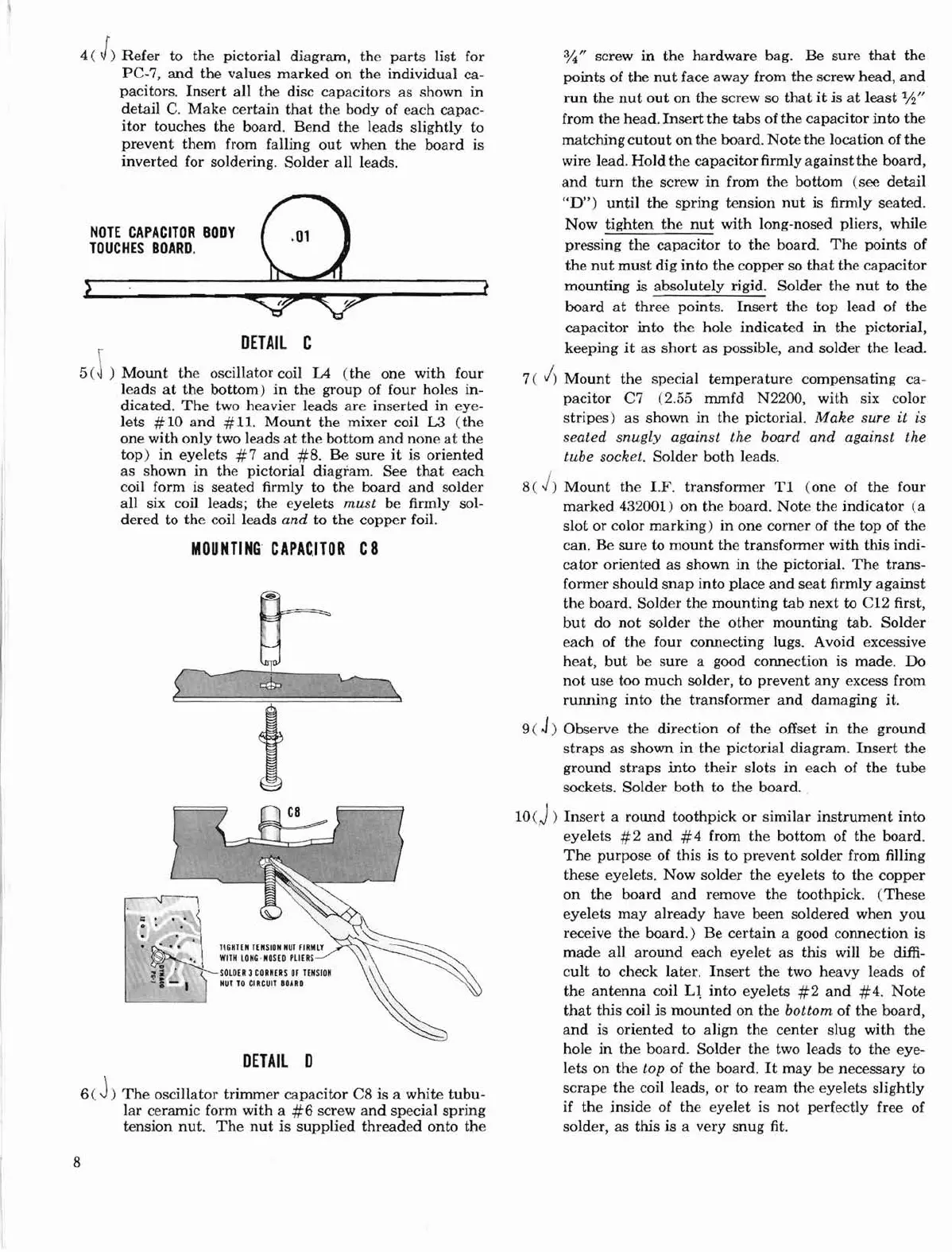
TlGHTlN
HNSION
NUl
fiRMLY
WITH
LONG·NOHO
PurRS
SOLO£R
3
CORNUS
OF
HN510H
NUl
TO
CIRCUIT
aouo
MOUNTING
CAPAC.lTOR
C8
%" screw
in
the
hardware
bag.
Be
sure
that
the
points
of
the
nut
face
away
from
the
screw
head,
and
run
the
nut
out
on
the
screw so
that
it
is
at
least
1;2"
from
the
head.
Insert
the
tabs
of
the
capacitor
into
the
matching
cutout
on
the
board.
Note
the
location of
the
wire lead.
Hold
the
capacitor
firmly
against
the
board,
and
turn
the
screw
in
from
the
bottom
(see
detail
"D")
until
the
spring
tension
nut
is firmly seated.
Now
tighten
the
nut
with
long-nosed pliers, while
pressing
the
capacitor
to
the
board.
The
points
of
the
nut
must
dig
into
the
copper
so
that
the
capacitor
mounting
is
absolutely
rigid.
Solder
the
nut
to
the
board
at
three
points.
Insert
the
top
lead
of
the
capacitor
into
the
hole
indicated
in
the
pictorial,
keeping
it
as
short
as
possible,
and
solder
the
lead.
7 (
j)
Mount
the
special
temperature
compensating
ca-
pacitor
C7 (2.55
nunfd
N2200,
with
six color
stripes)
as
shown
in
the
pictorial.
Make
sure
it
is
seated
snugly
against
the
board
and
against the
tube socket.
Solder
both
leads.
8 (
J)
Mount
the
I.F.
transformer
Tl
(one
of
the
four
marked
432001)
on
the
board.
Note
the
indicator
(a
slot
or
color
marking)
in
one
corner of
the
top of
the
can.
Be
sure
to
mount
the
transformer
with
this
indi-
cator
oriented
as
shown
in
the
pictorial.
The
trans-
former
should
snap
into
place
and
seat
firmly
against
the
board.
Solder
the
mounting
tab
next
to C12 first,
but
do
not
solder
the
other
mounting
tab.
Solder
each of
the
four
cormecting lugs. Avoid excessive
heat,
but
be
sure
a good connection
is
made.
Do
not
use too
much
solder, to
prevent
any
excess from
running
into
the
transformer
and
damaging
it.
g ( ,}) Observe
the
direction
of
the
offset
in
the
ground
straps
as
shown
in
the
pictorial
diagram.
Insert
the
ground
straps
into
their
slots
in
each
of
the
tube
sockets.
Solder
both
to
the
board
..
W() )
Insert
a
round
toothpick
or
similar
instrument
into
eyelets
#2
and
#4
from
the
bottom
of
the
board.
The
purpose
of this is
to
prevent
solder
from filling
these eyelets. Now
solder
the
eyelets
to
the
copper
on
the
board
and
remove
the
toothpick.
(These
eyelets
may
already
have
been
soldered
when
you
receive
the
board.)
Be
certain
a good
connection
is
made
all
around
each
eyelet
as
this will be diffi-
cult
to
check later.
Insert
the
two
heavy
leads
of
the
antenna
coil
L\
into
eyelets
#2
and
#4.
Note
that
this coil
is
mounted
on
the
bottom
of
the
board,
and
is
oriented
to
align
the
center
slug
with
the
hole
in
the
board.
Solder
the
two leads
to
the
eye-
lets
on
the
top of the board.
It
may
be
necessary
to
scrape
the
coil leads,
or
to ream
the
eyelets
slightly
if
the
inside
of
the
eyelet
is
not
perfectly
free of
solder,
as
this is a
very
snug
fit.
t
fJ
.
'~
c:
,
4 (
J)
Refer
to
the
pictorial
diagram,
the
parts
list for
PC-7,
and
the
values
marked
on
the
individual
ca-
pacitors.
Insert
all the disc
capacitors
as
shown in
detail
C.
Make
certain
that
the
body
of
each
capac-
itor
touches
the
board.
Bend
the
leads
slightly
to
prevent
them
from falling
out
when
the
board
is
inverted
for soldering.
Solder
all leads.
NOTE
CAPACITOR
BODY
TOUCHES
BOARD.
DETAIL
D
6(
J)
The
oscillator
trimmer
capacitor
C8 is a white
tubu-
lar
ceramic form
with
a
#6
screw
and
special
spring
tension
nut.
The
nut
is
supplied
threaded
onto
the
DETAIL
C
5
(I
)
Mount
the
oscillator coil
lA
(the
one
with
four
leads
at
the
bottom)
in
the
group
of four holes in-
dicated.
The
two
heavier
leads
are
inserted
in eye-
lets
#10
and
#11.
Mount
the
mixer coil 1.3
(the
one
with
only two leads
at
the
bottom
and
none
at
the
top)
in
eyelets
#7
and
#8.
Be
sure
it
is
oriented
as
shown
in
the
pictorial
diagram.
See
that
each
coil form is
seated
firmly
to
the
board
and
solder
all six coil leads;
the
eyelets
must
be firmly sol-
dered
to
the
coil
leads
and
to
the
copper
foil.
8