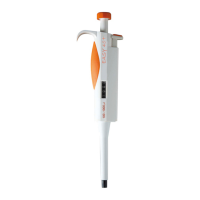
B. Reverse Pipetting
1. Press the operating button to the second stop.
2. Dip the tip attached to the pipette into the solution to a depth of
about 1cm, and slowly release the operating button. This action will fill
the tip with a volume that is larger than the set volume. Wait 1-2
seconds and withdraw the tip from the liquid, touching it against the
edge of the reservoir to remove excess liquid.
3. Disperse the liquid into the receiving vessel by pressing the
operating button gently and steadily to the first stop. This volume is
equal to the set volume. Hold button in this position. Some liquid will remain in the tip, which should
not be dispensed.
4. The liquid remaining in the tip can be dispensed back into the original solution by pressing the
button to the second stop or disposed together with the tip.
5. Release the operating button to the ready position.
Note : Reverse pipetting technique is recommended for viscous solutions, solutions having tendency
to foam or for dispensing very small volumes.
5. Pipetting Recommendations
• Aspirate liquid into the pipette only when a tip is attached to its tipcone.
• Allow liquids, tips, and pipettes to equilibrate to the ambient temperature.
• Pre-rinsing of tip 5 times with the liquid to be dispensed is recommended. This is important
especially when dispensing liquids which have a viscosity and density different from water.
• Pre-rinse the tip several times before use
• when pipetting liquids at temperature different from ambient.
• While pipetting, the pipettor should be
• vertically straight and tip should be dipped only a few millimeters into the liquid.
• Always control the push button movements
• with the thumb for consistency.
• Wipe the tip only if there is liquid on the outside of the tip, being careful to avoid touching
the tip’s orifice.
• Don't keep the pipette in your hand while not working, to avoid transferring to body heat.
Use the correct pipette tip designed for use with the pipette.
• Select the correct pipetting technique (e.g. Reverse, forward etc.) depending on the nature
of the liquid.
• Using excessive force to turn the push button outside the range specified for it may jam the
mechanism and damage the pipettor.


 To Next Page
 Loading...