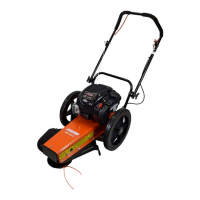
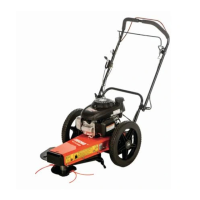
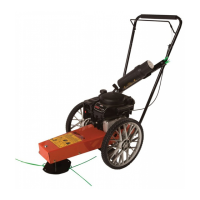
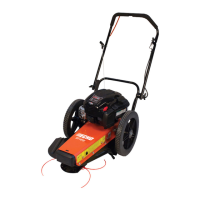
This document is the operator's manual for the ECHO WT-1610T Wheeled Trimmer, a piece of outdoor power equipment designed for trimming, mowing, and edging. The manual provides essential information for safe operation, assembly, maintenance, and troubleshooting.
The primary function of the ECHO WT-1610T Wheeled Trimmer is to cut grass and vegetation using a rotating trimmer disk equipped with cutting string. Unlike handheld trimmers, this unit is wheeled, allowing for easier maneuverability over larger areas and reducing operator fatigue. The design emphasizes user control and safety, with features aimed at making trimming tasks more efficient and less strenuous.
Key usage features of the WT-1610T include an adjustable handle bar, a trimmer bail for engaging and disengaging the trimmer disk, a recoil starter for the engine, and a tilt control handle. The handle bar can be adjusted to a desired position for comfortable operation and can also be folded down for hauling or storage, enhancing the unit's portability and storage convenience. The trimmer bail acts as a safety and operational control; lifting it starts the trimmer disk, and releasing it stops the disk. This ensures that the cutting mechanism is only active when the operator intends it to be, and allows for quick stops for inspection or servicing. The recoil starter is a standard pull-cord mechanism for initiating engine operation.
A notable feature of the WT-1610T is the Off Center Tilt (OCT) feature, which allows the trimmer head and body to tilt for trimming in hard-to-reach places or close to the ground. The degree of tilt can be adjusted using the height adjustment handle, offering four distinct settings: Level, 5.4 degrees, 10.3 degrees, and 13 degrees (maximum tilt). This versatility enables the operator to adapt the trimmer to various terrains and cutting requirements, improving efficiency and precision in challenging areas.
For optimal trimming performance, the manual recommends running the unit at full operating speed before starting to trim, mow, or edge. When trimming, the trimmer head should be placed on the ground, and the operator should walk slowly, ensuring the wheels remain on the ground to prevent undue pressure on the trimmer head. The cutting radius is dependent on the type and amount of cutting string used, with less than the full cutting radius recommended for difficult conditions and edging. For large open areas, mowing in a counter-clockwise direction, working from the outside towards the center, is advised, as grass discharges to the right side of the trimmer.
Safety is paramount in the operation of the WT-1610T. The manual highlights several critical safety precautions. Operators must read and understand all provided literature before use, as failure to do so could result in serious injury. The machine should not be operated by children or in the vicinity of bystanders, who should be kept at least 50 feet away. Personal protective equipment, including safety glasses and hearing protection, must be worn at all times. Loose-fitted clothing should be avoided to prevent entanglement with moving parts. The unit should only be operated in daylight or good artificial light and never in an enclosed area due to the risk of carbon monoxide poisoning. Fuel handling requires extreme caution, emphasizing the use of approved containers, refueling only a cool engine outdoors, and keeping away from open flames or sparks. The machine must never be operated without all shields in place, and all guards, deflectors, and shields must be in good working condition. A crucial operational safety note warns against operating the trimmer over an angle of 15 degrees, as higher angles may cause damage.
Maintenance features are detailed to ensure the longevity and efficient operation of the WT-1610T. A comprehensive maintenance schedule outlines regular checks and services for various components, including the air cleaner, engine oil, spark plug, fuel tank, nuts and bolts, cooling shrouds, belt, spark arrestor, entire machine, and starter drive. Engine maintenance is crucial, involving periodic cleaning to remove grass and buildup, and following the engine owner's manual for air filter cleaning and oil changes. The spark arrestor, if equipped, requires regular cleaning to prevent fire hazards.
The cutting height can be adjusted by flipping the trimmer head disk over, allowing for a reduction of approximately 3/4 inch (1.9 cm) from the standard 2-3/4 inch (7 cm) height. This adjustment involves removing the front cover, rotating the mow ball to align flat spots with the trimmer shaft opening, holding the trimmer shaft with a wrench, turning the mow ball counterclockwise to remove it, flipping the trimmer disk, and then reinstalling the mow ball by turning it clockwise.
Cutting string replacement is another key maintenance task. The manual specifies two thicknesses of cutting string: 155 mil (standard) and 175 mil (heavy duty), with the choice depending on cutting conditions. Various wrapping methods are illustrated, and a standard configuration involves feeding the string through specific holes on the trimmer head, leaving approximately 8 inches (20.3 cm) for the cutting surface, and ensuring the middle two strings are of even length. An optional method involves tying a knot in the middle of the string and inserting the loose ends through holes in the trimmer plate.
Drive belt checking, tensioning, and replacement are also covered. The drive belt should be inspected annually or after 20 hours of operation for cracks, fraying, or wear. Replacement involves shutting off the engine, disconnecting the spark plug wire, removing the front cover, loosening bolts to allow spindle hub movement, removing the plate to expose the belt, installing a new belt, and then re-tensioning by moving the spindle hub forward and tightening the bolts. The manual provides a note on proper belt tension, warning that a belt that is too tight will damage bearings/spindle shaft/belt, while a loose belt will slip and cause premature failure. It also suggests that if the belt is slipping, the engine should be placed under load in thick grass.
Troubleshooting guidance is provided for common issues such as the trimmer disk not turning, slow or rough cutting, excessive power requirement or stalling, drive belt squealing or smoking, engine starting difficulties, engine running but dying or not accelerating properly, and the drive belt rolling or falling off pulleys. For each problem, possible causes and remedies are listed, ranging from replacing worn parts to cleaning components or adjusting settings.
Overall, the ECHO WT-1610T Wheeled Trimmer is presented as a robust and versatile tool for outdoor maintenance, with a strong emphasis on user safety, operational flexibility through features like the OCT, and detailed instructions for routine maintenance to ensure reliable performance.


 To Next Page
 General