6
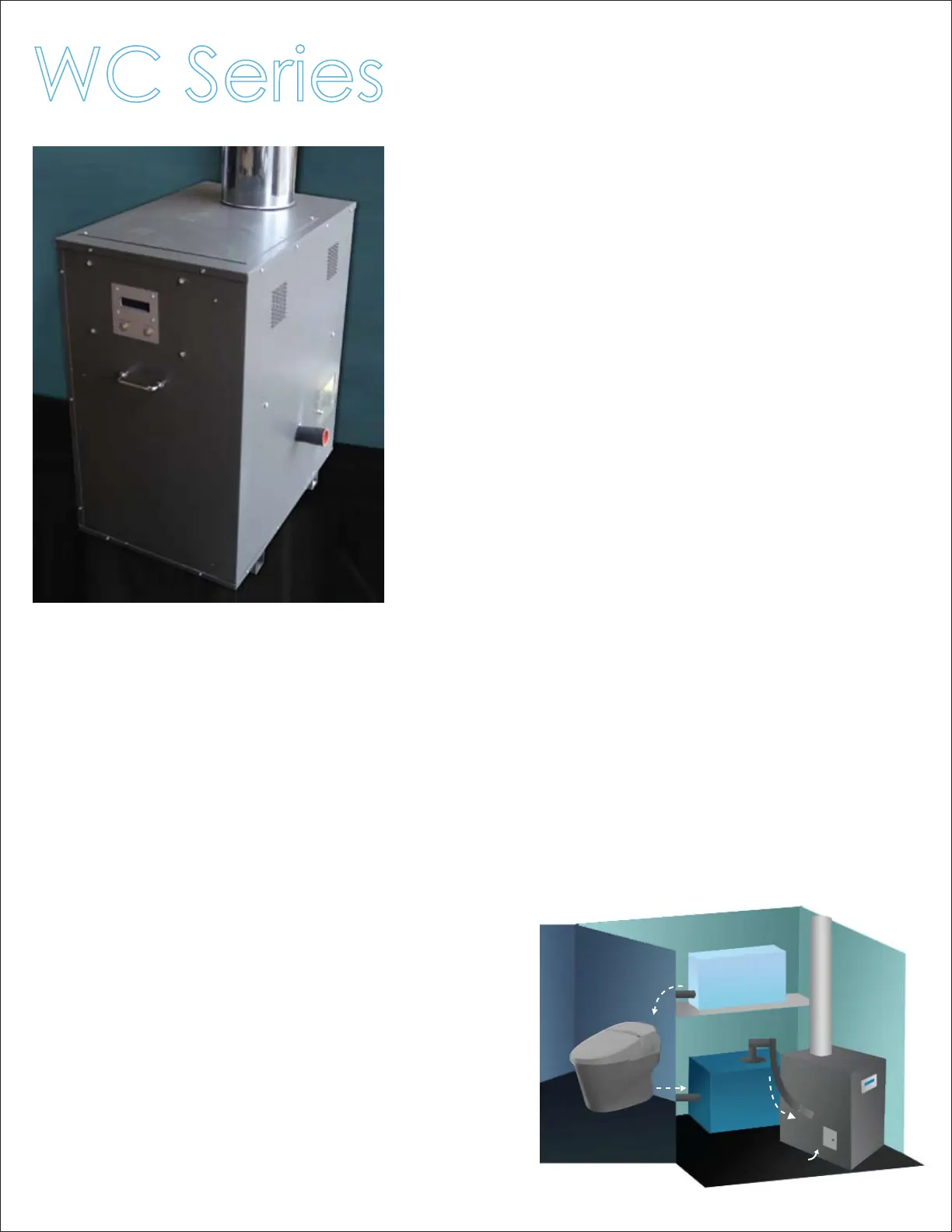
WC Series waste combustion system
Introduction
The WC Series consist of a wide range of incinerators in
different sizes and fuel sources. All products in the WC
Series incinerate waste and operate with low-flush toilets.
The WC5, WC12, WC32, and WC48 are all included in
the WC Series and use Propane, Natural Gas, or Diesel as
fuel source depending on model and size. The WC Series
are ideal in any remote application where a
conventional toilet is too expensive or difficult to install.
These incinerators along with a low flush toilet provide
ecological, economical, and logistical benefits as well as
eliminate costly and potential harmful environment
which is often associated with a standard pump out
process.
How the system works
After flushing the toilet, the low-flush toilet dissolves the
waste with the built in macerator pump before
Water Tank
Low-Flush
Toilet
Waste
Tank
Lid for
cleaning ashes
WC
transporting it into the waste holding tank. Only 0.3-0.5 gallons of water is being consumed. Inside
the holding tank, a sensor reads the level of the tank. Once a certain level has been reached, a
portioned amount of waste gets transferred by another waste pump into the WC incinerator (as
long as the system is set in automatic mode). The incineration process takes approximately 7
minutes until completed. If there is still waste in the waste tank, the pump will automatically
portion another batch of black water into the incinerator. This process is continuous for as long as
the sensor signals that waste is in the tank. Once the tank is empty, the WC models set itself in a
standby mode until the sensor signals that more black water in the holding tank and the
incineration process start over. WC Series may also be set in a manual mode; by doing so, one
can control the burn process manually and start and stop the incineration process if needed.
As shown in figure below, the WC incinerator is just one part of a complete WC system. In addition
to the incinerator, a water tank, a low-flush toilet with a macerator pump, a waste tank, fuel
(Propane, Natural Gas, or Diesel), and 12V DC or 120V AC are required.
A great advantage of installing this system is that
one can install multiple toilets to one system, which
makes the system more cost effective. It is also
possible to upgrade the size of the tanks if needed.
This is typically done when usage is higher.
By having larger water and fuel tanks,
refilling the tanks doesn’t need to be done
as frequently. By having a larger waste
holding tank, the max capacity of the
system increases. Larger or additional
WC incinerators can also be added to
the system to increase the amount of waste
burned per hour.
Click anywhere in the top portion of this page for updated/expanded articles on septic system design, inspection,
testing, maintenance, and repair online at InspectAPedia.com


 To Next Page
 Loading...