IV.
EARTH LOOP
WATER
PIPING
Since water is the
source of energy
in
the
wintertime
and
the
energy sink
in
the summertime,
good
water supply is
possibly
the most important requirement of a
geothermal
heat
pump
system installation. There are two common
types of water supplies,
closed
loop
systems
and
open
loop systems.
A.
Closed
Loop Applications
A closed loop
system
recirculates
the
same
water/antifreeze solution through a closed system of
underground high-density
polyethylene
pipe.
As the
solution
passes
through the
pipe,
it collects heat
(in
the
heathg mode)
that is being transferred
from
the
relatively
warm
surrounding soil through the
pipe
and into the
relatively cold solution. The solution is circulated to the
heat
pump,
which
pulls
heat out of the solution, and
then
back through the
ground
to extract more heat
from
the
earth.
The GeoSource 2000 is
designed
to operate on either
vertical
or
horizontal
closed
loop
applications.
Vertical
loops
are typically installed with a
well
drilling
rig up to
200 feet
deep or
more. Horizontal
systems
are typically
installed with excavating or trenching equipment
approximately
six to
eight
feet deep, depending on
geographic
location
and length ofpipe used.
Earth loops
must be
sized
properly
for
each
particular geographic
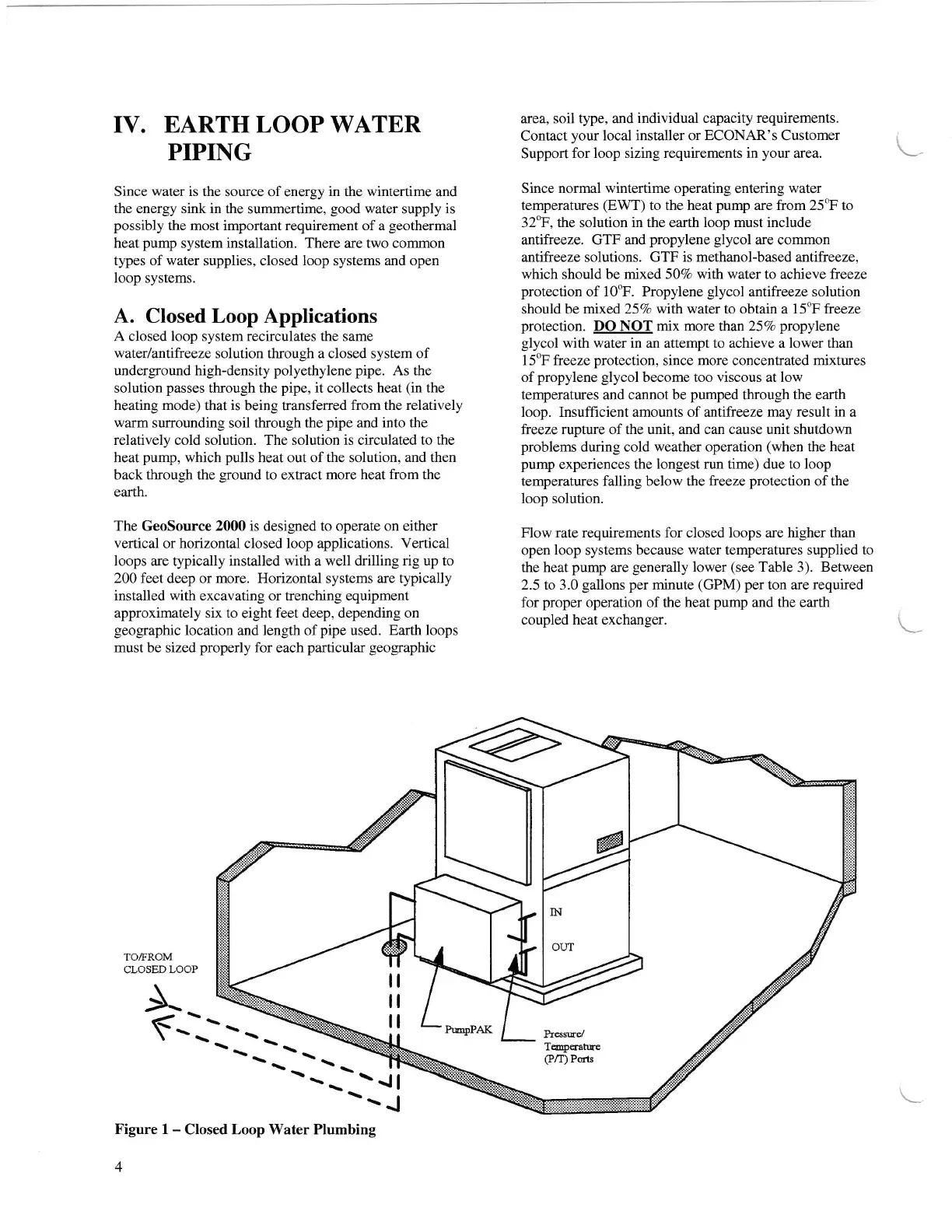
TO/FROM
CLOSED LOOP
area,
soil type, and
individual capacity requirements.
Contact
your
local installer or
ECONAR's
Customer
Support
for loop sizing requirements in
your
area.
Since
normal whtertime
operating entering
water
temperatures
@Ury)
to the heat
pump
are from 25oF to
32oF, the solution
in the
earth
loop must include
antifreeze. GTF and
propylene glycol
are common
antifreeze solutions.
GTF is methanol-based antTfreeze,
which
should
be mixed 50Vo with water to achieve freeze
protection
of 10oF. Propylene
glycol
antifreeze
solution
should be
mrxed25Vo with water to obtain
a
15oF freeze
protection.
DO NOT mix more than25%o
propylene
glycol
with water
in
an attempt to achieve a
lower
than
15T freeze
protection,
since more concentrated mixtures
ofpropylene
glycol
become too viscous at low
temperatures and cannot be
pumped
through the earth
loop. Insufficient amounts of antifreeze may result
in
a
freeze rupture of the unit, and can
cause unit shutdown
problems
during cold
weather operation
(when
the heat
pump
experiences the
longest run time) due
to
loop
temperatures falling below the freeze
protection
of the
loop solution.
Flow
rate requirements for closed loops are higher than
open loop systems because
water temperatures supplied to
the
heat
pump
are
generally
lower
(see
Table
3).
Between
2.5
to 3.0
gallons per
minute
(GPM) per
ton are
required
for
proper
operation of the heat
pump
and the earth
coupled
heat exchanger.
\
f
\
Figure 1-
Closed Loop Water Plumbing
4
.Jl
IN
OUT
PmPPAK
Presre'/
Tmposhre
(P/T)
Pofis
J
il
il
il



 To Next Page