COPYRIGHT©EDECOA, ALL RIGHT RESERVED,PSW-USA-Rev2.71
12 / 17
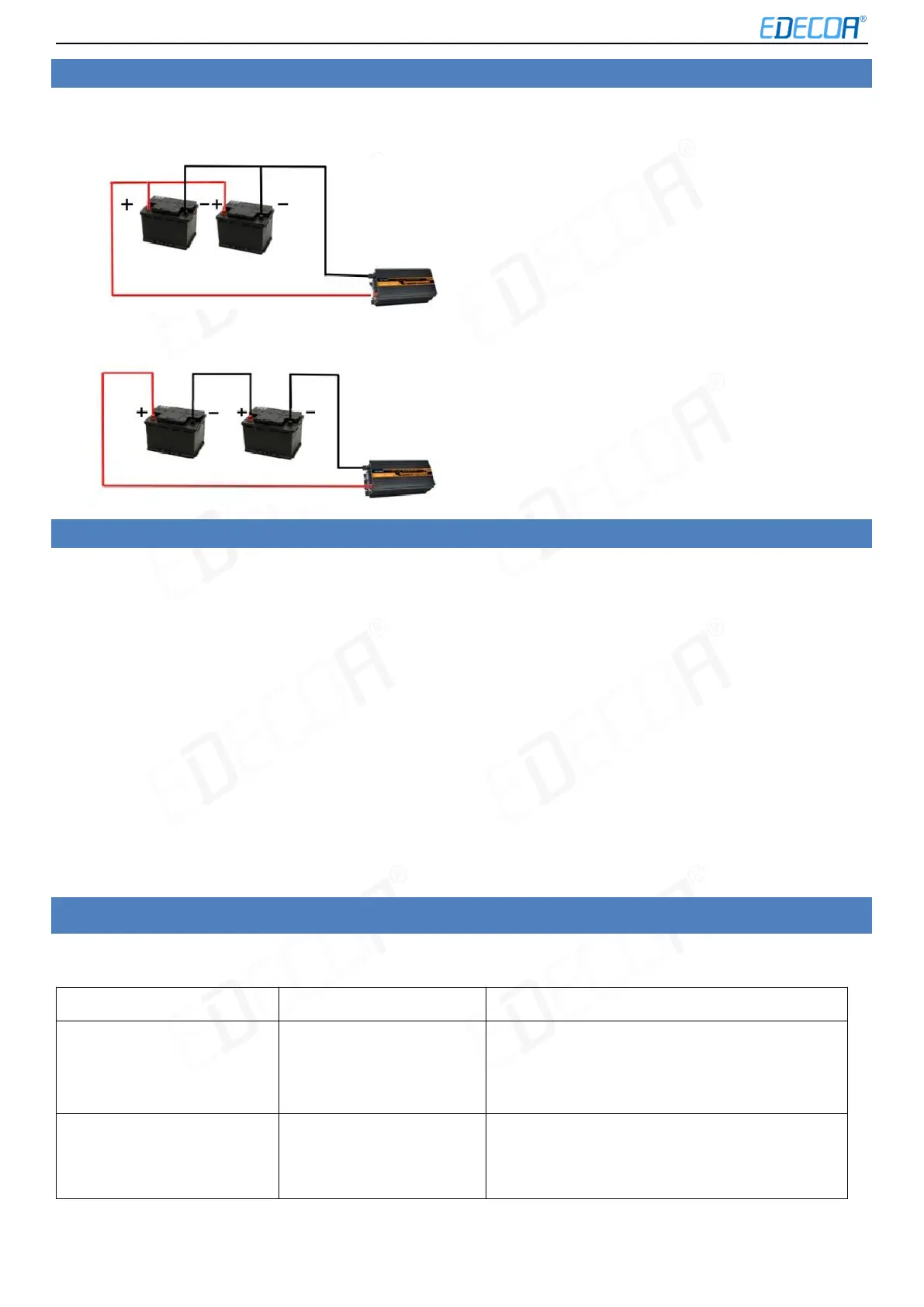
13. HOW TO CON NECT TWO OR MORE BATTERIES?
Parallel connected = same voltage doubled AH (TWO 12V batteries connect in paralleled will provide 12V output but
double the using time)
Connected in series = double voltage same AH (Two 12V batteries connect in series will provide 24V output)
14. PROTEC TION FEAT UR ES
Low voltage Protection:when the battery is in discharged condition, the inverter will shut down, at the same time, an
alarm will sound and the indicator light will turn on.
Over-voltage protection: when the input voltage exceeds rated voltage, the inverter will shut down, at the same time,
an alarm will sound and the indicator light will turn on. A substantial excess of the rated voltage, for example, at 48V on a
24V inverter will destroy the inverter!
Reverse polarity protection: when the inverter is connected reversely, inverter’s fuse will blow out to protect the
inverter. The DC input side with MOSFET protection will not work.
You have to replace all burnt fuses.
Over-load protection:when the continuous draw exceeds rated Watts, the inverter will shut down, at the same time,
an alarm will sound and the indicator light will turn on.
Short circuit protection: when the output side is short circuited, the inverter will shut down, an alarm will sound and
the indicator light will turn on.
Temperature control: If the temperature in the unite reaches 45°C the fan will start and cool down the device.
Over-temperature protection:when the inside temperature is over 75°C, the inverter will shut down, an alarm will
sound and the indicator light will turn on.
15.
PROBLEM CAUSES
PROBLEM POSSIBLE CAUSE SOLUTION
The inverter is ON but the LED
does not work. No response. No
alarm
Open circuit.
No DC input.
Fuse faulty.
1.Check entry circuit continuity
2.Check that the battery fuse is right.
3.Check all circuit connections are correct.
4.Check the ON/OFF button wiring.
The inverter is switched on and
the LED works. No AC output.
No alarm.
Reversed of polarity
connection on input side and
internal fuses have been
burnt.
1. Check and correct the polarity of input connections
and replace the internal fuse. (NOTE: Reversing the
polarity may cause irreversible damage to the fuse
circuit)



 To Next Page