667 TUBE TESTER
t
-jEICQL
1
«
PAGE
7
CONTINUE
PROCEDURE
FOR
TRANSISTOR
TESTING
(From Step
4,
Page
4)
5.
Locate
the type number of the transistor to
be
tested on
the
transistor
chart.
Note
whether
the
transistor is a n-p-n or p-n-ptype
and
the
specified
allowable
range
of
Beta.
Make
sure
that
the
TRANSISTOR
TEST
selector
is set at
"TUBE".
6.
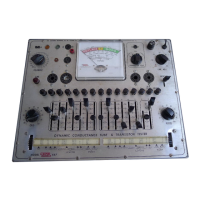
Insert the emitter (E), base (B),
and
collector
(C)
lead of the transistor
in the
corres-
ponding terminals of the
transistor
socket
located immediately
above the
TRANSISTOR
TEST
selector.
7.
Turn the TRANSISTOR TEST selector from
"TUBE" to position
Ion
the p-n-p
or n-p-n
side
depending
on the type of transistor under test. The indication on the
meter will
be propor-
tional
to the
collector current with emitter grounded
and no base signal.
On this
test, transistors
in
good
condition should read
in
the
"Iceo
GOOD"
area
(between
0
and 40
on
the 0
to
140
scale).
Reject
transistors that
read outside
the
"Iceo
GOOD" area (higher
than
40
on
theO
to
140
scale),
unless
note has been made on the chart that a higher reading
is
acceptable.
8o
Turn the TRANSISTOR TEST selector to position
2
and read the current
amplification
factor or Beta
(change in
collector current
caused
by
a change
in base current)
on the 0 to
140
Beta Scale.
A
good
transistor will read within the allowable range of Beta as given on the
chart
for the
particular transistor type. Transistors which
do not
give
a
reading
within the specified
allowable
range of
Beta may still
be
useable; see
data
sheet.
9.
Turn the
TRANSISTOR TEST
selector
back
to
"TUBE"
and then
remove
the transistor
from
the
transistor socket.
10.
Proceed with testing
another transistor
by
beginning with
step
5.
If
there are
no
more
transistors
or tubes to be
tested, turn the
tester
off
by
turning the
LINE
ADJ.
control
to its
AC-OFF
position.
If
there
is
a
tube to
be
tested,
proceed
directly
to step 5 of TUBE
TESTING
after
completing
step 9 of TRANSISTOR
TESTING.
NOTE: The
only
controls having any effect
in
transistor
testing
are the TRANSISTOR TEST
selector,
the LINE ADJ.
control, and
the
LINE push-button.
Provided that a
tube
has
not been left
inserted in any
of
the
tube
sockets, the settings of any other
lever
switches,
push-buttons or
potentiometers on the
panel
have no effect
and
are
immaterial.
CIRCUIT
DESCRIPTION
It
may
be
of
assistance in
understanding the functioning of the instrument to
examine
the
following
typical partial schematics, each of
which indicates the voltages
appliedand
the
place-
ment of the
meter
circuit
when performing the
tests
provided
(in
accordance with the
detailed
operating
instructions) for tubes
and transistors.
NOTE:' Rs
denotes
the
meter
shunt
resistance selected
by
S29
(Lever
S).
0
1,
0 2,
and
0
3
denote various a-c
voltages taken from taps on the high
voltage secondary
winding of the
power
transformer
and selected
by
S28
(Lever
V).
An asterisk denotes
the function
of
current-
limiting.


 To Next Page
 Loading...