EasyManua.ls Logo

Eico 667 - CIRCUIT DESCRIPTION (Continued); Transistor Test Circuitry Explained

Eico 667
29 pages
Print Icon
To Next Page IconTo Next Page
To Previous Page IconTo Previous Page
Loading...
667
TUBE TESTER
"
lE/CQl-,
<
PAGE
9
TRANSISTOR TESTS:
At
the
P-N-P 1 or
N-P-N
1 test
positions
of the
TRANSISTOR
TEST
selector,
a
measurement
is made
of
the
collector
current
that
flows
when
the
emitter
is
grounded
and
no signal
is
applied
to the
base. This
currentis
a function
of the
temperature,
the
resistivity
of the germanium and,
most
important,
becomes
quite
large if
there
is
contamination
of
the
surface
of the germanium
or
if
the
transistor has
been damaged
by
a
short
circuit.
At
the
P-N-P
2 or
N-P-N
2
position, a small
current
is put into the
base via
the
200K£2
resistor
R3
to
permit measurement
of the collector
-to-base
amplification
factor
Beta,
sometimes
called
Alpha
cb. In
some
cases
the range
of
Beta
given
in
the
chart
has
been
taken
directly
from
the
transistor
manufacturer’s
specification;
in
other cases Beta
has been
calculated
from the
grounded-base Alpha,
Alpha
ce, according to
the
relationship.
Alpha
ce
Beta
=
1
-
Alpha
ce
These
simple
tests
will
determine
if
the
transistor
is good or bad,
but will
not,
of
course,
duplicate
the factory tests
of frequency
response,
input
resistance,
output
resistance,
collector
capacitance
and other
electrical
characteristics
that are
necessary
for a
specific grade
of
transistor.
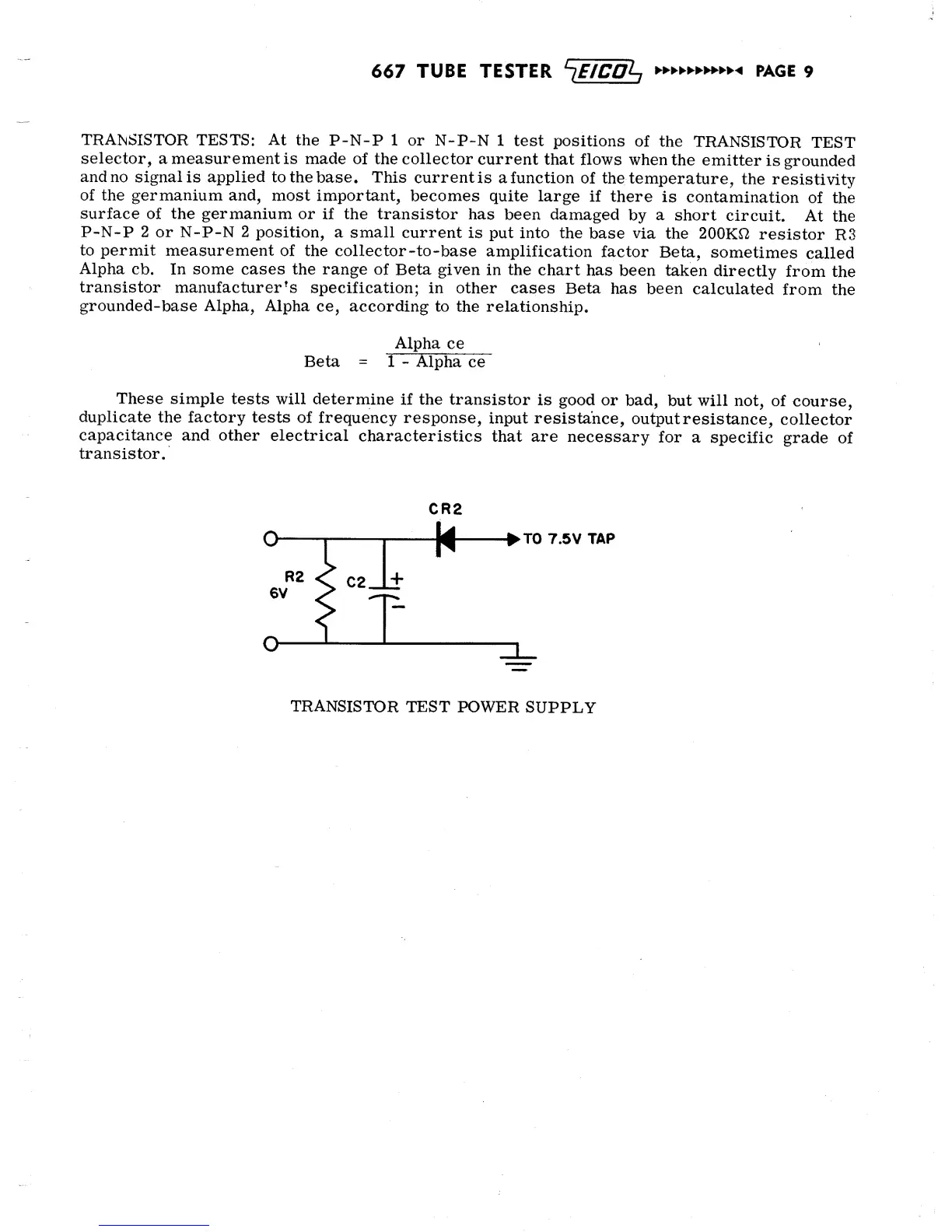
CR2
TRANSISTOR
TEST POWER
SUPPLY

Related product manuals