667
TUBE
TESTER
L
lEICO
L
>
«
PAGE
3
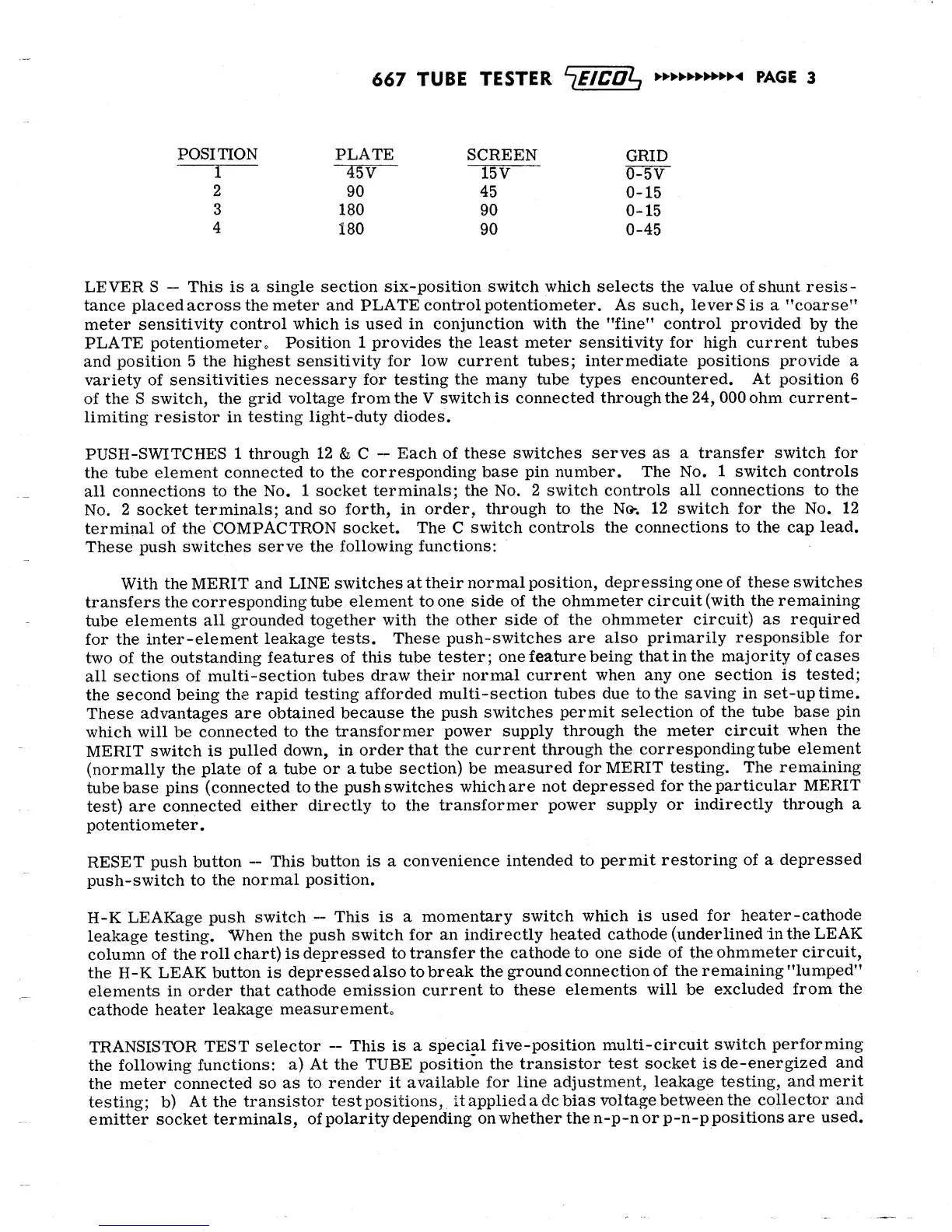
POSITION
PLATE
SCREEN
GRID
1
45V
~T5V
0-5V
2
90
45
0-15
3
180
90
0-15
4
180
90
0-45
LEVER
S
—
This is
a
single
section
six-position
switch
which selects
the
value
of shunt resis-
tance
placed across the
meter and PLATE control potentiometer.
As
such, lever
Sis
a "coarse"
meter sensitivity
control which
is
used in conjunction with the "fine" control provided
by
the
PLATE
potentiometer.
Position
1
provides
the least meter sensitivity for high current tubes
and position
5 the highest
sensitivity for
low current tubes;
intermediate
positions provide a
variety of
sensitivities necessary
for testing
the many tube types encountered.
At
position 6
of
the S switch, the
grid voltage from the V
switch is
connected through the
24,
000 ohm current-
limiting
resistor in
testing
light-duty
diodes.
PUSH-SWITCHES
1 through
12
&
C
—
Each of
these switches
serves as
a
transfer switch
for
the
tube
element
connected to
the corresponding
base pin
number. The No.
1
switch
controls
all connections
to
the No.
1 socket
terminals; the No.
2 switch
controls
all
connections
to
the
No.
2 socket
terminals;
and
so
forth, in
order, through to
the No-.
12
switch
for
the No.
12
terminal
of the
COMPACTRON
socket.
The
C
switch
controls
the connections to the cap
lead.
These push
switches
serve the
following
functions:
With
the
MERIT
and
LINE switches
at
their
normal
position, depressing one of
these switches
transfers the
corresponding tube
element to one
side of
the ohmmeter
circuit
(with the
remaining
tube
elements
all
grounded
together
with
the
other side
of
the ohmmeter
circuit) as
required
for the
inter
-element
leakage
tests.
These
push-switches
are
also
primarily
responsible
for
two of the
outstanding features of this
tube
tester;
one feature
being
that in the
majority of
cases
all sections of
multi-section tubes
draw
their
normal
current when
any one
section
is
tested;
the
second
being the
rapid testing
afforded
multi-section
tubes
due
to
the
saving in
set-uptime.
These
advantages are
obtained because
the
push
switches
permit
selection
of
the
tube
base
pin
which
will be
connected
to the
transformer
power
supply
through
the
meter
circuit
when
the
MERIT
switch
is
pulled down,
in
order that
the
current
through
the
corresponding tube
element
(normally
the
plate
of
a tube
or
a
tube
section) be
measured
for MERIT
testing.
The
remaining
tube
base
pins
(connected
to
the push switches
which
are
not
depressed
for the
particular MERIT
test)
are
connected
either
directly to the
transformer
power supply
or
indirectly
through a
potentiometer.
RESET
push button
—
This
button is
a
convenience
intended
to
permit
restoring of a
depressed
push-switch
to
the
normal
position.
H-K
LEAKage
push
switch
—
This
is
a
momentary
switch
which
is
used for
heater
-cathode
leakage
testing.
When the
push
switch for
an indirectly
heated
cathode
(underlined in the
LEAK
column of the
roll chart)
is
depressed
to
transfer
the cathode
to
one
side
of the
ohmmeter
circuit,
the H-K
LEAK
button is
depressed
also to
break
the
ground
connection of
the
remaining
"lumped"
elements in
order that
cathode
emission
current to
these
elements
will
be
excluded from the
cathode
heater
leakage
measurement.
TRANSISTOR
TEST
selector
—
This
is
a
special
five-position
multi-circuit
switch
performing
the
following
functions:
a) At the
TUBE
position
the
transistor
test
socket
is
de-energized
and
the meter
connected so
as
to
render it
available
for line
adjustment,
leakage
testing,
and
merit
testing;
b)
At the
transistor
test
positions,
it
applied
a
dc bias
voltage
between
the
collector
and
emitter socket
terminals,
of
polarity
depending on whether the
n-p-n or p-n-p
positions
are
used.


 To Next Page
 Loading...