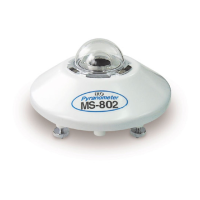
EKO Pyranometers MS-802, MS-802F, MS-402, MS-402F, MS-602
This document serves as an instruction manual for EKO Instruments' series of pyranometers, including models MS-802, MS-802F, MS-402, MS-402F, and MS-602. These devices are designed for measuring global broad-band solar radiation and are suitable for various outdoor environments, from PV module efficiency measurements to climatology research. EKO pyranometers comply with ISO9060:2018 (Class A, B, C) and ISO9060:1990 (Secondary Standard, First Class, Second Class) standards.
Function Description
EKO pyranometers are thermopile-based sensors that generate a voltage signal proportional to the solar irradiance absorbed on a black surface. This signal is then converted into Watts per meter squared (W/m²) using a calibration factor. The instruments are designed to measure cosine-weighted global solar irradiance over the entire hemisphere, with a field-of-view of 180 degrees.
The series offers three types of pyranometers to cover all ISO9060 standard classes:
- MS-802/MS-802F (ISO9060:2018 Class A): These are spectrally flat pyranometers designed as reference sensors for high-accuracy global broad-band solar radiation measurements. They feature robust brass housing for durability in harsh environments and are used for PV research and climatology studies. The MS-802F includes a ventilation system.
- MS-402/MS-402F (ISO9060:2018 Class B): Similar in design to the MS-802, these pyranometers also feature robust brass housing and are suitable for routine global irradiance measurements. They are multi-purpose high-quality monitoring sensors for PV and meteorological markets, with full temperature compensation. The MS-402F includes a ventilation system.
- MS-602 (ISO9060:2018 Class C): This is the smallest thermopile-based pyranometer in the series, offering an economic solution for measuring broad-band solar irradiance. It features exceptionally low temperature dependency, typically found only in higher-class pyranometers, and is a compact all-weather sensor.
Important Technical Specifications
The pyranometers operate within a wavelength range of 285 to 3000 nm and have a field of view of 2π (sr).
MS-802/MS-802F (ISO9060:2018 Class A):
- Response time (95% output): Approx. 5 Sec (<10 Sec)
- Zero off-set A (-200W/m²): ±6 W/m² (±7 W/m²)
- Zero off-set B (5K/hr): ±2 W/m²
- Total zero off-set c: ±8 W/m² (±10 W/m²)
- Non-stability: ±0.5%/yr (±0.8%/1yr)
- Nonlinearity: ±0.2% (±0.5%)
- Directional response: ±10 W/m²
- Spectral error: ±0.1% (±0.5%)
- Spectral selectivity: ±1% (±3%)
- Temperature response (-10 to +40°C): ±1%
- Tilt response: ±0.2% (±0.5%)
- Weight (with ventilation): 1.4kg (3kg)
- Maximum Operation Irradiance: 4000 W/m²
- Impedance: Approx. 500Ω
- Output Cable (outer diameter): 0.5mm² x 2 pins (φ6.7mm)
- Dimensions: Fixing Hole Pitch: 80 mm, Body Height: 65 mm, Leveling Screw Height: *16 mm, Width (including Sun Screen/Cover): φ160 mm, Overall Height (approx.): 108mm
MS-402/MS-402F (ISO9060:2018 Class B):
- Response time (95% output): Approx. 8 Sec (<20 Sec)
- Zero off-set A (-200W/m²): ±6 W/m² (±15 W/m²)
- Zero off-set B (5K/hr): ±2 W/m² (±4 W/m²)
- Total zero off-set c: ±8 W/m² (±21 W/m²)
- Non-stability: ±0.5%/yr (±1.5%/yr)
- Nonlinearity: ±0.2% (±1%)
- Directional response: ±20 W/m²
- Spectral error: ±0.1% (±1%)
- Spectral selectivity: ±1% (±3%)
- Temperature response (-10 to +40°C): ±1% (±2%)
- Tilt response: ±0.2% (±2%)
- Weight (with ventilation): 1.4kg (3kg)
- Maximum Operation Irradiance: 4000 W/m²
- Impedance: Approx. 500Ω
- Output Cable (outer diameter): 0.5mm² x 2 pins (φ6.7mm)
- Dimensions: Fixing Hole Pitch: 80 mm, Body Height: 65 mm, Leveling Screw Height: *16 mm, Width (including Sun Screen/Cover): φ160 mm, Overall Height (approx.): 108mm
MS-602 (ISO9060:2018 Class C):
- Response time (95% output): 17 Sec (<30 Sec)
- Zero off-set A (-200W/m²): ±10 W/m² (±30 W/m²)
- Zero off-set B (5K/hr): ±6 W/m² (±8 W/m²)
- Total zero off-set c: ±16 W/m² (±41 W/m²)
- Non-stability: ±1.7%/yr (±3%/yr)
- Nonlinearity: ±1.5% (±3%)
- Directional response: ±25 W/m² (±30 W/m²)
- Spectral error: ±0.1% (±5%)
- Spectral selectivity: ±1% (±3%)
- Temperature response (-10 to +40°C): ±2% (±4%)
- Tilt response: ±2% (±5%)
- Weight: 230g
- Maximum Operation Irradiance: 2000 W/m²
- Impedance: 20 to 140Ω
- Output Cable (outer diameter): 0.3mm² x 2 pins (φ4.8mm)
- Dimensions: Fixing Hole Pitch: 60 mm, Body Height: 45 mm, Leveling Screw Height: > 0mm, Width (including Sun Screen/Cover): φ78 mm, Overall Height (approx.): 66mm
Common Specifications:
- Operating Temperature (Accuracy guarantee range): -40 to +80°C (-10 to +50°C)
- Ingress Protection (IP Code): IP67 (IEC60529, JIS C0920)
- Paint: Munsell Color: N-9.5 White, Baked (MS-802/802F/402/402F), White Anodized (MS-602)
- Sensitivity: Approx. 7.00μV/W·m⁻²
- Ventilation Supply Power (optional for MS-802/402): AC (120V, 220V, 240V, 16W @ 50Hz/15W @ 60Hz) or DC (12V or 24V)
Usage Features
- Installation: Pyranometers should be mounted in a location with a full hemispheric field-of-view, free from obstructions above 5° horizon. The setup location should be easily accessible for periodic maintenance.
- Leveling: Instruments must be leveled horizontally using the integrated spirit level and leveling screws to avoid cosine and azimuth errors. For tilted installations, the pyranometer should first be leveled horizontally, then mounted in the desired tilted position.
- Wiring: Output cables should be routed through conduits and fastened to prevent movement and exposure to direct sunlight or rain/wind. Signal cables should be kept away from sources of electromagnetic noise.
- Data Acquisition: The output voltage signal (in mV) is converted to solar irradiance (W/m²) using the calibration factor provided on the certificate. A high-resolution measuring instrument (at least 5µV) or data logger is recommended.
- Ventilation Unit (MS-802F/402F): An optional ventilation unit helps minimize the negative effects of frost, snow, dew, and dust deposition on the glass domes, improving measurement accuracy. For AC versions, the power cable must be grounded.
Maintenance Features
Regular maintenance is crucial for accurate measurements and extended instrument lifetime.
- Clean Glass Dome: Wipe the glass dome with a soft cloth and alcohol several times per week to remove dirt, which can affect transmittance.
- Check Glass Dome Condition: Weekly inspection for cracks and scratches on the glass dome and rim to prevent water leakage.
- Check Spirit Level Bubble: Weekly verify that the air bubble in the spirit level is in the center ring to ensure horizontal positioning.
- Check Cable Condition: Weekly ensure the cable connector is properly connected and tightened, and that the cable is lined to prevent swinging by wind.
- Check Setup Base Condition: Weekly verify that the instrument and mounting base plate are securely fastened.
- Check Silica Gel: Weekly inspect the color of the silica gel (desiccant). If it turns reddish from dark blue, replace it with new silica gel to prevent condensation inside the dome (not applicable for MS-602).
- Recalibration: Recalibration is recommended every 2 years to maintain measurement accuracy, as sensor sensitivity can change over time due to natural aging of materials.
- Troubleshooting: The manual provides guidance for common issues such as no output, low output value, non-zero output at night, changed silica gel color, and unusual noise from the ventilation unit.


 To Next Page
 General