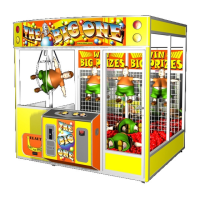
This manual describes the assembly and initial setup of a "Big One II" crane game, manufactured by ELAUT. The device is a large-scale arcade crane machine designed for prize redemption, featuring a transparent enclosure and a gantry system for manipulating prizes.
Function Description
The Big One II is a prize crane game where players attempt to pick up prizes using a remotely controlled claw. The machine is designed to attract players with its large size and visible prizes, offering an interactive and engaging experience. The core function involves a gantry system that moves horizontally and vertically, positioning a claw over prizes. Players use controls to maneuver the gantry and activate the claw to grab and drop prizes into a collection chute. The machine is intended for commercial use in arcades, entertainment centers, and other public venues.
Important Technical Specifications
The manual provides a list of "Necessary tools" which indirectly indicates some technical aspects and components of the device:
- Electric drill: Essential for assembly, suggesting the use of screws and possibly other fasteners requiring drilling.
- Bitholder: A standard accessory for electric drills, confirming the use of various screw types.
- Bits:
- Wooden crosscut: Implies the presence of wooden components in the machine's structure or packaging that need to be cut or drilled.
- Metal crosscut: Indicates the presence of metal components that require cutting or drilling.
- Indus 5mm: A specific type or size of bit, likely for industrial-grade fasteners or materials.
- Ladders (2): Given the size of the machine, ladders are required for reaching upper sections during assembly, suggesting a significant height.
- Rubber hammer: Used for gentle persuasion or seating components without damage, indicating parts that might be press-fit or require careful alignment.
- Cutting pliers: For cutting wires, cables, or possibly plastic ties during assembly.
- Drill Ø 3.6mm: A specific drill bit size, likely for pilot holes or specific fasteners.
Further details from the assembly steps reveal more specifications:
- Screws: Various types and sizes are used, including "3x screw n° 3", "4 screws n° 9", "3 butterfly screws (n° 1+7+6)", "2 wooden screws on the spotlight construction", "6x screw n°3", and "2x screw n°4". This indicates a robust and multi-material construction.
- Bolts: "8x bolts n° 2" and "butterfly bolt (n° 1+7+6)" are mentioned, suggesting strong structural connections.
- Profiles: "Lower profiles" and "alu profile" are mentioned, indicating the use of aluminum profiles for structural elements, likely for the frame or gantry system.
- Wheelblocks: These are crucial for the machine's mobility or stability, attached to the lower profiles and in the middle of the front and back, as well as the right side.
- Gantry-cable: This is a key component of the gantry system, responsible for its movement.
- Prize-box: A removable component, suggesting a modular design for prize loading and maintenance.
- Floor plates: The machine uses multiple floor plates (at least 4) for the base.
- Red spanwires: These are part of the grab mechanism and gantry.
- Aluminium cable channel: Used for cable management, indicating a need to protect and organize wiring.
- Speakers: The presence of speakers suggests audio feedback for gameplay.
- Control panel: The main interface for the player, connected via a "mains lead".
- Power connection: The crane connects to the "current network (outside the head)", indicating a standard electrical power requirement, likely 230 V as suggested by a warning label in one of the images.
- Red balls: These are the prizes or game elements that players attempt to grab.
Usage Features
The manual focuses on assembly, but some usage features can be inferred:
- Prize Redemption: The primary usage is for players to win prizes (red balls).
- Interactive Gameplay: The crane is controlled by players, offering an interactive experience.
- Modular Design: The prize-box is removable, allowing for easy restocking of prizes.
- Visible Prizes: The transparent enclosure allows players to see the prizes, enhancing appeal.
- Audio Feedback: The presence of speakers suggests that the game provides sound effects or music during gameplay.
- Robust Construction: The use of various screws, bolts, and metal/aluminum profiles indicates a durable machine designed for public use.
Maintenance Features
The assembly instructions also hint at maintenance aspects:
- Easy Prize Restocking: The prize-box is designed to be easily removed and re-inserted, facilitating quick restocking of prizes.
- Accessible Components: The assembly process involves attaching and detaching various panels and components, suggesting that internal parts like the gantry, wiring, and speakers are accessible for maintenance and repair.
- Cable Management: The use of an aluminum cable channel helps organize and protect internal wiring, making it easier to trace and repair electrical connections.
- Modular Construction: The machine's construction from distinct modules (e.g., front wall, back wall, roof panel, floor plates, prize-box) implies that individual components can be replaced or repaired without disassembling the entire machine.
- Removable Gantry: The gantry is installed as a separate unit, indicating it can be removed for maintenance or repair of its mechanical and electrical components.
- Protection Foil: The mention of removing a "protection foil" from the aluminum cable channel suggests that sensitive components are protected during shipping and can be easily uncovered for operation or maintenance.
- Wheelblocks for Mobility: While primarily for stability, the wheelblocks might also aid in moving the machine for maintenance or relocation.
In summary, the ELAUT Big One II is a robust, large-scale prize crane game designed for commercial use, featuring a modular construction for ease of assembly, prize restocking, and maintenance. It incorporates a gantry system for player interaction and is built with durable materials to withstand public use.

 Need help?
 General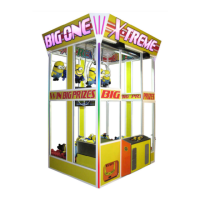



 To Next Page