3-3
PREPARING FOR THE ROAD
Construction - Usually a thin steel cable,
possibly plastic coated, and fitted with a
means of attachment to connect to the towing
vehicle.
Operation - The cable should be able to pull
tight to engage the caravan’s brakes without
any hindrance to its action, if the main
coupling of the caravan separates from the
towing vehicle. It should never become taut
during normal use.
Correct Procedure For Use
(i) Check cable assembly for damage. If in
doubt contact your Retailer or Service
Centre.
(ii) Make sure the cable runs as straight as
possible, and goes through a cable
guide underneath the caravan coupling.
(iii) Determine whether or not you have a
designated attachment point (a feature
of the tow bar which has been identified
by the tow bar supplier as being for the
attachment of a breakaway cable).
Where a Designated Attachment
Point Is Provided On The Tow Bar
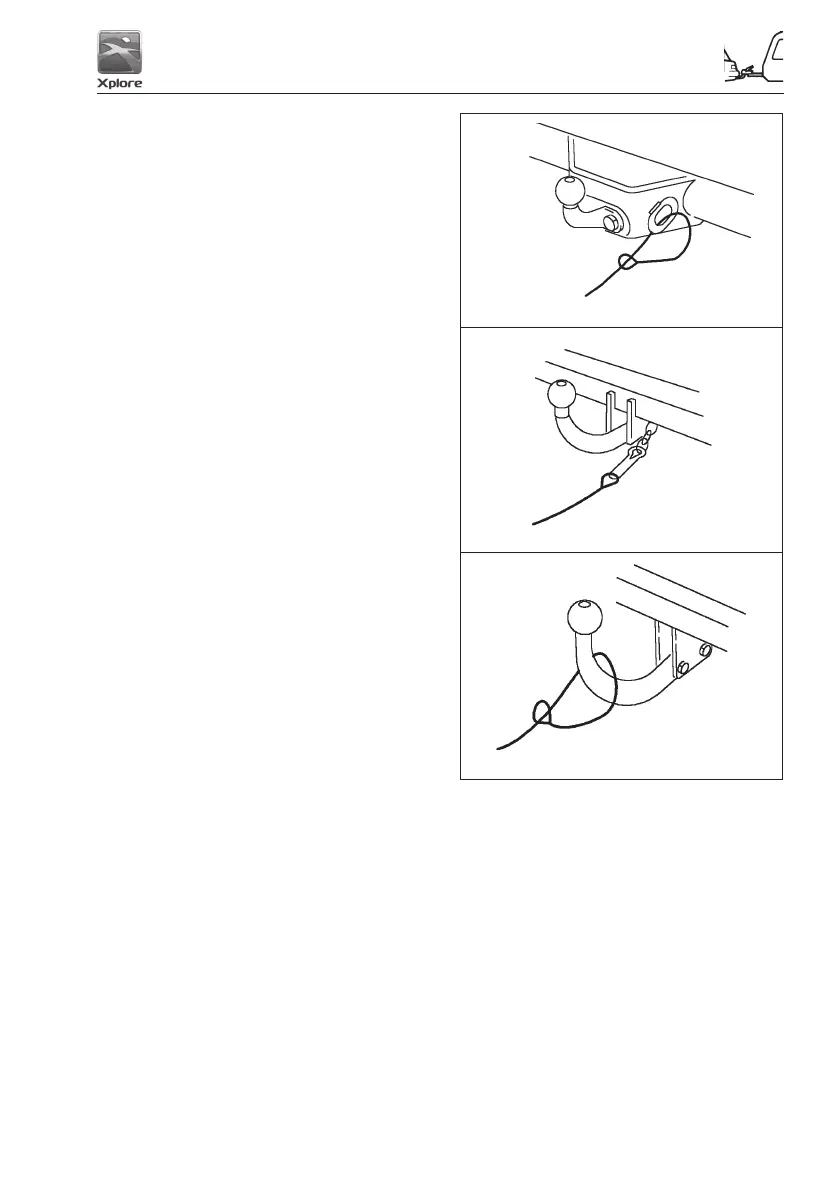
(i) Pass the cable through attachment point
and clip it back on itself (Fig 3-2, Step
1);
or
(ii) Attach the clip directly to the attachment
point (Fig 3-3, Step 2).
Note: this must be specifically permitted by
the caravan manufacturer’s guidance, as the
clip may not be sufficiently strong.
Where No Designated Attachment
Point Is Provided On The Tow Bar
(i) Fixed Ball - Loop the cable around the
neck of the tow ball. If you fit the cable
like this use a single loop only (Fig 3-4,
Step 3).
(ii) Detachable Ball - You must contact the
tow bar supplier for advice.
Other Means of Attachment
Alternatively, it may be possible to attach the
cable assembly to a permanent part of the
tow bar structure with the approval of the tow
bar supplier, or to an accessory sold for the
purposes of breakaway cable attachment.
When The Breakaway Cable Is
Attached Check To Ensure
(i) That the cable cannot snag in use on the
caravan hitch, jockey wheel or any
accessories e.g. a stabiliser, bumper
shield, cycle carrier etc.
(ii) That there must be sufficient slack in the
cable to allow the towing vehicle and
caravan to fully articulate without the
cable ever becoming taut and applying
the brakes.
(iii) That it is not so slack that it can drag on
the ground. Leave it too loose, and the
cable may scrape along the ground, and
be weakened so that it fails before doing
its job!
STEP 1
Fig 3-2
Fig 3-3
STEP 2
STEP 3
Fig 3-4



 To Next Page