52
useful for diversity operation where both antennas used for diversity
are connected to ANT 1/2/3.
There are two considerations to keep in mind when using the ANT 1,
2, and 3 selections for receive purposes:
• The current TX antenna is identified by an orange dot on the
associated ANT button in the RX antenna button group. Selecting this
antenna for receive is equivalent to using the =TX selection, i.e. the
signal passes through the ATU's L-network. But if you later switch to a
different transmit antenna, this will no longer be the case. The orange
dot moves to another button, and the ATU will now treat the selected
RX antenna as receive-only. The receive signal will no longer pass
through the L-network.
• Only one of the three ATU antennas can be used as a receive-only
antenna at a given time. For example, you cannot select ANT1 for TX,
ANT2 for main RX, and ANT3 for sub RX. If both receivers are set up to
use ATU antennas for receive, the most-recent ANT1/2/3 receive-
antenna selection will be applied to both receivers. This will be
reflected in their associated antenna icons.
Alternative ways to put the two receivers on different antennas: (1)
Use the RX ANT IN 1 or 2 inputs instead of ATU antennas for one or
both receivers. (2) Set one of the receivers to =TX ANT. This will allow
the other to use either of the non-transmit ATU antennas for receive.
(3) Set one receiver to =TX ANT and the other to =OPP TX ANT. This
requires that a two-antenna subset be specified for the transmitter
using the <TX> <ANT CFG> function.
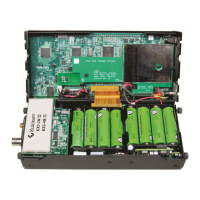
Note: On a basic K4, both receivers will always share the same
antenna. The K4D adds a second band-pass filter unit and a second A-
to-D converter, allowing the sub receiver to use a different antenna
from main. These modules can be installed in a basic K4 at any time,
converting it to a K4D.


 To Next Page