Need help?
Do you have a question about the ELECRAFT K4 and is the answer not in the manual?
Guides on navigating and using the transceiver's digital manual, including text styles and controls.
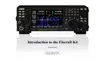
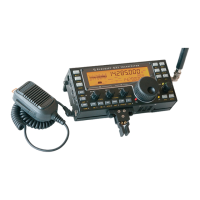
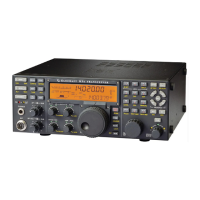
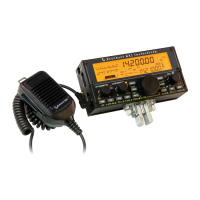
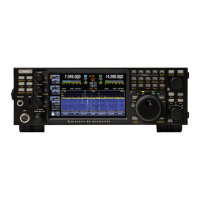
Provides a general description of the K4 transceiver's SDR capabilities, models, and features.
Specifies proper spacing and ventilation requirements for the transceiver unit.
Details recommended DC supply voltage, current ratings, and cable specifications.
Describes the HF/6m transmit-receive antenna jacks (ANT 1, 2, 3, 4) and their uses.
Details the 12 VDC input/output connectors and the station ground connection.
Explains ETHERNET and USB rear panel connections for connectivity and data transfer.
Explains the interaction methods for physical switches and touch screen controls.
Describes the K4's LCD interface, VFO displays, meters, icons, and primary function buttons.
Details the operation of the POWER on/off switch and the TUNE mode activation.
Adjusts transmit functions like power output, microphone gain, and sidetone pitch.
Controls receiver filter bandwidth, shift, hi-cut, and lo-cut settings.
Adjusts RF gain, squelch, and main/sub balance for receiver performance.
Launches the built-in operating manual for context-sensitive help and information.
Describes the frequency displays, mode icons, and tuning rate adjustments for VFOs.
Details VFO A controls, tuning rates, and the use of the numeric keypad for input.
Overview of the main function buttons for basic setup, transmit, receive, and panadapter operation.
Explains how to access and navigate the K4's configuration menu settings.
Describes access to special functions (F1-F14) for macros, screen capture, and software updates.
Details CW mode specific settings including keyer speed, sidetone pitch, and break-in operation.
Covers settings for PSK, FSK, and AFSK data modes, including text decode and transmit options.
Describes transmit settings specific to CW, PSK, and FSK modes, including keyer functions.
Details transmit settings for SSB, AM, and FM modes, including bandwidth and deviation.
Explains how to select HF bands, general coverage, memories, and transverter bands.
Describes direct numeric frequency entry for VFOs and scanning initiation.
Covers recalling frequencies from memory using the memory selection window.
Details selecting the transmit antenna and its effect on receiver antenna defaults.
Explains switching receivers to receive-only antennas and available selection options.
Provides setup procedures for CW operation, including keyer settings and break-in modes.
Details setup for voice modes, including mic selection, gain, compression, and monitoring.
Covers setup for data modes like DATA, AFSK, FSK, and PSK, and their connections.
Guides on configuring main and sub receivers for EQ, audio effects, and text decode.
Explains controls for optimizing receiver performance, including filter and RF/SQL knobs.
Details preamp and attenuator settings to manage receiver sensitivity and overload.
Covers TX EQ, LINE IN, microphone, and per-mode transmit settings.
Explains use of the XMTR knob for power, mic gain, compression, and sidetone pitch.
Describes bar graphs for power, SWR, ALC, and speech compression during transmit.
Explains S-meter calibration, signal levels, and indications for high signal conditions.
Describes the panadapter display, frequency markers, signal strength, and VFO association.
Explains the mini-pan for fine-tuning signals and its use with auto-spot.
Details enhanced dual receive capabilities of K4D/K4HD models with independent filters.
Explains diversity receive for improving copy of weak/fading signals using two antennas.
Covers recording and playing receive audio, and DVR transmit messages functionality.
Describes selecting and viewing system information like date, time, voltage, and signal levels.
Explains storing and recalling general-purpose and quick memories for frequencies and modes.
Details using SPLIT mode for transmitting on a different frequency than receive.
Guides on connecting and operating two external transverters simultaneously.
Describes controlling the K4 via logging software using USB, Ethernet, or RS232.
Explains accessing the K4's front panel remotely via network connection.
Steps to configure and establish a connection to a K4 server radio.
Guides on terminating connections, resolving remote connection issues, and updating software.
Step-by-step instructions for configuring RTTY operation using audio or direct modulation.
Instructions for configuring weak-signal modes like FT8 and JT65 using DATA mode.
Explains how to navigate and select menu entries, including unlocking and editing parameters.
Lists and describes all menu parameters alphabetically for configuration.
Sets the audio limiter threshold when AGC is disabled.
Configures AGC attack, decay, hold time, noise pulse reject, slope, and threshold.
Addresses common power-up issues, stuck logos, and software update failures.
Troubleshoots issues like no received signal, low signal levels, and audio artifacts.
Addresses problems with power output, transmit modes, and keying issues.
Lists and explains various error codes and suggested corrective actions.
 General
| Modes | SSB, CW, AM, FM |
|---|---|
| Power Output | 100 W (adjustable) |
| Display | High-resolution color |
| DSP | Yes |
| Antenna Tuner | Internal Automatic Antenna Tuner |
| Type | HF/50 MHz Transceiver |
| Receiver Sensitivity | 0.2 µV for 10 dB S/N (SSB, CW) |
| Supply Voltage | 13.8 VDC |
| Interface | USB, Ethernet, Audio In/Out |
| Frequency Range | 160-6 meters |

 To Next Page