8
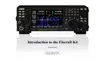
The K4's compact size and weight, combined with 11-15 VDC
operation and low current drain, make it suitable for field, travel, or
home station use.
Since the K4 is an SDR, Elecraft can provide updates to its signal
processing algorithms with software changes rather than by adding
new hardware. This ensures that the K4 can take advantage of new
modes, bands, or other features in the future. For example, a recent
addition was advanced speech compression and CESSB (Controlled
Envelope Single Sideband), a DSP feature that boosts average talk
power by as much as 8 dB.
The K4 uses direct sampling, meaning that signals are digitized right at
the receiver inputs, and the transmitter's amplifier chain is also driven
by a digitized signal. Older SDR architectures digitized signals at a low
intermediate frequency (IF), resulting in poor suppressions of down-
conversion or up-conversion images.
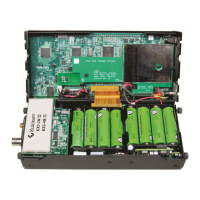
There are three models: the basic K4, with one set of receive filters
and one analog-to-digital converter (ADC); the K4D, with a second set
of receive filters and a second ADC; and the K4HD, which adds a
superheterodyne front end that can be enabled as needed to provide
even greater dynamic range. The superhet module uses high-
performance, narrow-band crystal filters such as those used in the
Elecraft K3S.
Even the basic K4 provides simultaneous dual receive on the same or
different bands/modes. However, the K4D and K4HD models include
an additional receiver module (KRX4) with a second set of band-pass
filters, improving signal handling during dual-receive operation on
different bands. The second receiver also permits diversity reception,
i.e., the use of different antennas for the two receivers to counteract
fading (QSB).


 To Next Page