
 Need help?
Do you have a question about the Electro-Voice DL12X and is the answer not in the manual?
Frequency response in typical enclosure, normalized for 1 Watt/1 Meter.
Power handling capacity as per EIA RS-426A and AES2-1984 standards.
SPL at 1 meter with 1 watt input power, averaged over frequency bands.
Minimum and nominal impedance values in standard and typical enclosures.
Second and third harmonic distortion levels at specific frequencies.
Angle of 6-dB-down points on polar responses for octave bands.
Key physical measurements including piston, voice-coil diameter, and depth.
BL factor, voice coil diameter, winding depth, and Xmax values.
Essential parameters for enclosure design: fs, Vas, Qes, Qms, Qts, Re.
Thermal rise after power test and PE(max) rating.
Recommended vented enclosure sizes and tuning frequencies for optimal response.
Recommended amplifier power range for optimal performance and reliability.
Details on bolt-hole diameter, bolt circle, and baffle opening diameter.
Connector type and polarity for connecting the speaker.
Information on magnet weight, material, frame, and finish.
Details on voice-coil material, insulation, form, and back cover.
Availability of accessories like mounting hardware kits.
Axial and standard baffle frequency response curves.
Impedance curves in standard and typical enclosures.
Harmonic distortion and beamwidth versus frequency.
Directivity index and polar response plots across frequencies.
Graphical representation of the speaker's physical dimensions.
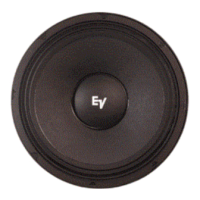
Overview of the DL12X as a professional low/mid-frequency reproducer.
Details on PROTEF coating, TIRTM, and FDDTM for enhanced performance.
Information on edge-wound aluminum wire, polyimide formers, and moisture resistance.
Explanation of beamwidth and directivity factor (Q) and index (D).
Explanation of AES and EIA standards used for power testing.
Explanation of the test setup for smooth, off-axis response.
Guidance on selecting the optimal amplifier size for the DL12X.
Specifics of AES and EIA power ratings and test voltages for the DL12X.
Recommendations for vented enclosures and low-frequency extension.
Explanation of extending low-frequency response with amplifier power.
Methods for protecting the speaker from low-frequency signals below tuning.
Benefits and considerations for stacking multiple speakers.
Requirements for mounting the DL12X, including cutout and bolt circle.
Conformity of DL12X specifications to AES Recommended Practice.
Detailed technical specifications for system design.
Details on the product warranty against defects and limitations.
 General
| Impedance | 8 ohms |
|---|---|
| Sensitivity (1W/1m) | 97 dB |
| Driver Size | 12 inches |
| Nominal Diameter | 12-inch |
| Voice Coil Diameter | 2.5 inches |


 To Next Page