B.
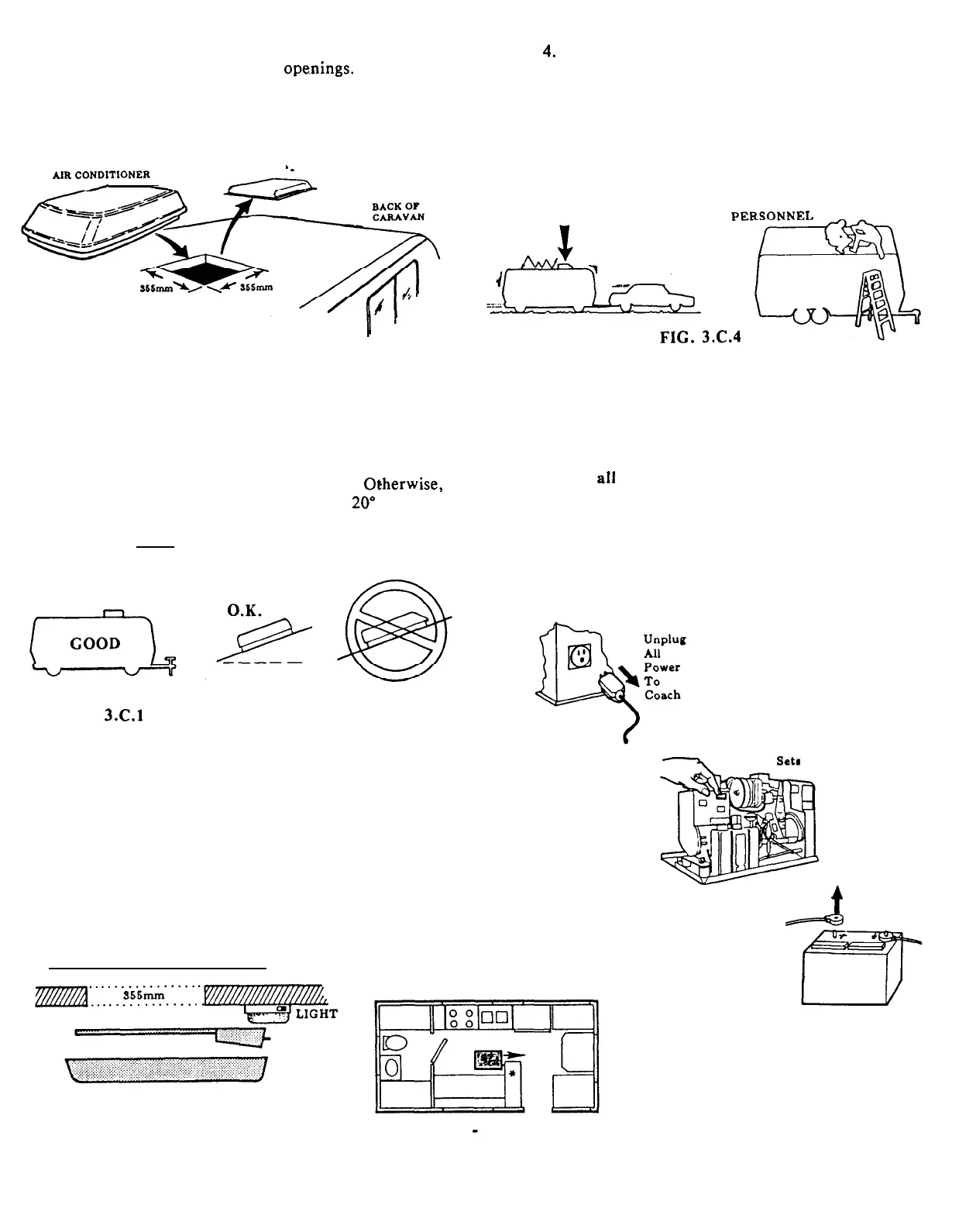
Many air conditioners
existing
roof vent
openings may be larger
X 355 mm and will
(FIG. 3.B)
can be installed at
ope.nings.
These
or smaller than 355
need modification.
NItCONDITIONER
ROOPVENT
-
-
’
-
REMOVE
FIG.
3.B
4.
Be sure your roof structure is capable
of supporting a weight of 65 Kg
when the
van is in
motion.
(Normally if the roof can support a
static load of approximately 100 Kg it
meets this requirement.) (FIG. 3.C.4)
FORCE WHILE
MOVING
WEIGHT
OF A/C
PLUS SERVICE
C.
Check
location acceptability
beginning the installation.
before
4. ROOF PREPARATIONS
1.
If possible, mount the air conditioner
in a section of the roof which is
both flat and level when the van is
parked on a level surface;
Orherwise,
a sideways pitch up to
20”
can be
tolerated but a backward pitch can
never be accepted.
20’ WITH A/C
FACING FORWARD
FIG.
3.C.l
2.
Check on the roof to be sure no
obstructions are in the area where
the air conditioner will be installed.
3.
Check
inside where
the
air
conditioner air box will be located to
insure there will be no interference
with door openings,
curtains,
room
dividers, etc. (FIG. 3.C.3)
ROOF/AIR
BOX CROSS-SECTION
FIG. 3.C.3
WARNING
Disconnect
all
power supplies
to the van, insure
the generator
is
shut off
if
present and
disconnect the positive battery terminal from
the battery before performing any cutting on
the
van.
FAILURE TO FOLLOW THIS
INSTRUCTION
MAY CREATE
A SHOCK
HAZARD. (FIG. 4)
Turn Off
T
Generator Sctr
FIG. 4.
t
Dirconnect
d
Battery
PROHIBITS INSTALLATXON
*CABINET
-
PROHIBITS USE
4








 To Next Page