7
Common Drying Problems
Many drying problems involve poor cleaning results, poor soil and stain removal, residues of lint and scum, and fabric damage.
For satisfactory drying results, follow these suggestions provided by The Soap and Detergent Association.
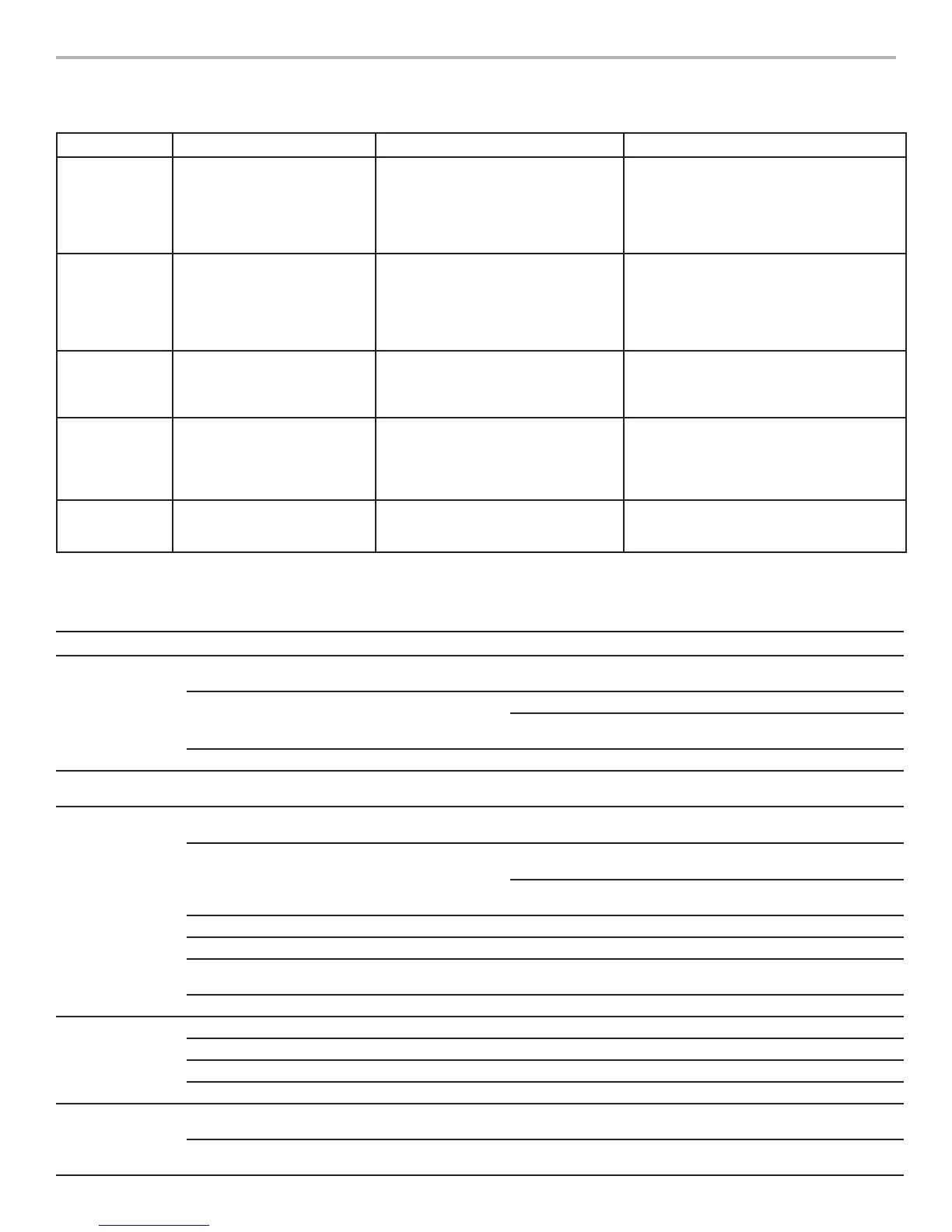
PROBLEM POSSIBLE CAUSES SOLUTIONS PREVENTIVE MEASURES
Greasy, oily
stains
Fabric softener sheet.• Rub fabric softener stains with bar •
soap. Rinse and rewash.
Add a few bath towels to small loads for •
proper tumbling.
Some “silk-like” fabrics should be air dried.•
Use proper drying temperature.•
Place fabric softener sheet on top of load •
before starting the dryer.
Lint Overloading.•
Overdrying causes static •
electricity.
Lint screen not clean when •
cycle began.
Lint is attached to “pills.”•
Reduce load size and rewash using •
liquid fabric softener in the fi nal
rinse.
Or, add a fabric softener sheet and •
tumble without heat.
Use lint brush or roller to remove lint.•
Do not overload dryer.•
Use fabric softener in washer or dryer to •
reduce static electricity.
Remove items when they are slightly damp •
to avoid overdrying.
Check that lint fi lter is clean and in place.•
Pilling
(Fibers break off,
ball up and cling
to fabric.)
Overdrying.• Use a lint brush or shaver to remove •
pills.
Use fabric softener to lubricate fi bers. •
When ironing, use spray starch or fabric •
fi nish on collars and cuffs.
Turn items inside out to reduce abrasion.•
Shrinking Temperature too high.•
Overdrying.•
Irreversible condition.• Follow fabric care label directions.•
If shrinking is a concern, check load often.•
Remove items while slightly damp and •
hang or lay fl at to complete drying.
Block knits into shape.•
Wrinkling Overloading.•
Leaving items in dryer after •
cycle ends.
Reduce load size and tumble at me-•
dium or low heat for 5-10 minutes.
Remove items immediately. Hang or fold.•
Do not overload dryer.•
Remove items as soon as cycle ends.•
Avoid Service Checklist
Before calling for service, review this list. It may save both time and expense. The list includes common occurrences that are
not the result of defective workmanship or materials in this dryer.
OCCURRENCE POSSIBLE CAUSE SOLUTION
Dryer does not start. Electrical power cord is not securely plugged in or plug
may be loose.
Make sure the plug fi ts tightly in wall outlet.
House fuse blown or circuit breaker tripped. Reset circuit breaker or replace fuse.
Make sure electrical line is not overloaded and the dryer is on a sepa-
rate circuit.
Thermal limiter tripped. Call authorized service person for replacement.
Dryer runs but won’t
heat.
There are 2 house fuses in the dryer circuit. If 1 of the 2 fuses is
blown, the drum may turn but the heater will not operate.
Replace fuse.
Drying cycle takes too
long, outside of the
dryer feels too hot or
smells hot.
Lint fi lter is clogged with lint. Make sure all lint has been removed from the dryer lint fi lter before
starting each cycle.
Exhaust duct requirements have not been met. Exhaust duct must be at least 4 inches in diameter and made of rigid or
semi-rigid metal.
When in place, the duct must have no more than two 90° bends and
must not exceed length listed in INSTALLATION INSTRUCTIONS.
Electric dryer is connected to a 208 volt circuit. Drying time will be 20% longer than drying on a 240 volt circuit.
Drying procedures have not been followed. See “Operating Instructions.”
Outside exhaust hood or exhaust duct may be clogged or
restricted.
Clean out any obstruction.
High humidity. Use a dehumidifi er near the dryer.
Excessive wrinkling. Dryer is overloaded. Do not overload. See “Operating Instructions.”
Items left in dryer too long. Remove items as soon as cycle ends.
Insuffi cient sorting of items. See “Operating Instructions.”
Drying temperature too high. Follow fabric care label instructions.
Scratching or chip-
ping of the drum
fi nish.
Foreign objects such as coins, pins, clips or buttons are
inside the dryer.
Always remove foreign objects from pockets before laundering. Re-
move objects from drum and restart dryer.
Permanently attached items such as belt buckles, zippers
and fasteners may be hitting the inside of the drum.
It may be necessary to sew a scrap of material securely around orna-
ments before drying to prevent scratching and damage to the dryer.




 To Next Page