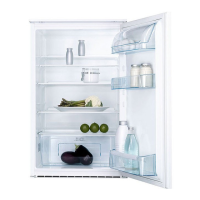
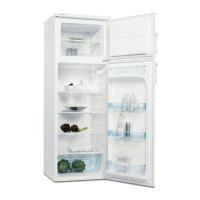
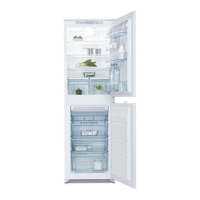
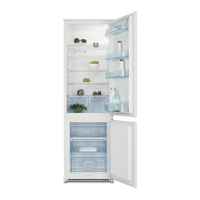
This document is a user manual for the Electrolux ERN29600 Fridge Freezer. It provides comprehensive information on safety, operation, daily use, helpful hints, care and cleaning, troubleshooting, installation, and technical data.
Function Description:
The Electrolux ERN29600 is a fridge freezer designed for keeping foodstuffs and beverages in a normal household setting. It features separate compartments for refrigeration and freezing, allowing for the storage of fresh food and long-term preservation of frozen and deep-frozen items. The appliance uses isobutane (R600a) as a refrigerant, a natural gas with high environmental compatibility.
Important Technical Specifications:
The technical information for this appliance is located on the rating plate on the internal left side and in the energy label.
- Dimensions of the recess:
- Height: 1780 mm
- Width: 560 mm
- Depth: 550 mm
- Rising Time: 24 hours
- Voltage: 230-240 V
- Frequency: 50 Hz
- Climate Class:
- SN: +10°C to +32°C
- N: +16°C to +32°C
- ST: +16°C to +38°C
- T: +16°C to +43°C
- Freezing Capacity: The maximum quantity of food that can be frozen in 24 hours is indicated on the rating plate.
- Electrical Connection: The appliance is supplied with a 13 amp plug. If the fuse needs changing, a 13 amp ASTA approved (BS 1362) fuse must be used. The wiring in the mains lead follows a specific color code: Green and Yellow for Earth, Brown for Live, and Blue for Neutral.
Usage Features:
- Temperature Regulation: The temperature is automatically regulated. Users can adjust the temperature regulator towards lower settings for minimum coldness or higher settings for maximum coldness. A medium setting is generally recommended. The exact setting depends on room temperature, door opening frequency, quantity of food stored, and appliance location.
- Freezing Fresh Food: The freezer compartment is suitable for freezing fresh food. For faster freezing, the temperature regulator can be set to higher settings. It is recommended to freeze top-quality, fresh, and thoroughly cleaned foodstuffs in small portions.
- Storage of Frozen Food: Before storing large quantities of food, it's advisable to run the appliance for at least 2 hours on higher settings. Drawers and baskets can be removed to optimize space. Frozen food should not be re-frozen once thawed.
- Thawing: Deep-frozen or frozen food can be thawed in the refrigerator compartment or at room temperature. Small pieces can be cooked directly from frozen, though cooking time will be longer.
- Ice-cube Production: The appliance includes trays for ice-cube production.
- Cold Accumulators: The freezer contains at least one cold accumulator to extend storage time during power cuts or breakdowns.
- Movable Shelves: The refrigerator walls are equipped with runners, allowing shelves to be positioned at different heights for flexible storage. Front half-shelves can lie over rear ones.
- Door Shelves: Door shelves can also be adjusted to different heights to accommodate various package sizes.
- Door Reversibility: The appliance door can be reversed to open from the left or right, depending on installation needs.
- Energy Saving Tips: Avoid frequent or prolonged door openings, do not store warm food or evaporating liquids, cover or wrap food, and ensure proper air circulation. Adjust the temperature regulator to warmer settings if frost forms on the rear wall due to high ambient temperature or full load.
Maintenance Features:
- Cleaning the Interior: Before first use and periodically, the interior and accessories should be washed with lukewarm water and neutral soap, then dried thoroughly. Abrasive powders or detergents should not be used.
- Door Seals: Regularly check and clean door seals to ensure they are free from debris.
- Condenser and Compressor: The condenser (black grill) and compressor at the back of the appliance should be cleaned with a brush to improve performance and save electricity. Care must be taken not to damage the cooling system.
- Outer Casing: The outer casing should be cleaned with warm water and a little washing-up liquid.
- Defrosting the Refrigerator: Frost is automatically eliminated from the refrigerator evaporator during normal use. The defrost water drains into a special container at the back of the appliance where it evaporates. The defrost water drain hole in the middle of the refrigerator compartment channel should be periodically cleaned using the provided cleaner to prevent water overflow.
- Defrosting the Freezer: The freezer should be defrosted when the frost layer reaches a thickness of about 3-5 mm. To prepare for defrosting, set the temperature regulator to higher settings about 12 hours prior to build up chill reserve. The defrosting process involves switching off the appliance, removing food, wrapping it in newspaper, and placing it in a cool place. The door should be left open, and a plastic scraper used to remove frost, with a basin underneath to collect water. A pot of warm water can be placed inside to speed up the process. After defrosting, the interior should be dried thoroughly before switching the appliance back on and reloading food after two or three hours. Sharp metal tools should not be used to scrape off frost.
- Replacing the Lamp: The lamp can be replaced by disconnecting the mains plug, removing the lamp cover screw, removing the cover, replacing the lamp with a new one of the same power (maximum power indicated on the lamp cover), installing the cover, tightening the screw, and reconnecting the mains plug.
- Closing the Door: Clean door gaskets, adjust the door if necessary, and replace defective door gaskets by contacting the Service Center.
- Periods of Non-Operation: For long periods of non-use, disconnect the appliance, remove all food, defrost (if applicable), clean the appliance and accessories, and leave the door(s) ajar to prevent unpleasant smells.

 Need help?
 General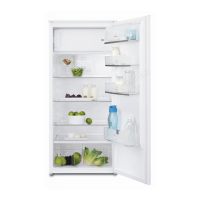



 To Next Page