
 Need help?
Do you have a question about the Electrolux KEAF7100L and is the answer not in the manual?
Safety guidelines for children and vulnerable individuals using the appliance.
General safety precautions and intended use of the appliance.
Instructions and warnings related to the proper installation of the appliance.
Guidelines for safely connecting the appliance to the electrical mains supply.
Procedures and precautions for connecting the appliance to the water supply.
Important safety instructions regarding the operation and use of the appliance.
Information about the appliance's internal lighting and safety warnings.
Information on contacting service and the availability of spare parts.
Instructions for safely disposing of the appliance at the end of its lifespan.
Visual overview of the dishwasher components with numbered labels.
Description of the buttons, indicators, and their functions on the control panel.
Details of available wash programmes, including phases and consumption values.
Contact information for obtaining performance test data according to EN60436.
How to select programmes and access user settings like water softener and acoustic signals.
Explanation of the water softener, how hardness affects it, and adjustment levels.
Step-by-step guide to adjusting the water softener level via the control panel.
Information about acoustic signals for malfunctions and programme completion.
Guide on how to enable the audible signal for programme completion.
Explanation of the AirDry feature for improved drying and energy saving.
Instructions on how to disable the AirDry feature for safety or preference.
Steps to perform before the first use, including water softener, salt, and rinse aid setup.
Detailed instructions on how to fill the salt container correctly.
Guide on how to fill the rinse aid dispenser and adjust its quantity.
Steps for turning on the appliance and selecting the appropriate wash programme.
Instructions on how to correctly add detergent, including powder or tablets.
Guidance on using combined detergent, rinse aid, and salt tablets.
Procedures for setting and starting wash programmes, including delay start options.
How to cancel a running programme and what happens at the end of a cycle.
Advice for optimal cleaning, drying, water/energy saving, and appliance care.
Recommendations for using cleaning agents and preventing issues like limescale.
Procedure for transitioning from multi-tablets to separate detergents, salt, and rinse aid.
Guidelines on how to properly load items into the upper and lower baskets for best results.
Essential checks to perform before starting a wash programme.
Instructions for safely and effectively unloading the dishwasher baskets.
Step-by-step guide on how to remove and clean the dishwasher's filter system.
Instructions for clearing any blockages in the spray arms.
Recommended methods and products for cleaning the exterior of the dishwasher.
Guide on how to clean the interior of the dishwasher, including the rubber gasket.
Procedure for checking and removing foreign objects from filters and the sump.
Solutions for problems related to activating the appliance or starting programmes.
Troubleshooting steps for when the appliance fails to fill with water.
Solutions for issues where the appliance is not draining water correctly.
Information and actions to take if the anti-flood device is triggered.
Troubleshooting for errors related to the water level detection sensor.
Solutions for problems concerning the wash or drain pump.
Diagnosing and resolving issues with water temperature or sensor malfunctions.
Steps to take for general technical errors or malfunctions detected by the appliance.
How to address situations where the water level inside the appliance is too high.
Explaining why the appliance may stop and start during operation and expected behaviour.
Reasons why a programme might last longer than expected and how to manage it.
Troubleshooting tips for minor leaks originating from the appliance door.
Solutions for problems encountered when closing the appliance door.
Identifying and resolving causes of rattling or knocking sounds during operation.
Causes and solutions for the appliance tripping the circuit breaker.
Addressing common problems with washing and drying performance.
Tips and solutions for achieving better washing results.
Advice for improving the drying performance of the dishwasher.
Causes and solutions for streaks or bluish layers appearing on dishes.
How to prevent or remove stains and dry water drops on dishes.
Reasons why dishes might remain wet and how to achieve better drying.
Explanation for moisture inside the appliance and potential causes.
Troubleshooting unusual foam formation during the wash cycle.
Causes and solutions for rust marks appearing on cutlery.
Troubleshooting why detergent might remain in the dispenser after a cycle.
Tips for eliminating or preventing unpleasant odours within the dishwasher.
How to deal with and prevent limescale build-up on dishes and the appliance.
Causes and solutions for dull, discoloured, or chipped tableware.
Technical specifications including dimensions, electrical connection, and water supply.
Details on the appliance's capacity and power consumption in different modes.
Information on accessing the EU EPREL database for product performance data.
Advice on recycling packaging and disposing of the appliance responsibly.
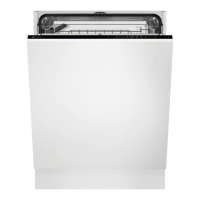
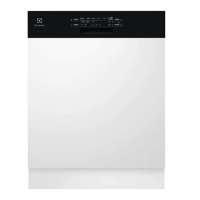
This document is a user manual for the Electrolux KEAF7100L dishwasher, providing comprehensive information on its function, usage, and maintenance.
The Electrolux KEAF7100L is a household dishwasher designed for cleaning crockery, cutlery, pots, and pans. It operates by using water, detergent, and rinse aid to remove food residues and ensure hygienic cleaning. The appliance features a water softener system that removes minerals from the water supply, which is crucial for optimal washing results and to prevent limescale buildup. The water softener needs to be adjusted according to the local water hardness, and salt is used to regenerate the resin in the softener device. The appliance also includes a rinse aid dispenser to improve drying results and prevent streaks.
The dishwasher offers various programmes tailored to different degrees of soil and types of load, including an ECO programme for efficient water and energy consumption, a programme for heavy soil, and a quick rinse option. It is equipped with an AirDry function, which automatically opens the door during the drying phase to improve drying results and reduce energy consumption. The appliance also has an internal lighting system.
Safety features are integrated throughout the design, including warnings against improper installation, use by children, and handling of detergents. It is designed to be connected to the water mains using new hose-sets and requires proper earthing for electrical safety.
To use the dishwasher, first, ensure the water tap is open and the appliance is activated. Before the first use, it is essential to adjust the water softener level according to the local water hardness, fill the salt container, and fill the rinse aid dispenser. A preliminary programme without detergent or dishes is recommended to remove any processing residuals.
Loading the baskets correctly is vital for optimal cleaning. Hollow items like cups and glasses should be placed with their openings facing downwards, and items should not touch each other to allow water to reach all surfaces. Light items should be placed in the upper basket, and cutlery in the cutlery basket. The spray arms must be able to rotate freely.
Detergent, either powder, tablets, or multi-tabs, should be placed in the detergent dispenser. If using multi-tabs that contain salt and rinse aid, the separate salt and rinse aid dispensers should not be filled, and the water softener and rinse aid dispenser should be set to their lowest levels.
Programmes are selected by pressing the programme button until the indicator for the desired programme flashes. A delay start function is available to postpone the programme start. The appliance can be paused by opening the door during operation, and it will resume after the door is closed. However, opening the door for more than 30 seconds during the drying phase (unless by AirDry) will end the programme.
Acoustic signals indicate programme completion and malfunctions. The AirDry function, which automatically opens the door, can be activated or deactivated through the user mode settings.
Regular maintenance is crucial for the dishwasher's performance and longevity. The filter system, consisting of three parts, needs to be cleaned regularly. This involves turning and removing the filters, washing them, and reassembling them, ensuring they are correctly positioned. The spray arm jets should also be checked for clogs and cleaned with a thin pointed object if necessary.
The interior of the appliance, including the rubber gasket of the door, should be cleaned with a moist soft cloth and neutral detergents. Abrasive products or solvents should not be used. To prevent grease and limescale deposits, especially with frequent short programmes, it is recommended to run long duration programmes at least twice a month and use a specific dishwasher cleaning product monthly.
After each use, it is advisable to check the filters and the sump for foreign objects (e.g., glass pieces, plastic, bones, toothpicks) that could decrease cleaning performance or damage the drain pump. If any objects are found, they should be removed.
The salt container and rinse aid dispenser should be refilled when their respective indicators are on. It is important to use only salt and rinse aid specifically designed for dishwashers. If multi-tabs are used, and a switch back to separate detergent, salt, and rinse aid is desired, a specific procedure must be followed, including setting the water softener to the highest level, ensuring salt and rinse aid containers are full, and running a short rinsing programme without detergent or load before readjusting the water softener and rinse aid levels.
In case of problems or malfunctions, the manual provides a troubleshooting guide with possible causes and solutions, often indicated by flashing indicators and acoustic signals. If issues persist or for alarm codes not described, contacting an Authorised Service Centre is recommended.
 General
| Cycle time | 227 min |
|---|---|
| Noise level | 49 dB |
| Drying system | AirDry |
| Delayed start timer | Yes |
| Dishwashing programs | Eco 50°C, Intensive 70°C, Normal, Quick, Soak |
| Number of place settings | 13 place settings |
| Door color | Not applicable |
| Water fill | Cold, Hot |
| Control type | Buttons |
| Display type | LED |
| Product size | Full size (60 cm) |
| Appliance placement | Fully built-in |
| Control panel color | Silver |
| Wi-Fi controlled | No |
| Remaining time indication | - |
| Connected load | 1950 W |
| Energy efficiency scale | A to G |
| Power consumption (off) | 0.5 W |
| Water consumption per cycle | 9.9 L |
| Energy consumption per cycle | 1.036 kWh |
 Weight and Dimensions
| Depth | 550 mm |
|---|---|
| Width | 596 mm |
| Height | 720 mm |
| Depth with door open | 1200 mm |
| Installation compartment width | 600 mm |
| Installation compartment height (max) | 880 mm |
| Installation compartment height (min) | 820 mm |


 To Next Page