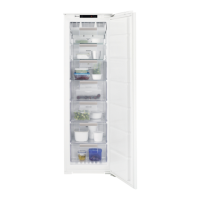
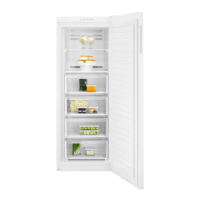
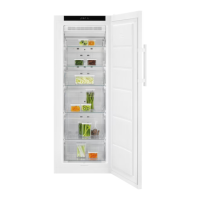
This document is a user manual for the Electrolux LUT6NF18C freezer. It provides comprehensive information on safety, installation, operation, maintenance, and troubleshooting.
Function Description
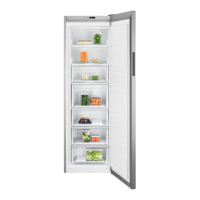
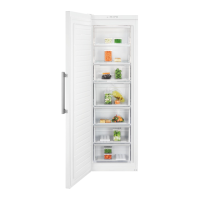
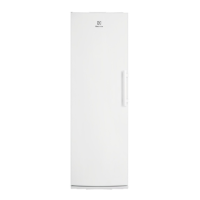
The Electrolux LUT6NF18C is a freezer appliance designed for household and similar applications. Its primary function is to freeze fresh food and store frozen and deep-frozen food for extended periods. The appliance features a frost-free freezer compartment, eliminating the need for manual defrosting. It is equipped with various functions to optimize food preservation and user convenience, including FastFreeze for rapid freezing, ChildLock for preventing unintentional operation, and DrinksChill for setting acoustic alarms for cooling items. The appliance also incorporates cold accumulators to increase storage time during power outages.
Important Technical Specifications
- Overall Dimensions (without handle and feet):
- Height (H1): 1769 mm
- Width (W1): 556 mm
- Depth (D1): 549 mm
- Space Required in Use (including handle and space for cooling air circulation):
- Height (A): 1780 mm
- Width (B): 36 mm
- Overall Space Required in Use (including handle, space for cooling air, and door opening):
- Height (H3 (A+B)): 1816 mm
- Width (W3): 780 mm
- Depth (D3): 1085 mm
- Ambient Temperature Range for Operation: 10°C to 43°C
- Refrigerant: Isobutane (R600a), a natural gas with high environmental compatibility.
- Electrical Connection: Earthed appliance, compatible with mains power supply parameters on the rating plate. Supplied with a 13 amp fuse (BS 1362 approved).
- Ventilation Requirements: Minimum 200 cm² airflow behind the appliance.
- Freezer Temperature Range: -15°C to -24°C (default recommended: -18°C).
- Freezing Capacity: Maximum amount of food that can be frozen without adding other fresh food during 24 hours is specified on the rating plate.
- Rising Time: The duration for which defrosted food can be safely stored after a power failure, as indicated on the rating plate.
Usage Features
- Control Panel: Located on the front, it includes a display, temperature warmer/colder buttons, OK button, Mode button, and ON/OFF button.
- Display: Shows timer, FastFreeze indicator, temperature, alarm indicator, ChildLock indicator, and DrinksChill indicator.
- Switching On/Off: Pressing the ON/OFF button for 3 seconds switches the appliance on or off.
- Temperature Regulation: Temperature can be set between -15°C and -24°C using the temperature regulators. The set temperature is retained after a power failure.
- FastFreeze Function: Accelerates the freezing of fresh food and protects existing frozen food from warming. It should be activated at least 24 hours before placing food to be frozen. The function stops automatically after 52 hours but can be manually deactivated.
- ChildLock Function: Locks control panel buttons to prevent unintentional operation. Activated and deactivated via the Mode and OK buttons.
- DrinksChill Function: Sets an acoustic alarm for a preferred cooling time (1 to 90 minutes), useful for chilling bottles or cans.
- High Temperature Alarm: Activates when the freezer compartment temperature increases (e.g., due to a power failure). An audible alarm sounds, and temperature indicators flash. Can be muted by pressing any button.
- Door Open Alarm: Activates if the freezer door is left open for approximately 90 seconds, with an audible alarm and flashing indicator. Stops when the door is closed.
- Freezing Fresh Food: Food should be evenly distributed in the top two compartments/drawers. FastFreeze should be activated 24 hours prior.
- Storage of Frozen Food: Freezer drawers facilitate organization. For large quantities, all but the bottom drawer can be removed to ensure air circulation. Food should be kept at least 15 mm from the door.
- Thawing: Frozen food can be thawed in the refrigerator or in a plastic bag under cold water.
- Ice-cube Production: The appliance includes trays for making ice cubes. Metallic instruments should not be used to remove trays.
- Cold Accumulators: These increase storage time during power cuts and should be placed in the front top area for best performance.
- Shopping Tips: Emphasizes buying frozen goods last, transporting them in insulated bags, and immediately placing them in the freezer. Advises against re-freezing partially defrosted food.
- Shelf Life Guide: Provides a general guide for the shelf life of various food types (bread, fruits, vegetables, meat, dairy, seafood) in months.
Maintenance Features
- Cleaning the Interior: Before first use and periodically, the interior and accessories should be washed with lukewarm water and neutral soap, then dried thoroughly. Abrasive products, chlorine, or oil-based cleaners should not be used. Accessories are not dishwasher safe.
- Door Seals: Regularly check and wipe door seals clean to ensure they are free from debris.
- Defrosting: The freezer compartment is frost-free, meaning no frost build-up occurs during operation, eliminating the need for manual defrosting.
- Period of Non-Operation: For long periods of disuse, the appliance should be disconnected from the electricity supply, emptied of food, cleaned, and the door left open to prevent unpleasant smells.
- Drain Examination: Regularly examine and clean the appliance's drain to prevent defrosted water from collecting at the bottom.
- Gasket Maintenance: If the door gasket is deformed or dirty, it should be cleaned or replaced by an Authorised Service Centre.
- Professional Repair: For repairs, contact an Authorised Service Centre and use original spare parts. Self-repair or non-professional repair can void the guarantee. Spare parts (thermostats, sensors, circuit boards, light sources, door handles, hinges, trays, baskets) will be available for 7 years after the model is discontinued. Door gaskets will be available for 10 years.
- Disposal: The appliance should be disconnected from the mains, the cable cut off, and the door removed before disposal to prevent children and pets from being trapped. The refrigerant circuit and insulation materials are ozone-friendly and contain flammable gas, requiring proper disposal through municipal authorities.

 Need help?
 General

 To Next Page