8
adjustments and wait 3 to 5 seconds between adjustments. As you approach peak the exhaust gas
temperature will rise much slower until it starts to decrease. When this happens you have reached peak
EGT. The 1`F resolution of the digital display will be invaluable in helping you precisely detect peak
EGT.
C) Finding The Cylinder That Peaks First: For most engines step B (Precision Leaning) will result in
a properly leaned engine. If you find this to be the case with your engine, this step will not be neces-
sary. But if you want to verify you have leaned to the cylinder that peaks first and your engine is
operating properly, perform the following with the cylinder found in step B at peak EGT. Slightly
enrich the mixture and quickly step through each cylinder. Any cylinder that shows a rising temperature
is a leaner cylinder. Check that this cylinder does not rise more than 15F before it starts decreasing in
temperature. If a cylinder rises more than 15F it may have a problem. See our Pilots Manual for
Diagnosing Engine Problems for more information.
The Smart Analyzers unique stable display allows you to precisely lean to peak EGT or to a specific tem-
perature below peak for most engines. Peak EGT with a float-type carbureted engine is frequently a vague
point because of the fuel/air distribution problems in these lower horsepower engines. As a result, these
engines tend to operate smoother at 25F on the rich side of peak EGT. The fuel-injected engines will
provide a more precise peak. Most engines normally operate within an EGT range of 1200F to 1600F at
cruise power.
Some engine manufacturers allow leaning to peak EGT at 75% power and below on their direct drive nor-
mally aspirated engines. For your engine, check the engine manufacturers recommended procedures. It is
not recommended to lean for peak EGT above 75% power settings. The richer mixture is needed to cool the
combustion temperatures and keep the anti-knock capability of the fuel high enough to prevent detonation
from occurring at the higher power settings.
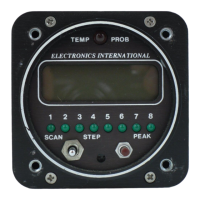
After leaning place the Smart Analyzer in the Scan Operating Mode. The Smart Analyzer will automati-
cally and continuously diagnose your engine during the entire cruise portion of your flight. A red Temp
Prob light will alert you if the Smart Analyzer detects a problem with your engine.
6. Descent:
During a long gradual descent the Smart Analyzer may be left in the Scan Operating Mode, but when the
mixture or throttle control is changed, the engine temperatures will drop and the Smart Analyzer will see this
as a problem. Therefore, during this phase of the descent place the Smart Analyzer in the Manual Operating
Mode and select a CHT channel. This will allow you to look for Shock-Cooling. Any cylinder above 300'F
and decreasing faster than 1'F in 3 seconds is Shock-Cooling.
SR-8A
Operating Instructions Operating The Smart Analyzer in Your Aircraft


 To Next Page