8
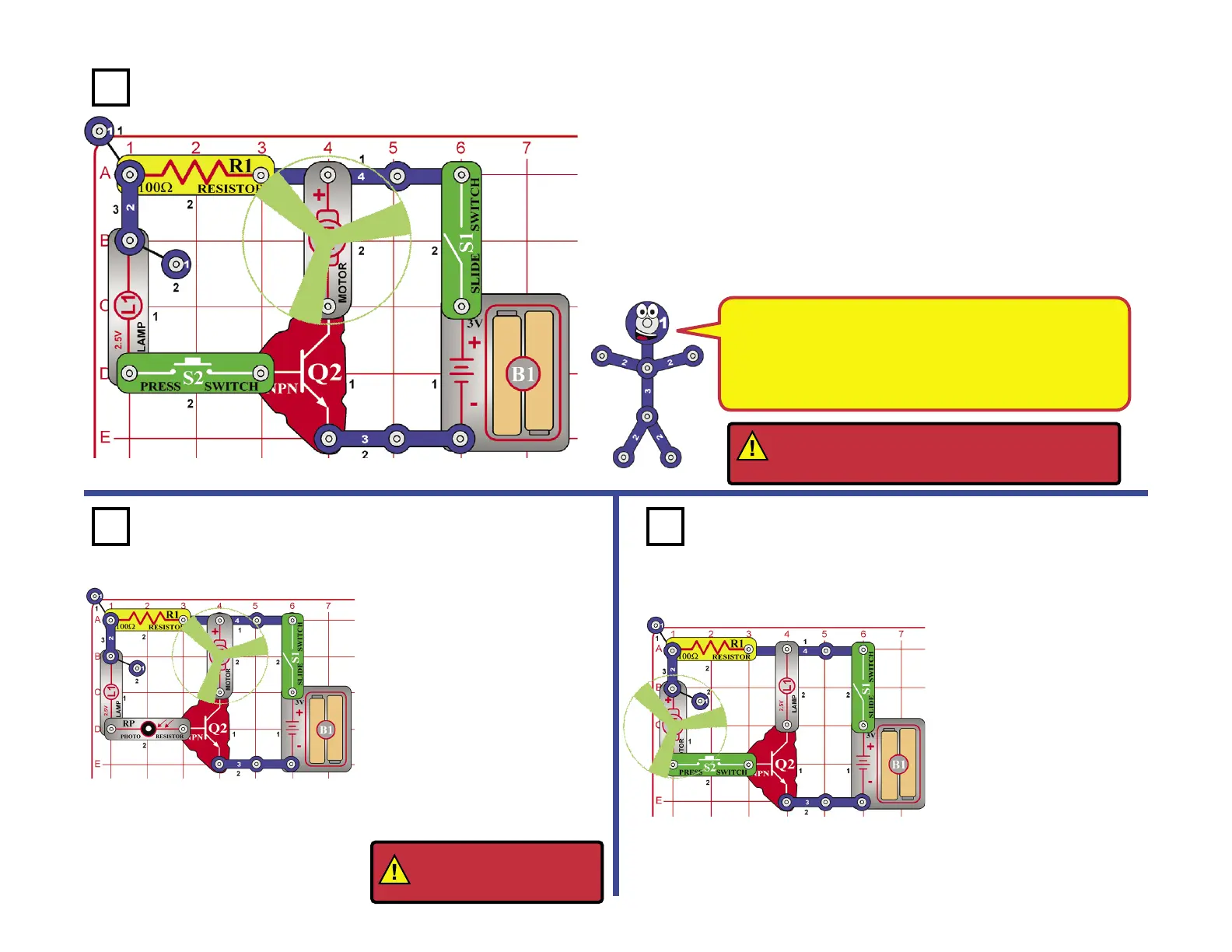
Project 76
Little to Big
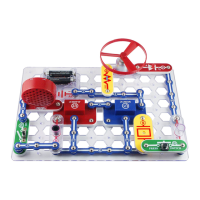
Place the fan on the motor (M1) and turn on the slide switch (S1), then compare
this circuit to Project #31. Push the press switch (S2), the lamp doesn’t light now
but the motor still spins.
The lamp is dark because the 100W resistor (R1) limits the current through it. The
NPN transistor (Q2) uses the small lamp current to create a large current that spins
the motor.
Now replace the 100W resistor (R1) with the larger 1KW resistor (R2). The motor
spins more slowly now, because the transistor cannot create as large of a motor
current from such a small controlling current.
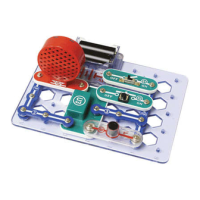
The lamp is dark because the
photoresistor limits the current
through it. The NPN transistor uses
the small lamp current to create a
large current that spins the motor.
If you tried to control the motor speed
by placing the photoresistor in series
with the motor, the motor would not
spin because the photoresistor would
limit the current. But the photoresistor
can control the motor speed with help
from the transistor. You may need to
shine a light on the photoresistor (RP)
if the motor does not spin.
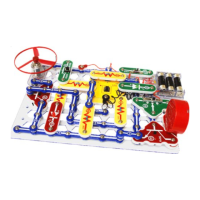
Compare this circuit to Project 75. It uses the
photoresistor (RP) to control the current to
the NPN transistor (Q2), instead of the press
switch (S2). You can adjust the speed of
the motor (M1) by changing how much light
shines on the photoresistor.
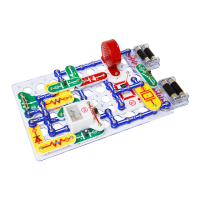
The motor doesn’t spin because the
100W resistor (R1) limits the current
through it. The NPN transistor (Q2)
uses the small motor current to create
a large current that lights the lamp.
Now replace the 100W resistor (R1)
with the larger 1KW resistor (R2). The
lamp is only slightly less bright even
though the motor current is much
lower.
Now place the 100W resistor back in
the circuit and replace the press switch
with the photoresistor (RP). A bright
light on the photoresistor will turn the
lamp on. But if the light is dim, then
the photoresistor has high resistance,
so little current ows through the
transistor and the lamp is off.
Compare this circuit to Project 23. Push the
press switch (S2), the motor (M1) doesn’t
spin now but the lamp (L1) still lights.
Project 75
Project 77
WARNING: Moving parts.
Do not touch the fan or
motor during operation.
WARNING: Moving parts. Do not touch the fan or
motor during operation. Do not lean over motor.
Fan may not rise until switch is released.
Transistors, such as the NPN transistor (Q2), can amplify
electric currents. In this circuit, the small current through the
resistor is used to control a larger current through the motor. A
large resistor value limits the current through the lamp, making
it very dim, but the transistor amplied current is large enough
to still spin the motor.
Light to LightLuminate & Rotate


 To Next Page