EasyManua.ls Logo

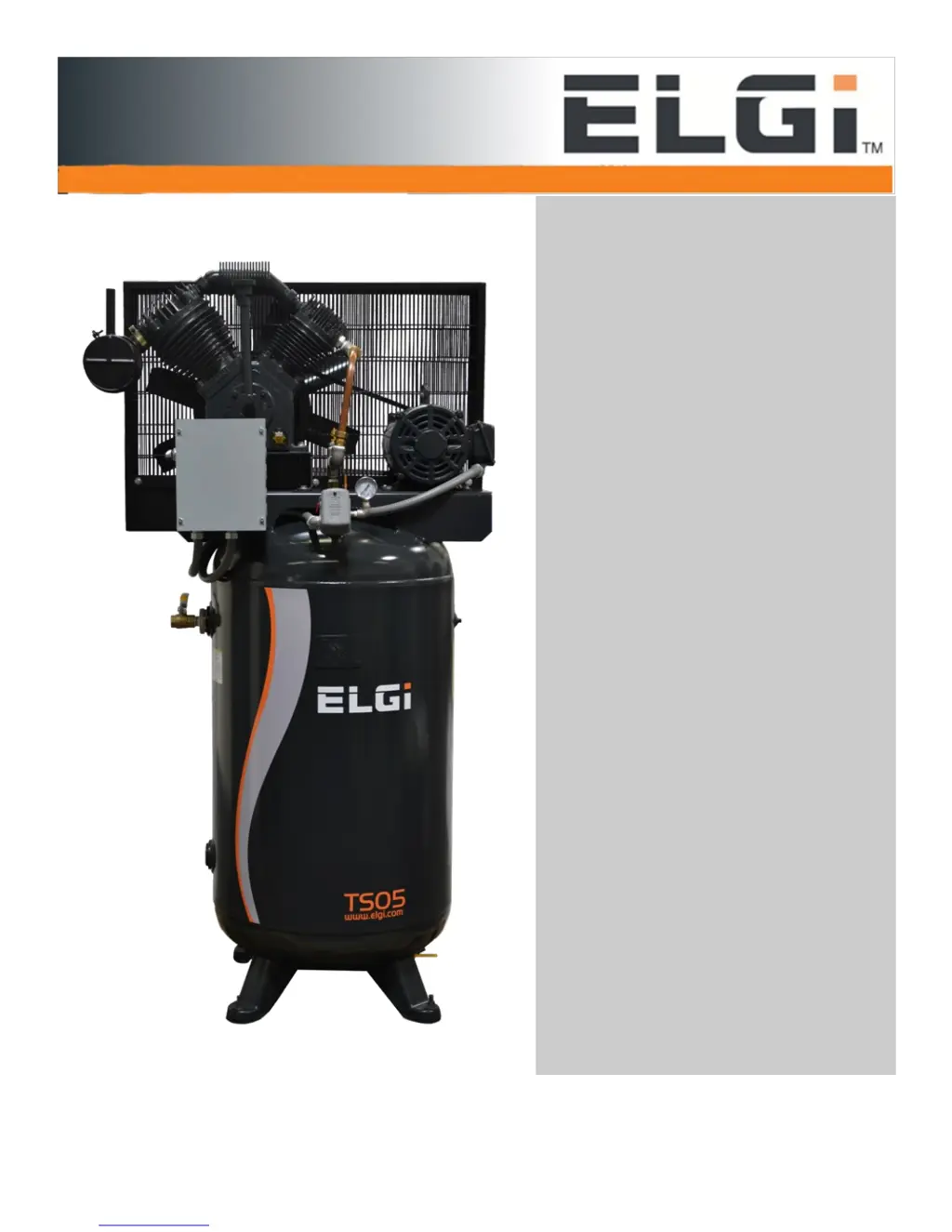
ELGi TS Series - User Manual

ELGi TS Series
32 pages
Print Icon
To Next Page IconTo Next Page
Loading...
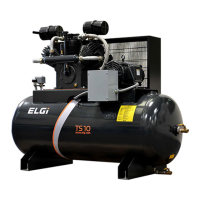
TS Series
TS05 to TS15
Two-Stage
Reciprocating
Air Compressor
OPERATION AND MAINTENANCE MANUAL

Questions and Answers

  • H
    Heather BakerAug 2, 2025
    Why is my ELGi Air Compressor overheating?
    • D
      David PerezAug 2, 2025
      Your ELGi Air Compressor may be overheating due to several reasons: the oil may be dirty, requiring an oil change; the oil level might be low, needing you to fill it to the maximum level with the correct grade of oil; the cylinder and cooler fins could be dirty, requiring cleaning with compressed air or manually; the breather valve may not be working; or the rotation might not be correct, requiring you to interchange two of the incoming power feeds to the motor.
  • M
    Morgan McdonaldAug 7, 2025
    What to do if there is oil carry over in compressed air from my ELGi TS Air Compressor?
    • S
      Scott AlexanderAug 7, 2025
      If you notice oil carry over in the compressed air from your ELGi Air Compressor, it could be due to a dirty air filter, which requires replacement. Alternatively, the oil level might be too high, needing adjustment to the correct level. It could also be that the oil viscosity is too low, requiring a change to the recommended grade. Other potential causes include a non-functioning breather, stuck or broken piston rings (change rings as a set), or excessive clearance between the piston and cylinder, which needs checking and changing as required.
  • J
    Joshua JohnsAug 13, 2025
    What causes cylinder, piston and ring wear in ELGi Air Compressors?
    • L
      Laura YoungAug 13, 2025
      Cylinder, piston, and ring wear in ELGi Air Compressors can be attributed to inadequate filter maintenance, suggesting an increase in the frequency of cleaning or changing the filter. It may also be caused by insufficient oil change frequency, indicating a need to increase the frequency with more periodic checks of the oil. Another possible cause is using an incorrect grade of oil, which requires changing to the correct grade.
  • J
    Jesse RodriguezAug 17, 2025
    What to do if my ELGi TS does not unload?
    • F
      fgibsonAug 17, 2025
      If your ELGi Air Compressor isn't unloading, the unloader tubing might be blocked, so you should open and clean it. Alternatively, the unloader itself may be defective, so you should replace the pressure switch.
  • E
    emily11Aug 22, 2025
    Why is there oil leaking through the breather valve of my ELGi TS Air Compressor?
    • X
      xguzmanAug 22, 2025
      Oil leaking through the breather valve of your ELGi Air Compressor can occur if the piston rings are stuck or broken, requiring you to change the rings as a set. It could also be due to a breather valve that is not working, which means you should check all related parts for wear. Another possibility is excessive clearance between the piston and cylinder, so check and change as required.
  • N
    Nathaniel GonzalezAug 27, 2025
    Why is there water or rust formation in the crankcase of my ELGi TS Air Compressor?
    • K
      Kristin WhiteAug 28, 2025
      Water or rust formation in the crankcase of your ELGi Air Compressor may be due to a faulty breather valve. Check and replace the breather.

Summary

Safety Precautions

1.0 General Information

System Configurations

Overview of tank-mounted reciprocating air systems.

Compressor Module

Details on the two-stage, air-cooled, lubricated reciprocating compressor design.

Compressor Drive and Motor

Information on V-belt drive, belt guard, and NEMA rated motor.

Intake Filter

Description of the inlet air filters and their function.

Control System

Features of the NEMA 1 and U.L. labeled control panel.

Air Receiver

Specifications for the ASME Coded air receiver tank.

2.0 Installation

2.1 Inspection upon Receiving

Instructions for inspecting the system upon delivery.

2.2 Handling

Guidelines for safely moving and lifting the compressor package.

2.3 Location

Recommendations for indoor installation environment and surface requirements.

2.4 Space Requirements

Recommended clearance for ventilation and maintenance access.

2.5 Wiring

Critical safety warnings and compliance requirements for electrical connections.

3.0 Control Panel

3.1 Wiring Schematics

Diagrams illustrating wiring for single-phase and three-phase compressors.

4.0 Initial Startup

5.0 Maintenance

Daily or before compressor starting

Daily checks including oil level, condensate drain, and belt tension.

150 Hours or 10 Days

Maintenance for 150 hours or 10 days, including oil change.

250 Hours or 20 Days

Maintenance for 250 hours or 20 days, checking noise, leaks, and settings.

500 Hours or 1 Month

Monthly maintenance including oil change and filter cleaning.

1000 Hours or 3 Months

Maintenance for 1000 hours or 3 months, including valve inspection and filter change.

2500 Hours or 1 Year

Annual maintenance tasks, including cooler cleaning and motor lubrication.

2 Years

Two-year maintenance including receiver cleaning and safety valve testing.

7500 hours or 3 Years

Major overhaul for the compressor after 7500 hours or 3 years.

5.1 Pressure Switch Adjustment

Instructions on how to adjust the cut-in and cut-out pressure settings on the switch.

6.0 Troubleshooting

7.0 Replacement System Parts 5 HP

7.1 Replacement Pump Parts - TS05

Detailed breakdown and part numbers for TS05 compressor pump components.

8.0 Replacement System Parts 7.5 HP

8.1 Replacement Pump Parts - TS 7.5

Detailed breakdown and part numbers for TS 7.5 HP compressor pump components.

9.0 Replacement System Parts 10 HP

9.1 Replacement Pump Parts - TS 10

Detailed breakdown and part numbers for TS 10 HP compressor pump components.

10.0 Replacement System Parts 15 HP

10.1 Replacement Pump Parts - TS 15

Detailed breakdown and part numbers for TS 15 HP compressor pump components.

ELGi TS Series Specifications

General IconGeneral
BrandELGi
SeriesTS Series
TypeScrew Compressor
Working Pressure7.5 - 13 bar
Drive TypeDirect Drive
Cooling SystemAir / Water
Voltage380V to 415V
Frequency50 Hz

Related product manuals