Resistors (1/8W or greater)
R1 to R6 = 470 Ω
R7, R8 = 100 Ω
R9 = 470 KΩ
R10 = 100 KΩ
R11 = 4.7 KΩ
Capacitors (16V or greater, except as noted)
C1 = 0.1uF 50V
C2 = 2.2µF 50V
C3, C9 = 0.1uF
C4 = 10µF 10V
C5, C6 = 27pF
C7, C8 = 560pF 50V
C10 = 0.01µF
Semiconductors
D1 = 1N4001
D2 = 1N5232B or SA5.0AG TVS
D3 = 1N914 or 1N4148
L1, L2, L3, L4 = Yellow LED
L5 = Red LED
L6 = Green LED
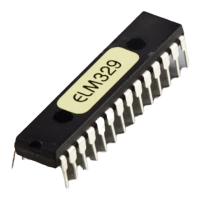
U1 = ELM329 (CAN Interpreter)
U2 = MCP2561 (CAN Transceiver)
U3 = LP2950 (5V, 100mA regulator)
U4 = FTDI DB9-USB-D5-F
(UART Converter)
Misc
X1 = 4.000MHz crystal
ELM329 Socket = 28pin 0.3” (or 2 x 14pin)
76 of 83
ELM329DSC Elm Electronics – Circuits for the Hobbyist
www.elmelectronics.com
Figure 10. Parts List for Figure 9
Example Applications (continued)
the crystal, as it will not have the accuracy required.
As always, you are not limited to the circuit of
Figure 9. It is only a starting point that you can build
on. The following pages show some alternative
communications interfaces that may be of interest if
you are considering modifying the circuit. Also, be sure
to read our application note AN04 – ELM327 and
Bluetooth on the web site under ‘help’ for a discussion
on connecting with Bluetooth (the ELM327 information
applies to the ELM329 as well).
Figure 11 shows a very basic RS232 interface that
may be connected directly to pins 17 and 18 of the
ELM329. This circuit ‘steals’ power from the host
computer in order to provide a full swing of the RS232
voltages without the need for a negative supply. This
circuit is limited to data rates of about 57.6 kbps, but
has the advantage that it uses commonly available
components and does not require a special integrated
circuit.
The circuit of Figure 12 is useful if you wish to
make a high speed RS232 interface. It uses a
MAX3222E integrated circuit that only needs a few
capacitors in order to function. These capacitors are
used for an internal charge pump function that creates
the dual polarity voltage supply that an RS232 output
requires. One advantage to using the MAX3222E is
that it can be put into a Low Power mode by the
ELM329 (disconnect the +5V from pin 18, and then
connect pin 18 to pin 14 of the ELM329).
If you use the MAX3222E, you must also modify
the power supply of Figure 9. C2 should be increased
to 10 µF, and C4 to 33 µF. Without these larger
capacitors, you would likely experience ‘LV RESET’s
as the MAX3222E transceiver is switched on and off.
Testing has shown that these values for C2 and C4
should be adequate, but if you still see an occasional
‘LV RESET’, you may want to increase them even
further.
The MAX3222E RS232 transceiver handles all of
the voltage translation and logic inversion needed to
provide standard RS232 communications between the
ELM329 and the controlling computer. The ‘E’ version
shown is capable of up to 250 kbps communications,
which is likely enough for most applications. (The
versions without the ‘E’ are only rated to 120 Kbps.)
In all, the MAX3222 has been a great chip, but we
do caution you about one problem that we have
encountered. If pin 18 (the Shutdown pin) is held low


 To Next Page